The global watch industry continues to evolve, and for brands pursuing excellence in quality and smart value sourcing, China remains a pivotal manufacturing hub. Especially for those specializing in mid-to-high-end stainless steel watches, partnering with the right OEM ODM watches partner is increasingly critical. Successful international brands, ranging from established names to ambitious microbrand entrepreneurs, rely on efficient Watch factory China sourcing to bring their visions to life and capture market share.
This 2026 guide is designed for B2B buyers including American brand watch managers, watch design brand founders, savvy watch distributors, watch vertical e-commerce leaders, and discerning watch specialty retailers. We'll navigate the complexities of selecting a custom watch manufacturer in China, covering essential models, material standards, compliance imperatives, cost drivers, and critical FAQs.
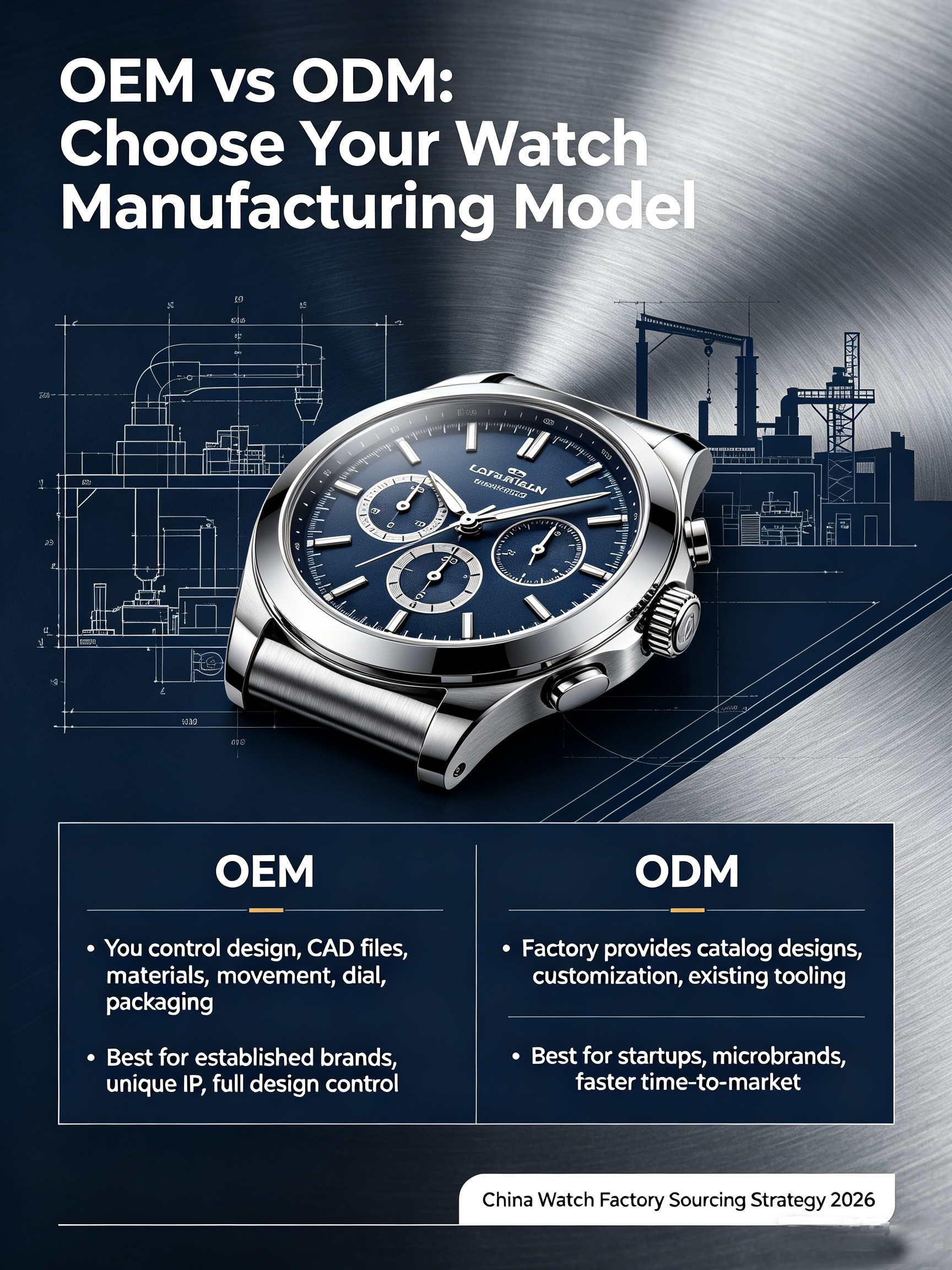
OEM vs. ODM: Deciding the Ideal Manufacturing Model for Your Brand Strategy
Understanding the core difference between OEM (Original Equipment Manufacturing) and ODM (Original Design Manufacturing) isn't just industry jargon – it's fundamental to your procurement success and brand positioning.
OEM (Original Equipment Manufacturing)
Here, you bring the design specifications – often down to the finest technical detail. You control the concept, aesthetics, technical drawings (CAD files), materials (like the specific grade of stainless steel), movement choice (Japanese or Swiss), dial design, and packaging. The Watch factory China partner's role is to execute your vision with precision manufacturing, quality control, and assembly.
Best For: Established brands with strong in-house design teams, unique proprietary technology, or those requiring strict adherence to brand-specific design language. Ensures complete control over intellectual property if the design is truly original. Ideal when sourcing components for wholesale stainless steel watches under your own brand.
ODM (Original Design Manufacturing)
The custom watch manufacturer provides the design capabilities. They offer pre-existing "catalog" watch designs, modules, and technical solutions that you can select, customize (within defined parameters such as dial color, hands, straps, minor case embellishments, and brand engraving), and brand as your own product. This leverages the manufacturer's expertise and existing tooling.
Best For: Startups (microbrands), entrepreneurs without extensive design resources, companies seeking faster time-to-market, distributors wanting unique designs without the overhead of full design cycles, or those testing new market segments. Offers cost and speed advantages.
Strategic Choice Summary
|
Criteria
|
OEM Model
|
ODM Model
|
Best Suited For
|
|
Design Control
|
Maximum - You provide specs
|
Limited - Modify existing
|
Established brands, Unique IP needs
|
|
Investment/Capital
|
Higher (molds, R&D, tooling)
|
Lower (leverage existing)
|
Startups, Microbrands, Fast launch
|
|
Time-to-Market
|
Longer (design validation to production)
|
Shorter (modify & produce)
|
Distributors, Trend-focused product
|
|
Manufacturer's Role
|
Production execution
|
Design & Production
|
Retailers seeking branded exclusives
|
|
IP Risk
|
Lower (if done correctly)
|
Higher (similar designs possible)
|
Brands needing distinct identity
|
Recommendation: Define your brand's core value proposition clearly. If unique design is paramount and resources allow, OEM offers maximum differentiation. For speed & cost-efficiency, particularly when entering a market or expanding a line quickly, ODM can be strategic. Some brands adopt a hybrid approach, using ODM for core lines and OEM for flagship models. Always prioritize manufacturers with strong design capabilities and strict quality control systems.
Building a reputation hinges on quality. For mid-to-high-end stainless steel watches, asserting strict standards with your custom watch manufacturer is non-negotiable. Here are the core material and component benchmarks discerning B2B buyers demand.
Case & Bracelet Material - The Undisputed Champion: 316L Surgical-Grade Stainless Steel
While 304L is adequate for lower-cost watches and some applications, 316L stainless steel possesses significantly superior attributes crucial for premium timepieces:
-
Hypoallergenic: Essential for comfort and safety against skin irritation, meeting stricter consumer expectations globally.
-
Enhanced Corrosion Resistance: Contains molybdenum (2-3%), providing far greater protection against saltwater corrosion (essential for sports/dive watches), chlorides, and industrial pollutants compared to 304L's chromium-nickel composition alone. Long-term durability and surface integrity are paramount.
-
Superior Surface Finish: Polishes to a higher luster and maintains its aesthetic appeal longer, a critical factor in wholesale stainless steel watches destined for discerning buyers.
Insist & Verify: Specify "316L Stainless Steel" explicitly in your contract and request material certification sheets. Reputable Watch factory China partners will readily provide this.
Watch Movement - The Heart Beating Inside
Japanese Quartz Movements (Miyota/Citizen & Seiko) represent the industry standard for reliability, accuracy, and scalability within the OEM ODM watches landscape for good reason:
-
Miyota (Citizen Group): Widely used, highly reliable, readily available globally for servicing. Offers excellent variety (simple analog, chronograph, pointers). The epitome of practical reliability.
-
Seiko: Holds a slightly higher perceived heritage prestige in some markets. Also offers robust performance and variety.
Value Proposition: Delivers high accuracy (±10~20 sec/month), multi-year battery life, significant shock resistance, and reliable performance at a fraction of Swiss costs. This allows brands to offer excellent quality wholesale stainless steel watches at competitive B2B prices.
Swiss Quartz Movements (Ronda/ETA) command a significant price premium and sometimes longer lead times. While technologically equivalent or slightly superior in some specific metrics, their primary value lies in market perception and brand heritage association. For brands targeting ultra-premium positioning or specific luxury segments, Swiss movements can be justified but offer marginal cost-performance ratio for most B2B scenarios demanding high quality.
The Verdict: For the vast majority of American brand watch initiatives or microbrand launches, Japanese movements (Miyota/Seiko) offer the optimal blend of proven performance, serviceability, reliability, and cost-efficiency achievable via Watch factory China partnerships. For premium or luxury positioning, Swiss mechanical options (NH-based automatics, Ronda quartz chronographs) become necessary considerations if the cost structure supports it.
Coating & Finishes - Ensuring Lasting Elegance
PVD (Physical Vapor Deposition) coating is an advanced coating technique essential for colored stainless steel watches (black ion, gold tone, rose gold, gunmetal, etc.), delivering far more than just aesthetic value:
-
Durability: PVD forms a hard, uniform coating molecularly bonded to the underlying 316L steel. It is vastly superior to older electroplating methods, resisting scratches, chipping, and fading significantly longer. This ensures watches maintain their new appearance throughout shelf life and wear, reducing warranty claims for watch distributors.
-
Wear Resistance: Critical for bracelets and cases subject to daily abrasion. High-quality PVD is highly resistant to routine scratches and wear, reinforcing the perception of quality in OEM ODM watches.
-
Biocompatibility: Quality PVD is safe for skin contact, aligning with consumer expectations for hypoallergenic products where plating is necessary.
Critical Inspection: Demand samples showcasing PVD quality early. Assess resistance to impact and deliberate scratching. Inferior plating always reveals flaws quickly.
These quality points are theoretical without robust Quality Control (QC). Ensure your custom watch manufacturer implements stringent QC protocols: batch-by-batch material verification, movement accuracy testing pre- & post-assembly, water resistance testing (tailored to watch claims), and thorough final inspection. Seek documented QC reports linked to international standards like ISO 9001.
Navigating Compliance: Avoiding Pitfalls for US, Australian & Global Markets
Regulatory non-compliance is a costly landmine destroying business relationships and causing irreparable brand damage. It’s a top decision-maker pain point in B2B procurement. Partnering with a seasoned Watch factory China manufacturer who proactively understands these requirements is paramount for watch design brands and distributors.
United States Market Requirements
CPSC (Consumer Product Safety Commission) applies broadly to all consumer goods sold in the US, with key regulations impacting OEM ODM watches:
-
Lead Content: Strict limits apply to watch manufacturing materials, especially in PVD coatings and painted/printed components. Ensure the factory conducts compliance testing.
-
Phthalates: Restrictions exist on certain plastics used in straps or internal components. Specify compliant materials.
-
Small Parts (Choking Hazard): Primarily affecting children's watches, but relevant considerations exist for mechanisms released by breakage in adult watches. Robust construction designed for durability mitigates this risk.
-
Labeling: Country of Origin marking ("Made in China") must be compliantly applied, with correct sizing info on watch bands.
California Proposition 65 (Prop 65): California maintains a dynamic list of chemicals known to cause cancer, birth defects, or other reproductive harm. This heavily applies to watch materials including alloys, inks, adhesives, and coatings. Manufacturers must perform rigorous material analysis proving non-use or provide compliant warnings if listed substances exceed trace thresholds. Documented material declarations and SDS are essential.
FCC Declaration: Necessary for watches containing electronics, requiring technical synopses on interference limits.
Action Required: Mandate legally binding Certs of Compliance (CoC) from your manufacturer detailing testing against CPSC/Prop requirements. Procure samples and conduct 3rd party lab testing before full production. Manufacturers familiar with US export routinely manage these requirements.
Australia & New Zealand Market Requirements
Australian Government consumer safety regulators enforce strict AS/NZS standards and consumer laws for imported consumer watches:
-
AS/NZS ISO 8124 (Safety of Toys): While primarily targeted at toys, the small parts safety clauses establish a safety framework applicable to watch components for vulnerable user groups.
-
AS/NZS ISO 1413 (Shock-Resistant Watches): Premium watch internal shock protection mechanisms (like Miyota auto-regulators) inherently meet this functional requirement.
-
Australian Consumer Law (ACL): Enforces stringent truth-in-advertising rules, requiring verifiable water resistance and performance claims. Misleading marketing incurs severe penalties.
Action Required: Include clauses in your manufacturing contract requiring compliance statements against relevant AS/NZS clauses. Ensure specific testing documents related to water resistance claims.
Global Market Compliance
Markets like the EU enforce REACH and RoHS directives restricting hazardous chemical substances. Japan implements strict JIS standards for watch materials and water resistance. Always partner with a custom watch manufacturer experienced in your target export nations. Proactive compliance is far cheaper and safer than costly product recalls and brand penalties.
Maximizing Your Investment: The Strategic & Cost Advantages of Factory-Direct Sourcing
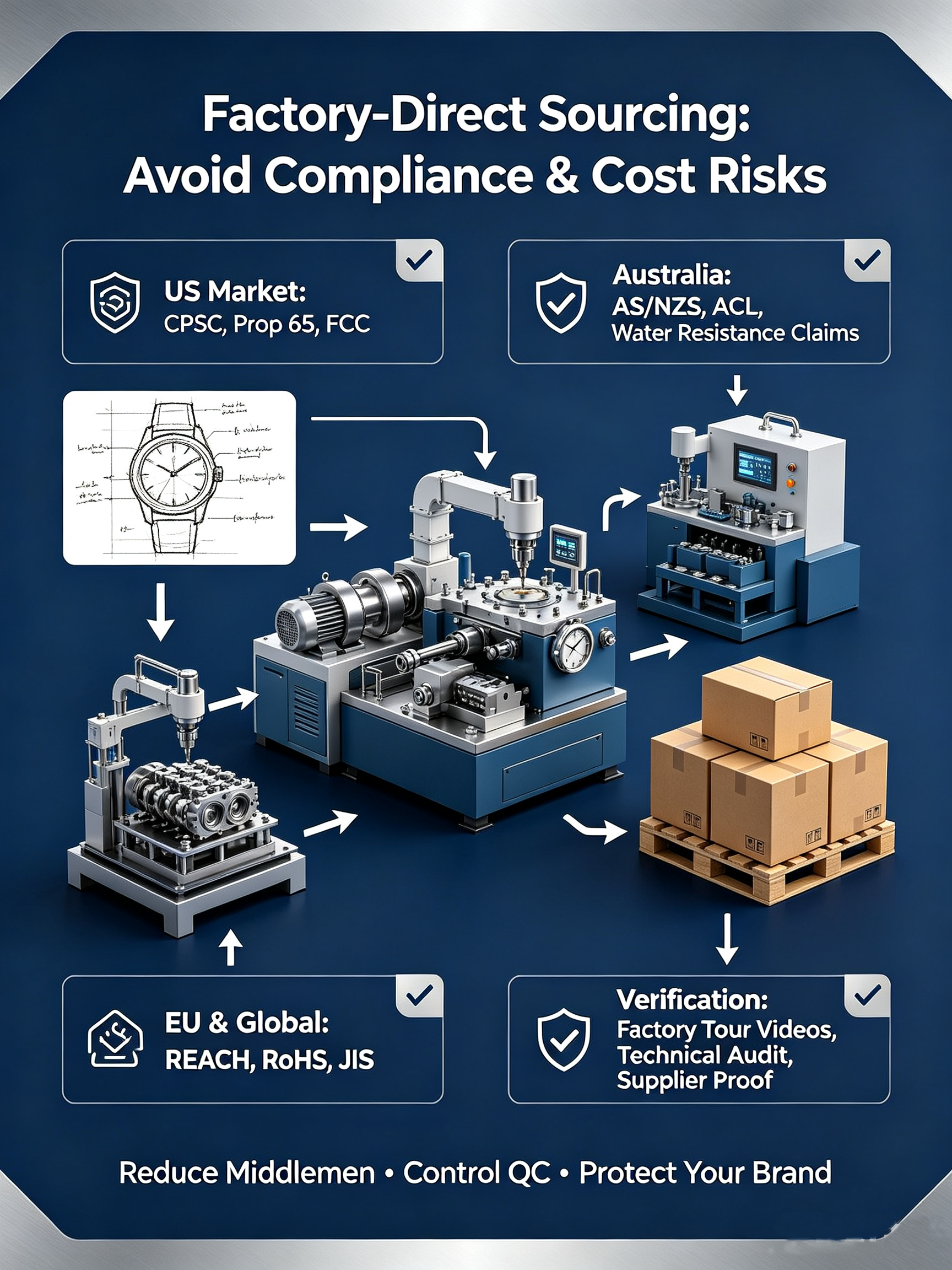
Beyond simple production, genuine factory-direct engagement with your chosen OEM ODM watches partner unlocks significant strategic value and cost-efficiency for watch brands, distributors, and retailers. This contrasts sharply with dealing with intermediaries or trading companies with limited upstream control.
-
Design-to-Delivery Integration & Efficiency: Working directly with a capable Watch factory China enables seamless workflows from conceptual design (OEM) or ODM selection/modification, through technical engineering, prototyping, material validation, mass production, rigorous QC, and final logistics. This eliminates miscommunication, bottlenecks, and delays inherent with third-party intermediaries.
-
Significant Cost Savings: Eliminating agent commissions directly boosts your profit margin or enables more competitive wholesale stainless steel watches pricing strategies for market expansion.
-
Transparent Component Pricing & Negotiation: Direct factory partnerships deliver full visibility into component costs (Miyota movements, sapphire crystals, premium clasps), allowing optimized Bills of Materials (BOM) and targeted cost negotiation.
-
Agile Problem-Solving: In-house factory teams can rapidly iterate solutions for design or manufacturing challenges without third-party relay delays, saving critical project timelines and reducing production risks.
-
Long-Term Strategic Partnerships: Direct collaboration builds mutual brand alignment. Factories can optimize production processes, develop custom upgrades, and launch cost-effective variants tailored to your long-term wholesale stainless steel watches strategy.
-
Full-Spectrum Quality Control: On-site QC verification at every production stage is far more effective than post-shipment downstream audits, drastically reducing product returns, defects, and recall risks for distributors and retailers.
How to Verify True Factory-Direct Manufacturers
Distinguish authentic watch manufacturers from trading brokers with these critical verification steps:
-
Request full factory tour videos covering core departments: CNC machining, watch assembly lines, laser engraving workshops, and QC testing rooms.
-
Ask technical-specific questions about in-house equipment and processes to eliminate generic broker responses.
-
Verify direct, long-term partnerships with key component suppliers (movement distributors, sapphire crystal producers, PVD coating facilities).
FAQ: Critical Questions for B2B Watch Procurement
Q: What is a typical MOQ (Minimum Order Quantity) for custom watch production?
A: MOQs vary based on design type and factory capabilities. ODM catalog designs feature low entry MOQs of 100–300 units per model/color variant, with some factories offering 50-unit minimums for simple designs to support microbrands. Fully custom OEM new designs require higher initial MOQs (500–1000+ units) to cover mold and tooling investment costs. Repeat OEM orders with existing tooling feature significantly reduced MOQs.
Q: How long does sample development take for OEM & ODM watches?
A: ODM modification samples take 10–20 working days on average, as they leverage existing factory tooling. Custom OEM prototype development requires 30–60 working days, including 3D digital prototyping, custom mold creation, component modification, and multi-round quality testing. Rushed sample production is available but increases costs and quality risks.
Q: Can Chinese OEM/ODM watch factories provide full packaging services?
A: Yes, nearly all reputable custom watch manufacturers offer integrated one-stop packaging solutions, including custom branded gift boxes, cartons, user leaflets, warranty cards, and compliance labeling. Full packaging customization streamlines your supply chain, reduces logistics costs, and ensures consistent brand presentation for wholesale distribution.
Q: What is the best shipping option for bulk watch orders?
A: For large-volume wholesale stainless steel watches orders, sea freight (FCL/LCL) offers the most cost-effective solution with 20–50 day port-to-port transit times. Air freight (5–10 day door-to-door delivery) is ideal for urgent small-batch orders, samples, or high-value premium watch lines. Always clarify Incoterms (FOB, EXW) with your factory to confirm shipping responsibilities and cost allocation.
Q: What are the standard payment terms for B2B watch manufacturing orders?
A: New clients typically require a 30–50% deposit to confirm production, with the remaining balance paid before shipment. Long-term trusted partners can negotiate flexible terms such as 30% deposit, 40% production confirmation payment, and 30% pre-shipment balance. Telegraphic Transfer (T/T) is the universal, secure payment method for China watch manufacturing B2B transactions, with all terms formalized in written contracts.
Final Takeaways
Selecting the right China-based custom watch OEM & ODM manufacturer is the foundation of sustainable brand growth and profitable wholesale stainless steel watches business. Prioritize transparent, ISO-certified factories with proven technical capabilities, strict compliance expertise for your target markets, flexible OEM/ODM solutions, and verifiable factory-direct operations. By leveraging strategic factory partnerships, rigorous quality standards, and proactive regulatory compliance, B2B watch brands and distributors can build differentiated, high-quality product lines and capture long-term global market share in 2026 and beyond.


