
In the high-stakes world of international horology, particularly within the discerning markets of the United States and Australia, the term "Premium" is often used but rarely quantified. For a watch brand builder, microbrand watch manufacturer, or a private label watch manufacturer, the difference between a successful launch and a catastrophic recall lies in the fundamental materials used in production. In the B2B procurement sector, two materials have emerged as the absolute "Gold Standards" for mid-to-high-end commercial timepieces: 316L Stainless Steel and Sapphire Glass.
As a benchmark watch manufacturer in China with a 60-year heritage, BESSERON has seen the industry evolve from basic alloys to high-performance metallurgy. We understand that for a US boutique or an Australian online retailer, the quality of the "Shell" is the most important factor in customer retention and ROI. This article provides a comprehensive technical analysis of these non-negotiable standards and why they are the foundation of every brand that sells.
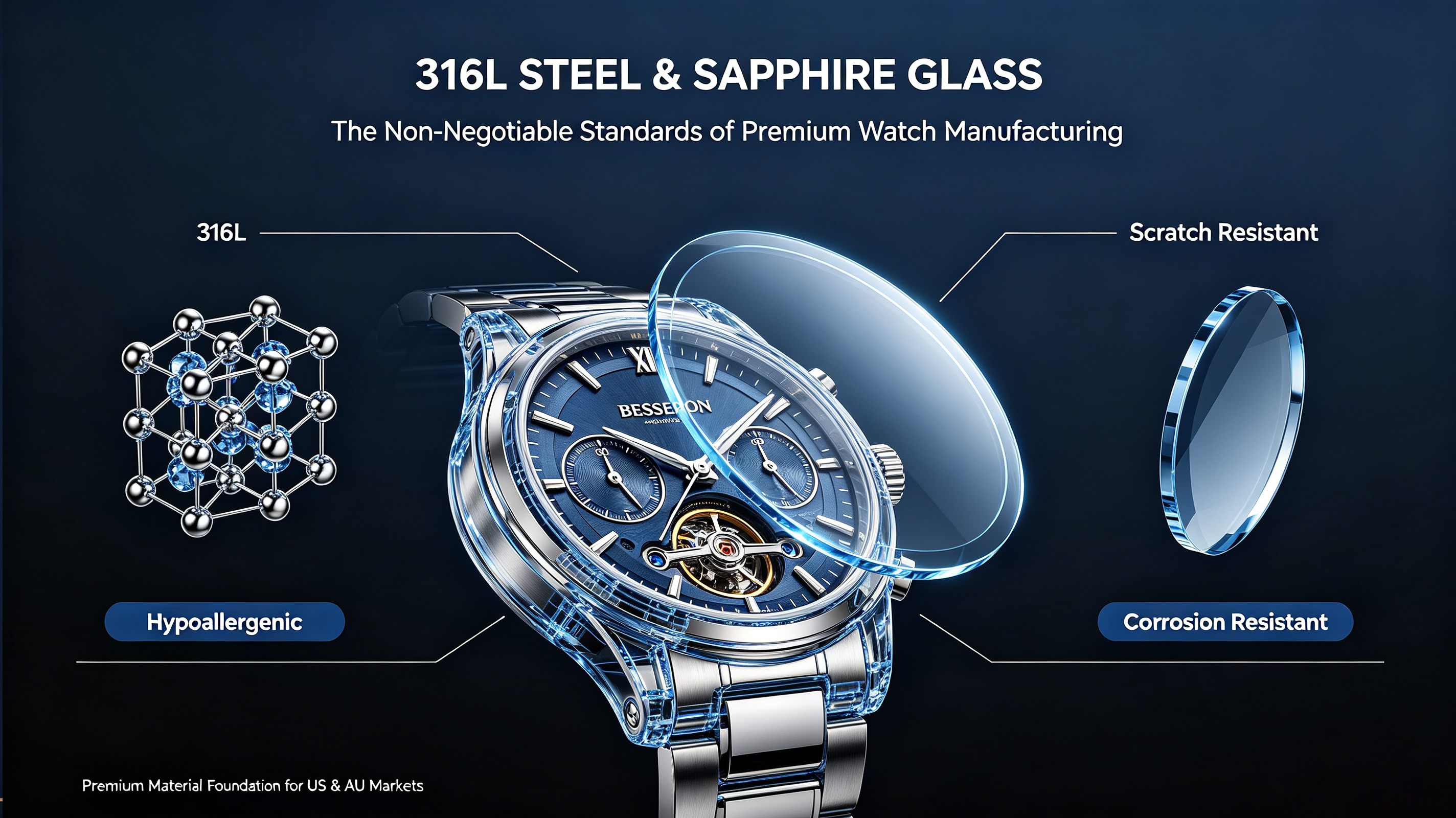
When sourcing from an oem watch manufacturer, the choice of steel is the first technical gate. While lower-end manufacturers may use 304 steel or zinc alloy to cut costs, BESSERON strictly utilizes 316L Surgical Grade Stainless Steel. But why does this specific alloy matter so much to a watch brand builder?
The "L" in 316L stands for "Low Carbon," but the real secret is the addition of Molybdenum. This element provides 316L with exceptional resistance to pitting and crevice corrosion, particularly in environments rich in chlorides (like salt-air or perspiration). For brands targeting the coastal lifestyles of Australia or Florida, using anything less than 316L is a recipe for premature tarnishing and customer complaints.
One of the biggest risks for a private label watch manufacturer in the US market is skin irritation (Nickel Dermatitis). 316L steel is specifically designed to be hypoallergenic. It has a low nickel-release rate that complies with the strictest global health standards (including REACH in the EU and equivalent US regulations). By ensuring your watches are made of 316L, you are protecting your brand from the legal and reputational risks associated with consumer skin reactions.
If the case is the body of the watch, the glass is its "Window to the Soul." In the B2B segment, offering Sapphire Glass is the single fastest way to elevate a product from a "fashion accessory" to a "luxury timepiece."
To understand the superiority of sapphire, we must look at the Mohs scale of mineral hardness. Standard mineral glass has a hardness of about 5 to 6. Sapphire glass, which is synthetically produced from alumina (Al2O3), has a hardness of 9. It is the second hardest material on Earth, surpassed only by diamond.
For a microbrand watch manufacturer, this is a powerful selling point. A sapphire crystal will remain flawlessly clear and scratch-free for decades, even if the user accidentally scrapes it against a brick wall or metal doorframe. In contrast, mineral glass will develop "micro-scratches" within months, dulling the dial's appearance and reducing the watch's perceived value.
At BESSERON, we go a step further. Our sapphire crystals often feature a multi-layer Anti-Reflective (AR) coating on the underside. This reduces glare, ensuring that your custom logo and the intricate details of the dial remain crisp and visible even in direct sunlight—a feature highly prized by enthusiasts in the US watch community.
Using premium materials like 316L steel is only half the battle; the other half is how those materials are shaped. As a premier watch manufacturer in China, BESSERON utilizes high-precision CNC (Computer Numerical Control) machining.
In the production of Tank watches or Integrated Sports watches, the tolerances (the allowable deviation in measurements) must be incredibly tight. We operate with a tolerance of +/- 0.01mm. This precision ensures:
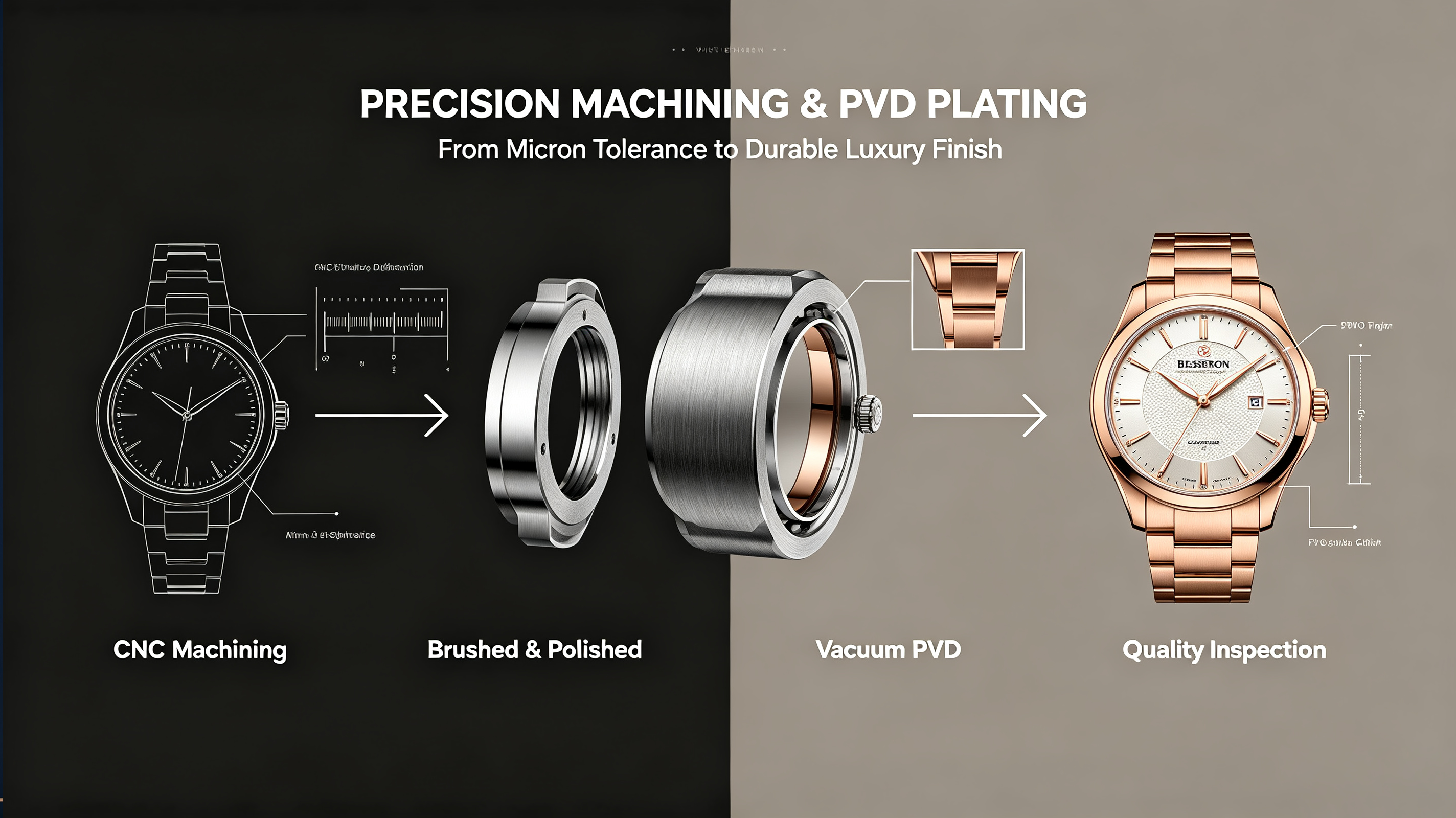
For many US boutique brands, color is the primary aesthetic driver—especially Gold, Rose Gold, and Coffee Gold. However, traditional electroplating is a major point of failure. BESSERON solves this through PVD (Physical Vapor Deposition) Vacuum Plating.
In our PVD chambers, real gold or titanium ions are evaporated in a vacuum and fired at the 316L stainless steel case. This doesn't just "paint" the surface; it creates a molecular bond. The result is a finish that is 10 times more durable than electroplating.
For an oem watch manufacturer, PVD is an investment in longevity. It ensures that the Rose Gold finish on your ladies jewelry watch won't wear off on the wearer's wrist, preventing the "fading" issues that plague cheaper competitors.
In the US market, a "Sports Watch" label carries an implicit promise of durability. For a watch brand builder, the water resistance (WR) rating is a critical data point.
As a high-grade watch supplier in China, we don't just "sample test." Every single case undergoes a two-stage verification:
For microbrand watch manufacturers building dive watches, we offer testing up to 30ATM (300 meters), ensuring your "Tool Watch" can handle the professional-grade demands of the US consumer.
In the B2B world, quality must be auditable. For a US or Australian brand, importing from a watch manufacturer in China requires a supply chain that passes both quality and ethical scrutiny.
From a strategic B2B perspective, the cheapest watch is often the most expensive. High return rates, shipping costs for repairs, and negative social media reviews can quickly destroy a brand's profit margins.
By insisting on 316L Stainless Steel and Sapphire Glass, a watch brand builder is investing in "Brand Insurance."
[BESSERON ADVANTAGE SECTION] BESSERON WATCH MANUFACTURER is a top-tier integrated watch manufacturing group with a 60-year time-honored watchmaking heritage. As a benchmark leading factory in the global custom watch segment, we have focused on customized watch manufacturing for over 25 years.
We serve worldwide brands, distributors, and emerging Watch Brand Builders by providing a foundation of uncompromising quality. Every BESSERON timepiece is constructed from 316L medical-grade stainless steel and features scratch-resistant sapphire glass as a standard configuration. By utilizing precision Japanese movements (Automatic or Quartz), we guarantee that your brand is built on a foundation of reliability. Our OEM/ODM services are supported by all-round considerate services and strict global compliance certifications (BSCI/ISO). With decades of practical experience and genuine customer testimonials, BESSERON is the manufacturer that helps you build watch brands that sell.
Q1: What is the real difference between 316L and 304 stainless steel for watches? A1: 316L contains 2-3% Molybdenum, which makes it highly resistant to corrosion from salt and sweat. 304 steel lacks this and can develop "pitting" or rust spots over time, especially in coastal markets like Australia or the US West Coast.
Q2: How can I prove to my customers that the glass is real Sapphire? A2: You can use a "Diamond Tester" (thermal conductivity probe) which will give a positive reading for sapphire but not for mineral glass. BESSERON can also provide material certification reports for your marketing materials.
Q3: Is PVD plating the same as "gold-filled" or "gold-plated"? A3: PVD (Physical Vapor Deposition) is superior to standard gold-plating. It is a vacuum process that creates a much harder, more wear-resistant layer that is chemically bonded to the steel at a molecular level.
Q4: Do you provide a warranty for the water resistance of your watches? A4: Yes. As an experienced oem watch manufacturer, we provide a 1 to 2-year warranty on the construction and water resistance of our timepieces, assuming proper care (like ensuring the crown is screwed in).
Q5: Why is CNC machining better than stamping for watch cases? A5: Stamping is for high-volume, low-cost watches. CNC machining allows for much sharper edges, more complex geometries (essential for Tank and Integrated Sports styles), and tighter tolerances for better waterproofing.

