Automatic vs. Quartz: Choosing the Right Heart for Your Integrated Sports Watch Collection
In the modern horological market, the integrated sports watch has become one of the most desirable categories for watch brand builders and consumers alike. From the high-luxury boutiques of New York to the fast-growing e-commerce landscapes of Australia, demand for timepieces that blend a rugged case with a seamless, tapering bracelet is at an all-time high.
However, for private label watch manufacturers and watch brand builders, one of the most critical decisions during the R&D phase is choosing the right movement: automatic vs. quartz.
This decision is about more than choosing between mechanical soul and electronic precision. It is a strategic choice that affects the watch’s silhouette, retail price point, target audience, and long-term brand positioning. As a premier watch manufacturer in China, BESSERON has helped thousands of brands navigate this decision. This article explores movement selection for integrated sports watches from both a technical and commercial perspective.
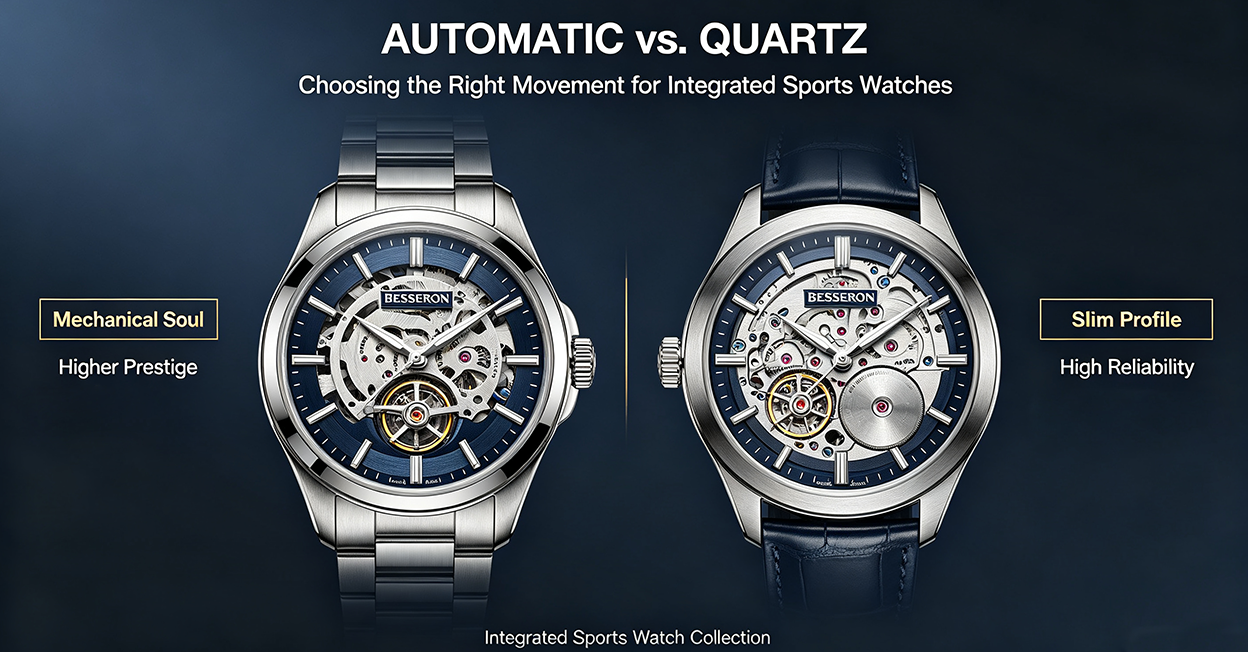
1. The Integrated Aesthetic: Why the Movement Defines the Watch Silhouette
The defining feature of an integrated sports watch is its sculptural profile. The bracelet must flow directly from the case in one continuous line, creating a seamless look on the wrist. This aesthetic is extremely sensitive to case thickness.
The Slimness Requirement
Integrated sports watches look best when they remain slim and balanced. A bulky integrated design can feel clunky because the bracelet does not have the flexibility of traditional lugs. Every millimeter of case thickness directly impacts how the watch wears and how it photographs.
Movement Height Is the Starting Point
Movement choice fundamentally determines the final thickness of the watch.
-
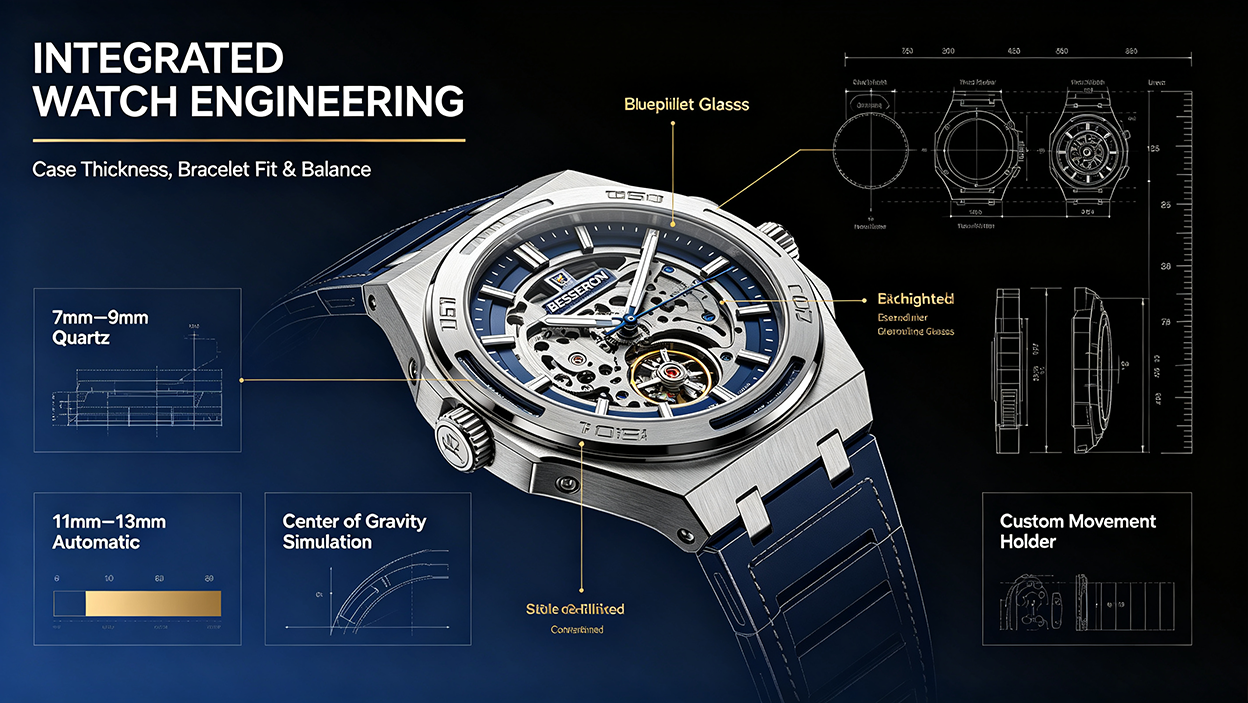
A high-grade quartz movement allows for a slimmer case, often between 7mm and 9mm.
-
An automatic movement, with its rotor, gears, and mechanical stacks, usually requires a case thickness between 11mm and 13mm.
For brands targeting a luxury sport aesthetic inspired by iconic integrated sports watches, achieving a slim profile with an automatic movement is a high-end engineering challenge. For brands targeting fashion-forward, daily-wear, or high-volume e-commerce segments, quartz offers an unbeatable combination of slimness, comfort, and reliability.
2. The Case for Custom Automatic Watches: Building Enthusiast Credibility
For microbrand watch manufacturers and premium watch brand builders, the automatic movement is often the best choice for flagship collections. The reason is credibility.
The Sweeping Second Hand and Mechanical Appeal
Watch enthusiasts in the US and Australian markets value the sweeping second hand as a visual signal of real watchmaking. An integrated sports watch with an exhibition case back allows users to see the mechanical heartbeat inside, creating a stronger emotional connection with the product.
This connection directly supports a higher retail price point. For brands targeting watch collectors, hobbyists, and premium buyers, an automatic movement is often non-negotiable.
Longevity and Heirloom Value
Automatic watches are perceived as forever pieces. While quartz watches are often seen as functional tools, custom automatic watches are viewed as heirloom items that can be passed down over time.
For watch brand builders, this allows for a higher MSRP, typically ranging from $$450 to$$1,200, depending on finishing, movement choice, and overall build quality.
3. The Case for Custom Quartz Watches: Reliability, Thinness, and High-Volume Sales
While mechanical movements appeal to enthusiasts, the mass market—including TikTok sellers, boutique fashion brands, and lifestyle-focused retailers—often prefers quartz. As a specialized custom quartz watch manufacturer, BESSERON sees three main reasons for this preference.
Instant Reliability and Lower Returns
For B2B buyers, return rate is one of the most important metrics. Quartz movements are inherently more shock-resistant than mechanical movements. For a sports watch intended for active daily use, a Japanese quartz movement from Miyota or Seiko Epson offers set-and-forget reliability that minimizes customer support issues.
Accessible Luxury Price Point
Quartz allows brands to offer the integrated look at a more accessible retail price, typically between $$150 and$$299. This is a strong sweet spot for impulse purchases, gift sales, and high-volume e-commerce.
By reducing the cost of the movement, brands can allocate more budget to premium external materials such as 316L stainless steel and sapphire glass, creating a product that feels luxurious without the high cost of mechanical movement.
Low Maintenance for End Consumers
Quartz watches require no winding, no regulation, and very little long-term care. For lifestyle consumers who want a stylish sports watch without the responsibility of mechanical watch ownership, quartz is often the better choice.
4. Engineering Challenges: Thickness and Integration
Regardless of whether you choose automatic or quartz, the integrated design creates unique engineering hurdles that only a top-tier OEM watch manufacturer can solve.
Bracelet-to-Case Transition
In a standard watch, the movement sits centrally within the case. In an integrated sports watch, the case often has a more complex geometry to accommodate the first link of the bracelet. This requires custom movement holders, precise stem alignment, and careful crown placement to ensure perfect functionality despite the non-standard case shape.
Weight Distribution
Automatic movements are heavier. In an integrated sports watch, where the bracelet represents a large portion of the total mass, balance is critical. If the case is too heavy, the watch will slide forward on the wrist and feel unbalanced.
BESSERON’s R&D team uses center-of-gravity simulations to ensure that every integrated sports watch project delivers balanced weight distribution, comfortable wear, and consistent quality.
5. Material Standards: 316L Steel and Sapphire Are Non-Negotiable
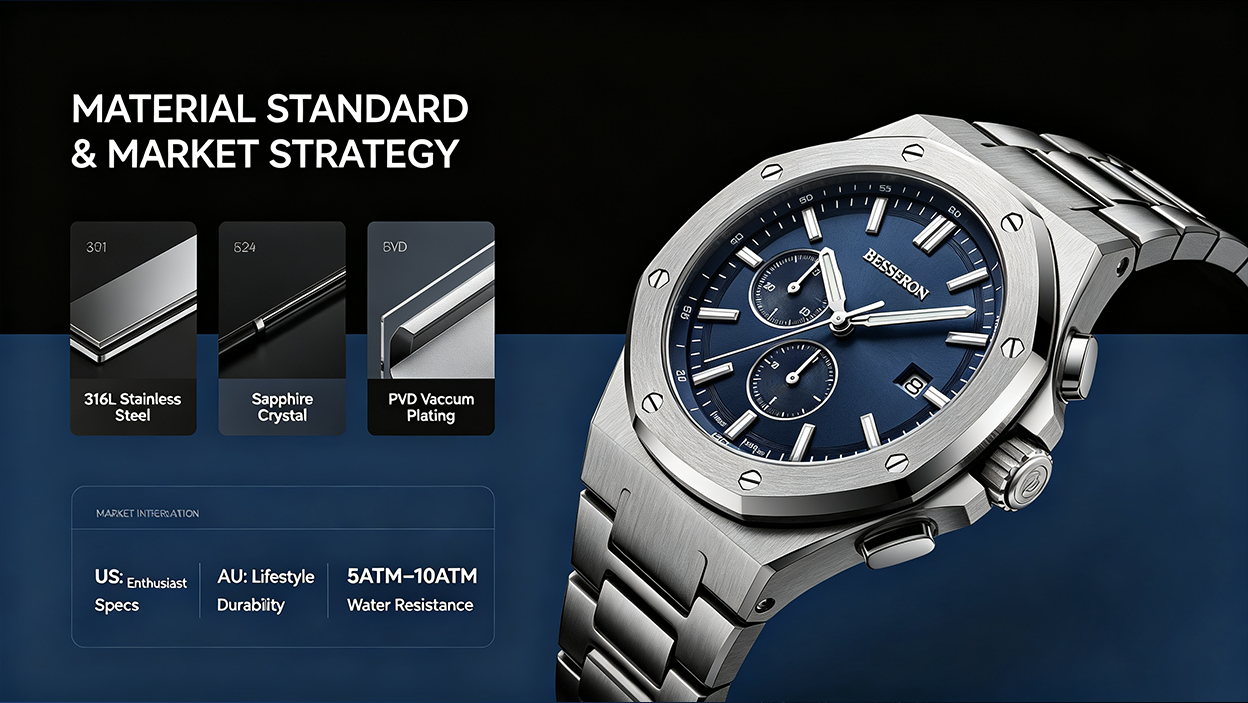
Whether your watch is powered by an automatic or quartz movement, the external build quality must meet premium standards. US and Australian consumers have very low tolerance for cheap materials, especially in the sports watch category.
|
Component
|
Standard Specification
|
Why It Matters
|
|
Case and Bracelet
|
316L Stainless Steel
|
Hypoallergenic, corrosion-resistant, and delivers the solid luxury weight buyers expect.
|
|
Crystal
|
Sapphire Glass
|
Scratch-resistant (9 on Mohs scale), essential for sports watches worn during active use.
|
|
Plating
|
PVD Vacuum Plating
|
Ensures gold and rose-gold finishes do not wear off easily during daily wear.
|
|
Bezel
|
Brushed and Polished 316L
|
Defines the luxury sport aesthetic with clean lines and premium texture.
|
BESSERON uses 316L medical-grade stainless steel as the baseline for all integrated sports watches. For integrated designs, we pay special attention to brushing quality, chamfer polishing, and link tolerances, because these details define whether a watch feels premium or generic.
6. Market Segmentation: US vs. Australian Consumer Preferences
Movement selection should also be influenced by your target market.
US Market: Spec-Driven Enthusiasts
The US market is highly competitive for microbrand watches. Watch enthusiasts actively compare movement specifications, case material, water resistance, and finishing. For this audience, a custom automatic watch manufacturer providing movements like the Miyota 9015 or Seiko NH35 is often the strongest path to building credibility.
Australian Market: Lifestyle and Durability
Australia has a large lifestyle consumer segment that values durability, water resistance, and waterfront style. While watch enthusiasts exist, many buyers prioritize practicality. High-spec quartz watches with 10ATM water resistance are extremely popular because they offer a slim profile, low maintenance, and reliable performance.
7. Cost vs. Value: Optimizing Your ROI
From a B2B perspective, movement selection is ultimately an ROI decision.
Automatic Watch ROI
-
Higher unit cost
-
Higher retail price potential
-
Stronger brand prestige
-
Better for premium positioning
-
Requires more customer education
-
More sensitive to shipping shocks and regulation
Quartz Watch ROI
-
Lower unit cost
-
Higher sales volume potential
-
Lower after-sales support
-
Better for slim and fashion-forward designs
-
Ideal for accessible luxury price points
-
More consistent mass production performance
BESSERON’s services include feasibility analysis for every new project. We help brands calculate the total land cost, production risk, and market positioning for both automatic and quartz options, so you can choose the movement that best matches your brand strategy.
8. Why BESSERON Is the Right Partner for Integrated Sports Watches
BESSERON WATCH MANUFACTURER is a top-tier integrated watch manufacturing group with
60 years of watchmaking heritage and over 25 years of specialized experience in custom watch production.
Whether you are looking for a custom automatic watch manufacturer to build a high-beat enthusiast piece or a custom quartz watch manufacturer for a slim, fashion-forward integrated collection, BESSERON delivers.
We strictly use 316L medical-grade stainless steel and scratch-resistant sapphire glass as standard. Our OEM/ODM services are supported by full BSCI and ISO certifications, helping US and Australian brands meet global compliance requirements.
From initial design and movement selection to case engineering, prototyping, and mass production, BESSERON provides the technical depth and manufacturing stability needed to build premium integrated sports watch collections.
FAQ: Movement Selection and Integrated Sports Watches
Q1: Can an integrated sports watch be both automatic and slim? A1: Yes, but it requires premium automatic movements like the Miyota 9015 or other slimmer mechanical calibers. BESSERON specializes in slim-automatic case engineering to help brands achieve a thinner profile without sacrificing mechanical credibility.
Q2: What is the battery life of your Japanese quartz movements? A2: Most high-grade Japanese quartz movements we use, including Miyota and Seiko Epson, offer a battery life of 3 to 5 years, providing a low-maintenance experience for end consumers.
Q3: Do your integrated bracelets support quick-release pins? A3: Yes. We can engineer quick-release systems into integrated bracelets, allowing users to swap between the steel bracelet and a custom-fitted FKM rubber strap—a popular feature for US sports and lifestyle brands.
Q4: How do you test the water resistance of integrated watches? A4: Every integrated watch undergoes a multi-stage pressure test in our ISO-certified laboratory, including both vacuum and high-pressure water testing, to ensure the stated 5ATM or 10ATM rating is fully verified.
Q5: Can we put a custom logo on the movement? A5: For automatic watches with exhibition case backs, we offer laser-engraved or custom-colored rotors. For quartz watches, branding is typically focused on the dial, case back, and crown, where it is most visible to customers.


