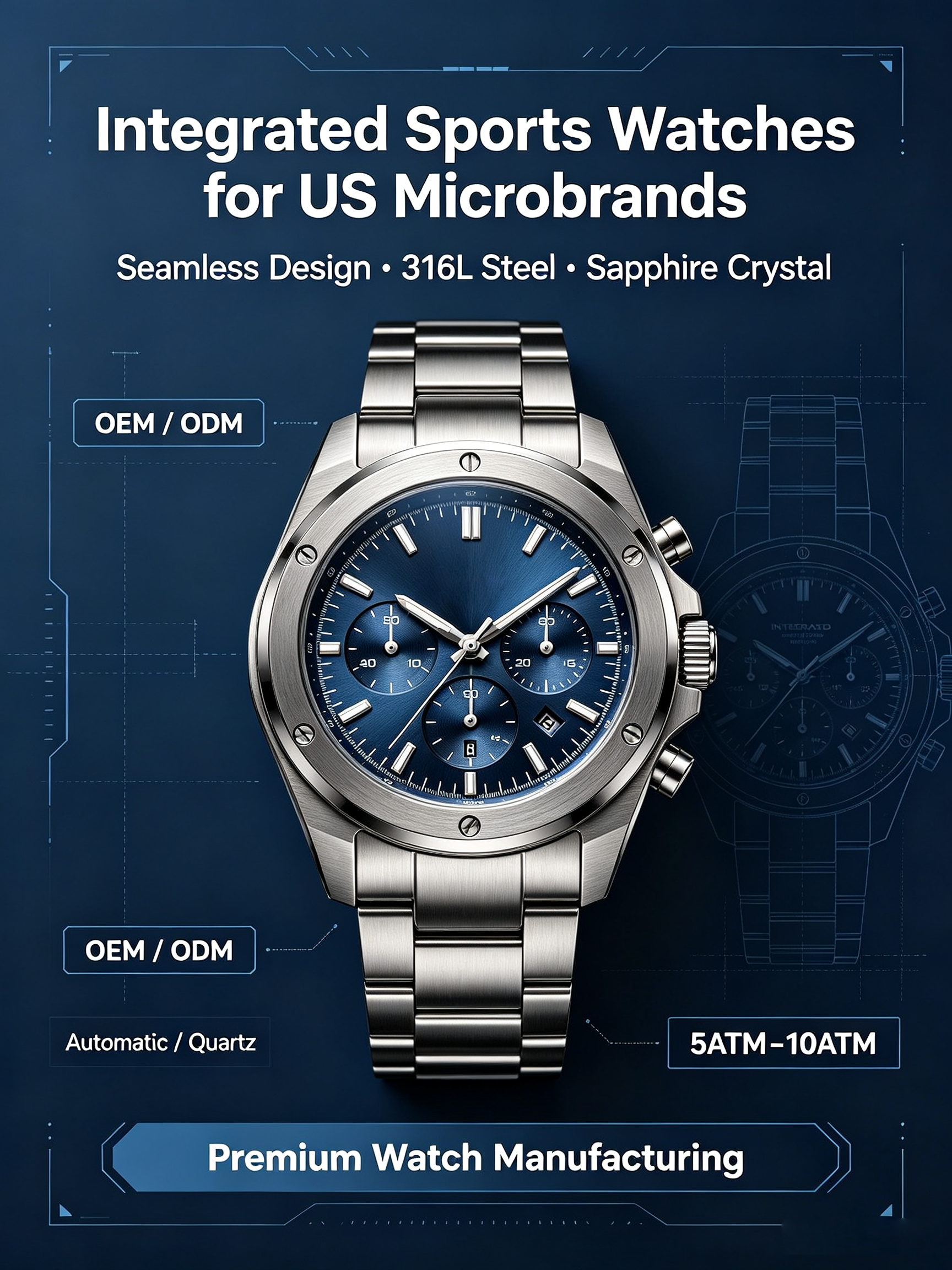
In the contemporary horological landscape, few designs have captured the imagination of collectors and the strategic focus of brand owners quite like the integrated sports watch. Characterized by a seamless flow from the watch case to the metal bracelet, this iconic aesthetic first pioneered in the 1970s has undergone explosive market growth across the United States and Australia. For microbrand founders, private label watch operators and independent watch startups looking to expand market share, mastering the integrated sports watch category is no longer an optional product line—it has become a mandatory core offering to maintain competitiveness with mainstream horology brands.
Yet breaking into high-end integrated sports watch production carries substantial technical barriers. Unlike conventional timepieces with separate lugs and detachable straps, integrated bracelet designs demand ultra-precise CNC machining, zero-tolerance component fitting and hand-finished assembly to deliver the signature fluid silhouette consumers associate with luxury. This in-depth B2B procurement guide acts as a complete operational blueprint for US microbrand operators, TikTok e-commerce sellers, and emerging watch brand builders. We cover every stage of integrated sports watch development: trend analysis, technical engineering, material selection, movement matching, factory sourcing, compliance standards, marketing strategies, and key manufacturing FAQs to help you design and launch premium, market-ready integrated sports watches that resonate with North American watch enthusiasts.
1. The Rise of the Integrated Bracelet Watch Movement: Why US Microbrands Are Shifting Focus
The booming popularity of integrated sports watches stems from a fundamental shift in consumer purchasing behavior across the US market. Modern watch buyers prioritize multi-purpose versatility above all else; an integrated sports watch effortlessly transitions from morning gym workouts, casual weekend outings, corporate office meetings to formal evening dinners. For watch brand builders, this “one-watch wardrobe” positioning creates a powerful, easy-to-communicate marketing narrative that drives higher customer conversion and repeat purchase rates.
Industry data aggregated from leading microbrand enthusiast forums, watch review platforms and social media horology communities confirms that the Gérald Genta-inspired integrated silhouette ranks as the most searched design language within the sub-$1,000 price segment. Partnering with a specialized microbrand watch manufacturer eliminates the multi-million-dollar R&D and tooling costs that Swiss luxury conglomerates absorb to develop original integrated watch lines. The core competitive advantage lies in flawless execution of the lug-less integrated structure, which transforms a basic timekeeping accessory into a sculptural piece of industrial wearable art that stands out against generic fashion watches.
2. Technical Anatomy: Engineering the Perfect Integrated Sports Case and Bracelet
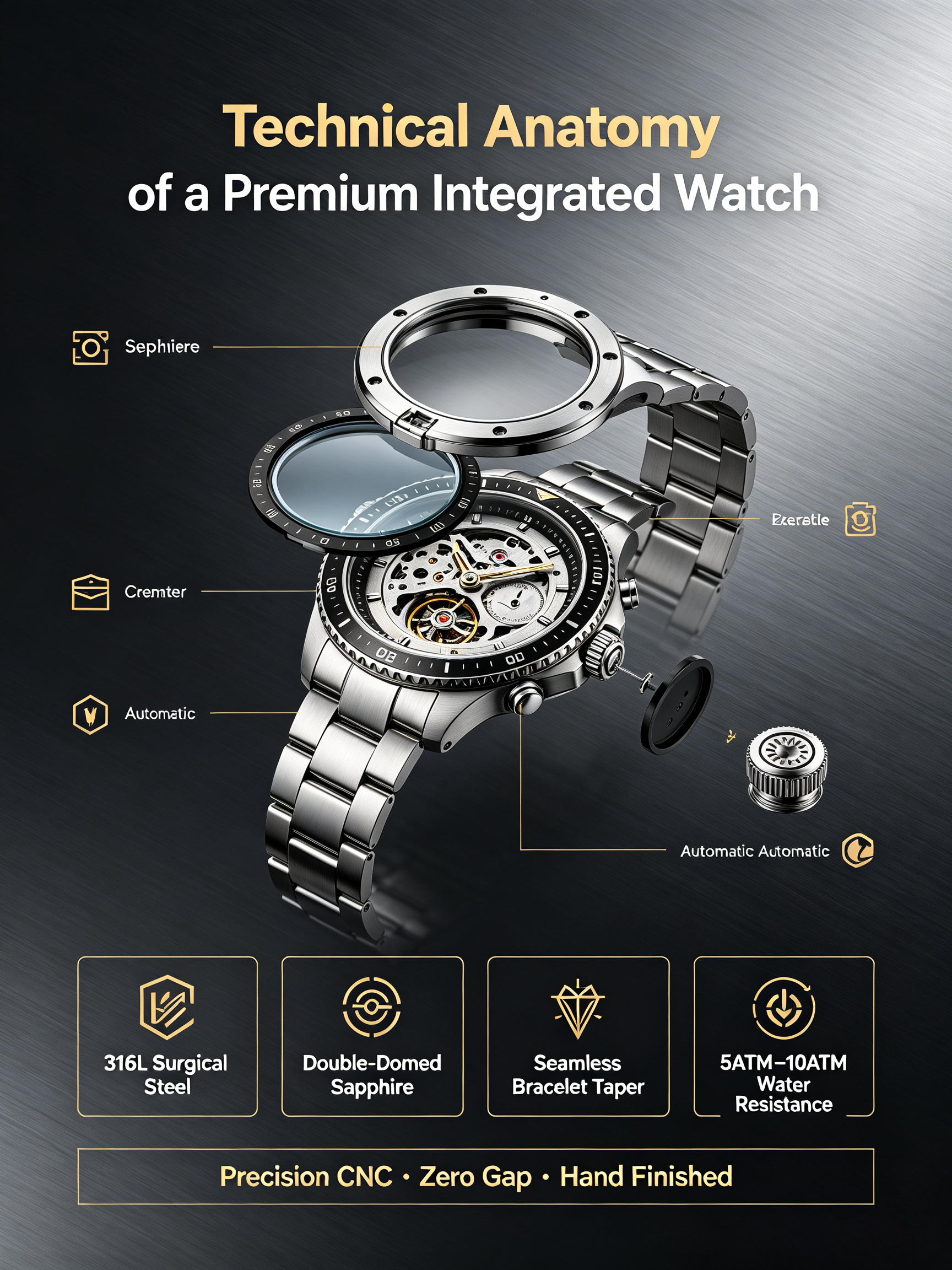
Watch Manufacturing a premium integrated sports watch revolves around microscopic dimensional tolerances that traditional mass-production factories cannot consistently deliver. Standard watches separate the case and strap as two independent components, while integrated watch construction fuses the bracelet links as an uninterrupted geometric extension of the watch case—every millimetre of transition directly impacts perceived luxury value.
Core Integrated Watch Engineering Standards
-
Seamless Case-to-Bracelet Transition Geometry The junction point where the case lugs merge with the first bracelet link must eliminate all visible gaps, uneven edges or misalignment. Even minor spacing between metal surfaces instantly signals low-quality craftsmanship to seasoned watch collectors and B2B wholesale buyers. All transition angles require precise multi-axis CNC milling to match contour curves perfectly across the entire watch profile.
-
Graduated Bracelet Tapering A signature hallmark of high-end integrated sports watches is progressive bracelet tapering: wide links at the case lugs gradually narrow toward the clasp. This balanced shape boosts long-term wrist comfort and delivers refined visual elegance, a detail cheap watch manufacturers often overlook to cut production costs.
-
Layered Dual Finishing Contrast Luxury integrated timepieces rely on the intentional interplay of satin brushed surfaces and mirror-polished chamfered edges to catch light dynamically. Top-tier oem watch manufacturers deploy 5-axis CNC machinery to carve sharp, clean dividing lines between brushed and polished finishes, avoiding blurred, messy transitions that diminish premium positioning.
As a leading watch manufacturer in China, BESSERON leverages advanced 3D CAD simulation software to model every case and bracelet contour before raw steel undergoes cutting and machining. Digital pre-production modeling eliminates costly tooling revisions and ensures the final finished watch presents as a single cohesive sculptural unit, rather than disjointed assembled metal parts.
3. Choosing the Right Movement: Custom Automatic vs Quartz for Sports Timepieces
Your watch movement acts as the core identity of your integrated sports watch and directly dictates target retail price brackets, audience demographics and brand positioning. Microbrand watch manufacturers split production lines into two primary movement categories to cater to distinct US consumer groups.
For enthusiast-focused microbrands targeting mechanical watch collectors, automatic movements remain the top priority. Mechanical calibers deliver the emotional “horological soul” that loyal hobbyists seek, supporting premium pricing and strong brand loyalty.
-
Seiko NH35 Automatic Movement: A reliable, cost-effective workhorse with a smooth sweeping second hand, ideal for mid-tier integrated sports watches priced between $$300$$700.
-
Miyota 9015 High-Beat Automatic Movement: Slim-profile high-frequency caliber, perfectly suited for thin integrated watch case designs where internal space is limited. This model is the most requested movement for luxury microbrand integrated lines across the US market.
For TikTok fashion sellers, entry-level lifestyle brands and mass-market collections priced $$150$$300, high-precision Japanese quartz movements deliver superior commercial advantages:
-
Ultra-thin internal construction to maintain slim integrated case proportions
-
Enhanced shock resistance built for active sports daily wear
-
Zero manual winding maintenance for casual consumers
-
Lower overall component costs to support competitive retail pricing and higher sales volume
Brands can mix both mechanical and quartz SKUs within a single integrated watch design lineup to cover multiple price tiers and capture broader customer segments.
4. Materials Matter: Why 316L Stainless Steel and Sapphire Crystal Are Non-Negotiable
In the mid-to-high-end B2B watch space, material grade directly defines product perceived value. If you operate a private label watch brand, rigid material specifications are mandatory to justify your retail price point and compete with established microbrands. Below is a clear industry standard comparison against BESSERON’s premium manufacturing requirements:
|
Component
|
Generic Low-End Industry Standard
|
|
|
Watch Case & Integrated Bracelet
|
304 Stainless Steel
|
316L Surgical-Grade Stainless Steel
|
|
Front Watch Glass
|
Basic Mineral Crystal
|
Double-Domed Sapphire Crystal with Multi-Layer Anti-Reflective Coating
|
|
Protective Bezel
|
Thin Aluminum
|
Solid Ceramic or Brushed 316L Steel
|
|
Water Resistance Rating
|
3ATM Daily Splash Proof
|
5ATM – 10ATM Sports & Swimming Certified
|
Key Material Breakdown
-
316L Surgical Grade Stainless Steel 316L alloy contains added molybdenum, delivering unmatched resistance to sweat corrosion, saltwater pitting and chemical oxidation—critical for sports watches worn during coastal, gym and outdoor activities. The material also holds crisp mirror polishing and uniform satin brushing far better than inferior 304 steel, retaining a pristine luxury finish for years of daily wear.
-
AR-Coated Sapphire Crystal Sapphire ranks 9 on the Mohs hardness scale, nearly scratch-proof compared to soft mineral glass that scratches easily with minor contact. Multi-layer inner anti-reflective coating eliminates glare in sunlight, gym lighting and studio product photography—an essential feature for social media marketing content creation.
5. The Manufacturing Process: From R&D to Mass Production with a Top-Tier China Factory
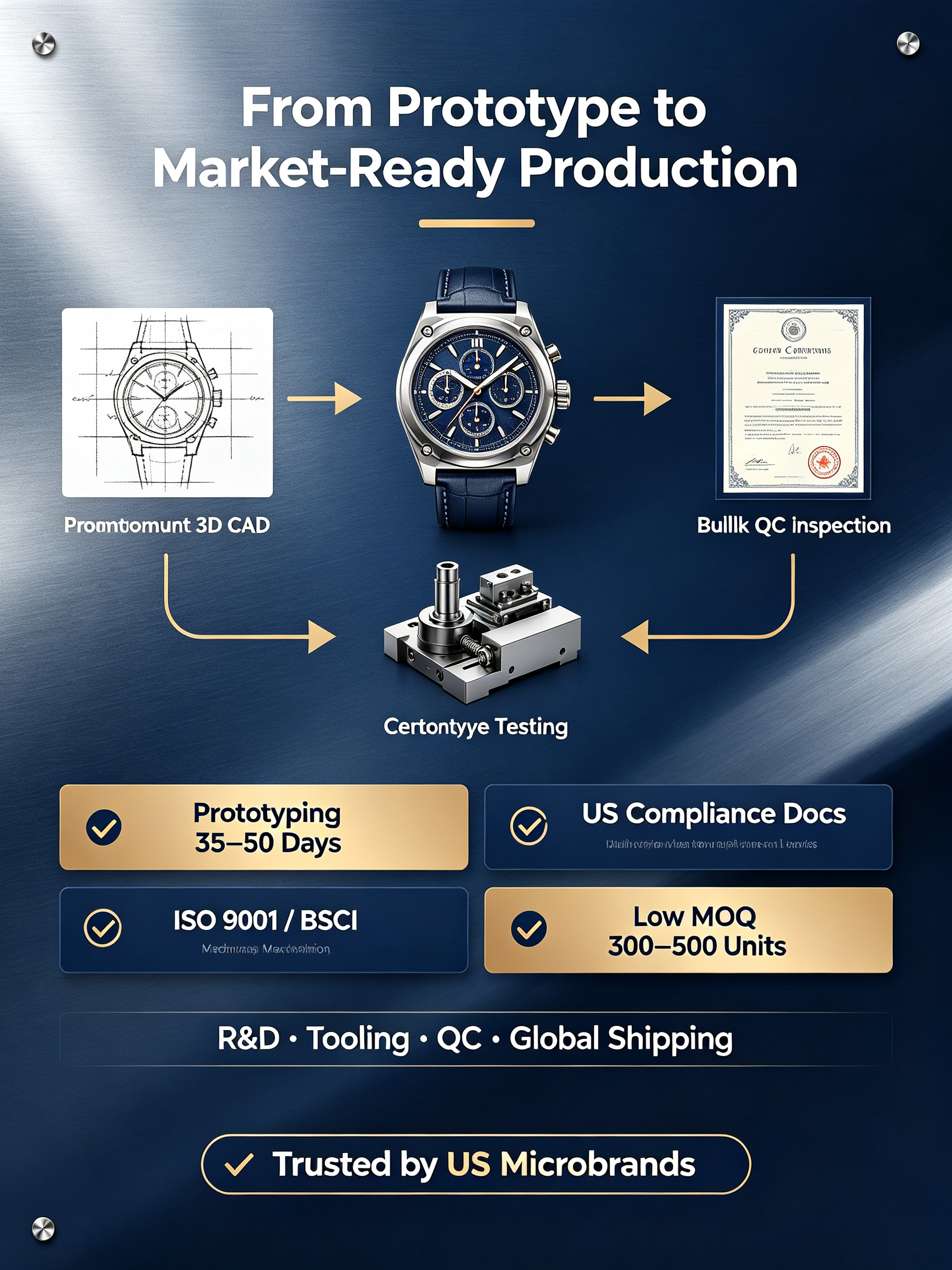
Launching a custom integrated sports watch requires a manufacturing partner fluent in full-cycle OEM/ODM workflows. A trusted professional watch supplier in China follows this standardized five-stage production pipeline to guarantee consistent quality for US microbrands:
-
Brand Consultation & Custom Design Engineering Convert your brand sketches, reference images or rough concept notes into precise technical 2D drawings and 3D CAD models. Our engineering team adjusts case curves, bracelet tapering and finish layouts to align with your brand’s unique aesthetic vision.
-
Functional Pre-Production Prototyping Craft a fully wearable, functional prototype using identical CNC tooling planned for mass production. Test wrist ergonomics, bracelet link flexibility, gap-free case integration, movement fit and water resistance before finalizing molds.
-
Premium Component Sourcing Secure authentic Japanese Miyota/Seiko movements, certified 316L steel blanks, sapphire crystal, ceramic bezels and custom engraved dial components from verified global suppliers.
-
Mass Precision Production & Surface Finishing Run multi-axis CNC machining for cases and integrated links, apply durable PVD vacuum coating for colored finishes, and complete hand polishing/brushing by skilled watch artisans. All assembly takes place inside dust-free cleanrooms to avoid surface blemishes.
-
Multi-Stage Strict Quality Control Every finished integrated sports watch undergoes mandatory timing calibration, vacuum pressure water resistance testing, surface defect inspection and bracelet movement checks before packaging and shipment.
6. Compliance and Quality Control: Ensuring Your Brand Meets Global Standards
For US and Australian microbrand owners, regulatory compliance represents the biggest risk mitigation tool in overseas watch sourcing. Partnering with a watch manufacturer in China lacking official global certifications exposes your brand to customs delays, product seizures and costly market recalls. Confirm your manufacturing partner holds these critical accreditations:
-
ISO 9001: Global quality management system certification for standardized production and QC protocols
-
BSCI: Social ethical manufacturing audit, verifying safe factory labor conditions for Western brand requirements
-
CE & RoHS: Hazardous substance restriction certification, guaranteeing lead-free, nickel-safe watch materials compliant with US consumer goods laws
BESSERON provides full bundled compliance documentation with every bulk order, including material test reports, SGS certification sheets, country-of-origin marking proof and customs filing paperwork. This seamless compliance support eliminates administrative friction between factory production and US retail distribution.
7. Marketing Your Integrated Sports Watch: Growth Tips for TikTok and Watch Brand Builders
Once your custom integrated sports watch completes production, targeted visual marketing unlocks maximum sales potential for social media-native microbrands:
-
Macro Close-Up Product Photography Showcase the seamless case-bracelet transition, contrast between brushed and polished metal, and crystal clarity in high-resolution close-up shots. These detailed textures perform exceptionally well on Instagram, Pinterest and product listing pages.
-
TikTok Bracelet Flexibility Demo Videos Create short-form content demonstrating smooth bracelet articulation with a “no rattle” flex test. High-quality integrated links move fluidly without loose clinking noise—an instant visual signal of superior build quality for scrolling viewers.
-
Heritage-Driven Brand Storytelling Highlight your factory’s professional watchmaking legacy in marketing copy. Consumers assign higher perceived value to timepieces manufactured by facilities with decades of specialized horology expertise, differentiating your microbrand from generic drop-shipping fashion watch competitors.
8. Partnering with BESSERON: 60 Years of Watchmaking Heritage at Your Service
BESSERON WATCH MANUFACTURER stands as an industry benchmark within the global custom watch manufacturing sector, fully tailored to satisfy the strict technical and branding demands of US and Australian watch brand builders. Backed by a 60-year time-honored watchmaking heritage and over 25 years of dedicated focus on customized OEM & ODM watch production, our factory delivers unmatched specialized expertise for integrated sports watch development.
Our core competitive advantage lies in end-to-end integrated manufacturing capabilities covering design, prototyping, machining, finishing and compliance support. Whether you require a custom automatic watch manufacturer to build complex mechanical integrated sports pieces or a custom logo watch manufacturer for high-volume private label fashion collections, BESSERON delivers consistent premium results.
We exclusively utilize medical-grade 316L stainless steel and scratch-resistant multi-layer AR sapphire glass across all production lines, paired with reliable premium Japanese mechanical and quartz movements to guarantee long-term product performance. Our full-spectrum OEM/ODM services are fully backed by internationally recognized BSCI and ISO compliance certifications, ensuring every custom timepiece aligns with ethical manufacturing standards and US import regulations. We do not merely produce watches—we provide long-term manufacturing partnerships designed to help independent microbrands build profitable, recognizable watch lines that sell consistently across global marketplaces.
Q1: What is the minimum order quantity (MOQ) for a fully custom OEM integrated sports watch?
A1: Standard MOQ for fully original custom integrated sports watch OEM projects ranges from 300–500 units per single model. Exact minimums shift based on integrated bracelet complexity, custom mold requirements and movement selection. Pre-existing ODM integrated watch templates carry lower entry MOQs for early-stage startups.
Q2: Why is 316L stainless steel the mandatory material for luxury integrated sports watches over other steel grades?
A2: 316L low-carbon stainless steel contains molybdenum alloy additives that deliver superior resistance to sweat corrosion, saltwater damage and chemical discoloration—essential for sports watches worn in active coastal, gym and outdoor environments. It also retains smooth, long-lasting polishing and brushing finishes far better than cheaper 304 steel alternatives.
Q3: Can I customize the automatic movement rotor with my brand logo for exhibition case back designs?
A3: Yes. As a leading custom automatic watch manufacturer, BESSERON offers two premium rotor branding options: high-precision fiber laser engraving and fully custom molded rotors with raised brand emblems, perfectly visible through sapphire exhibition case backs to boost unique brand identity.
Q4: How long does full prototyping take for a custom integrated sports watch line?
A4: Complete high-fidelity functional prototype development for original integrated sports watch designs takes 35–50 working days. Extended lead times stem from custom tooling production required to craft seamless integrated bracelet links and matching case geometry. Simplified ODM modification prototypes can be delivered faster.
Q5: Are all watches manufactured at your factory fully compliant with US import safety and labeling regulations?
A5: Every bulk order includes complete official compliance documentation, certified material safety test reports, and correctly applied “Made in China” country-of-origin marking to facilitate smooth US and Australian customs clearance without delays or penalties. All materials adhere to US lead and heavy metal restrictions for consumer wearable goods.


