
If you run an independent brand or a boutique in Australia and you have been thinking about adding a watch line, you are not alone. Minimalist dress watches have become one of the most dependable categories in the entire accessories market, and for good reason: they are timeless, affordable to produce, and instantly recognisable when they carry your brand's design language. This guide is written specifically for B2B buyers — brand founders, boutique owners and purchasing managers — who want to understand exactly what goes into launching a custom minimalist quartz watch, from design specifications and customization options to MOQs, sampling, pricing and factory selection. By the end, you will know precisely what to ask your manufacturer and how to bring a profitable, differentiated watch to the Australian market.
Before we go further, a note on how this guide is structured for buyers. Each section is written to arm you with the exact language, specifications and questions you need in conversations with manufacturers — the same information professional sourcing teams use when they evaluate a new supplier. Whether you are a brand founder approving your first watch, a buyer adding a category to an existing accessories line, or a purchasing manager comparing three factories, the sections below follow the real procurement sequence: market validation, design brief, specification, sampling, pricing and supplier selection. Read them in order, or jump to the section that matters to your current decision — every section ends with the practical details you can take straight into a supplier conversation. And where Australian market specifics matter — climate, gifting seasons, retail structure, pricing in AUD — they are called out explicitly, because the difference between a generic watch launch and a successful one is almost always local market intelligence.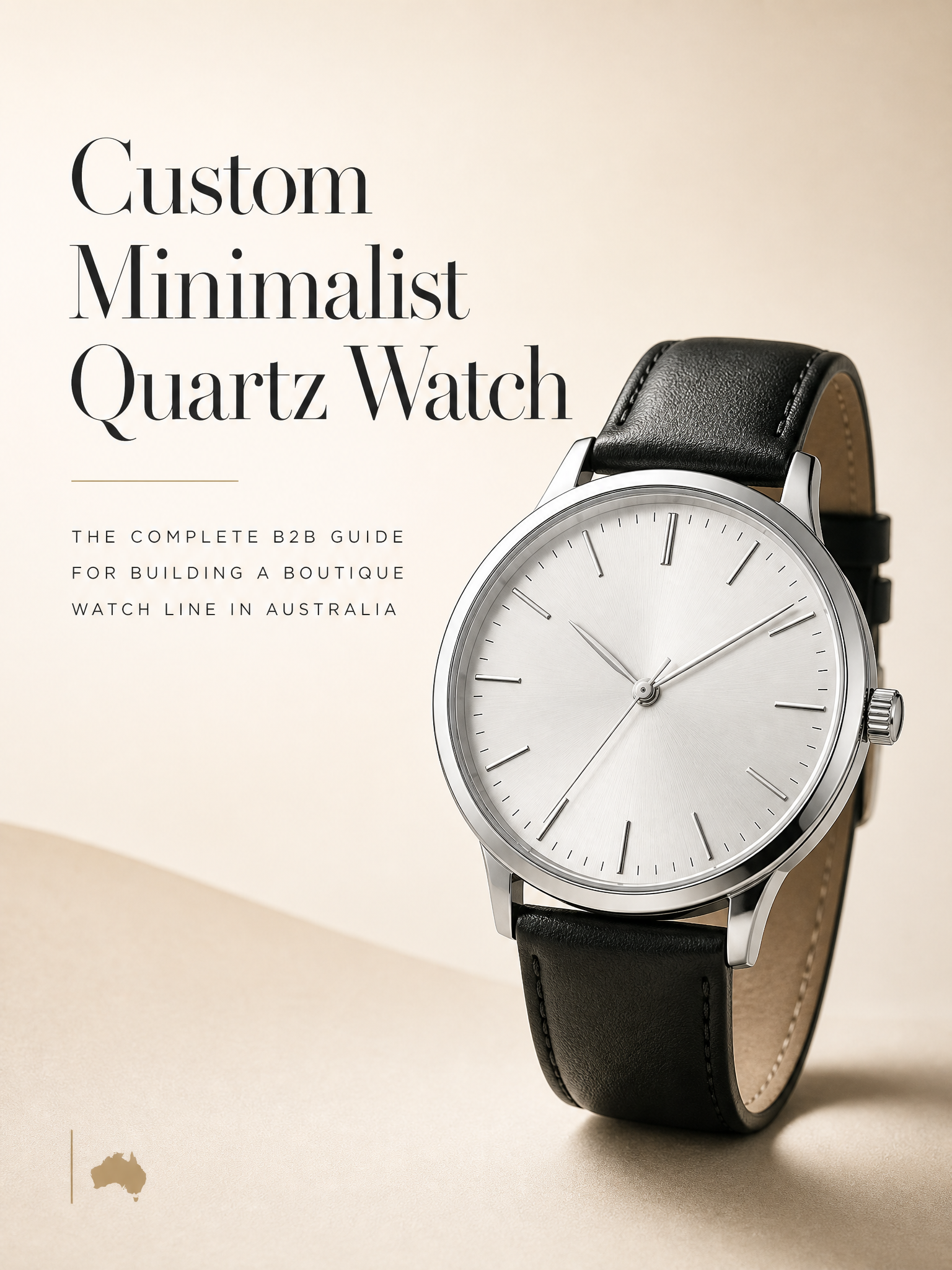
Australia is a market built on clean, understated design. From Melbourne's laneway cafés to Sydney's coastal architecture, the aesthetic that wins is quiet confidence — and that is exactly the language of the minimalist dress watch. Market data supports the category's strength. According to IMARC Group, the Australian watch market was valued at USD 2.27 billion in 2025 and is projected to reach USD 3.31 billion by 2034, growing at a CAGR of 4.07% over 2026–2034. Research and Markets puts the figure in local currency at AUD 2.85 billion in 2025, with a projection of AUD 6.33 billion by 2034 — a CAGR of 8.30%. Whichever number you rely on, the direction is the same: the market is growing steadily, and there is room for new brands.
The online channel is equally encouraging. Industry data cited by Expert Market Research indicates that e-commerce user penetration in Australia reached 65.3% in 2024 and is still climbing. For an independent brand, that means a watch line can be launched without a single retail location — a Shopify store, a strong hero image, and a tight colour story are enough to begin selling. Retail consultants who advise Australian lifestyle brands consistently point to the same opportunity: a minimalist watch is one of the lowest-risk category additions available, because it is seasonless, gender-neutral in appeal, and universally wearable. Unlike fashion-forward categories that rise and fall with trends, minimalism has proven durable across every economic cycle.
Understanding the buyer is as important as understanding the market. Australian consumers are informed, comparison-shopping buyers: they read reviews, compare specifications across three or four brands, and respond to honest product claims — which is why overstating water resistance or case material quality is punished quickly in online reviews. For B2B brands, the practical consequence is that the watch you launch must survive public scrutiny: genuine Japanese movements, correctly rated water resistance and real stainless steel are not optional features, they are the baseline your customers will verify. There is also a quiet recurring demand worth planning for: minimalist watches are a popular gift category in Australia, particularly for graduations, job milestones and Christmas, so a well-executed minimalist line generates repeat purchase events throughout the year rather than a single launch spike.
Finally, consider the category's inventory logic. Because minimalism is seasonless, unsold stock does not become obsolete the way fashion-driven products do — a navy dial that underperforms in spring can sell steadily through winter, and slow-moving colourways can be re-promoted rather than discounted into margin destruction. That makes the minimalist watch one of the lowest-risk product categories for a growing brand to carry.
Before you brief a factory, understand what Australian boutique customers actually expect from a minimalist watch — and what separates a generic import from a signature piece. Design consistency is the first priority. Your watch must look like a natural extension of your existing product line, sharing its colour palette, material sensibility and typography. The second priority is authenticity of the minimalism itself. True minimalist design is not the absence of detail; it is the deliberate reduction of detail. Every element that remains — the shape of the hands, the spacing of the markers, the texture of the dial — must be intentional.
B2B buyers we work with across Sydney and Melbourne consistently ask for four things. First, a slim case profile (typically 6–8 mm) that slips under a shirt cuff and wears comfortably all day. Second, a dial that stays legible at a glance, which means clean markers, well-proportioned hands and a matte or sunray finish that avoids glare. Third, materials that survive Australian conditions — genuine leather or fine mesh straps, and case finishes that resist humidity and sweat. Fourth, and most importantly, a dial that carries the brand's logo with taste. The logo is the entire point of a custom watch for a boutique brand: it turns an accessory into a signature.
Colour and size strategy deserves its own planning. The safest portfolio for a first minimalist launch is three SKUs: a 36 mm in silver with black or navy dial, a 38 mm in two-tone, and a 32 mm ladies' option — covering the majority of wrist sizes and styling preferences with minimal tooling duplication. Within those, colour psychology matters: black and silver read as universal and corporate; champagne and sand read as warmer and more premium; navy and green are the "distinctive but safe" choices that photograph well. Australian retailers we work with report that neutral palettes outsell bold colours roughly three to one in this category, but that a single signature colour — often drawn from the brand's identity — outperforms everything when it is promoted as a signature rather than just another option.
Size inclusivity is also a practical Australian consideration. The market spans a wide range of wrist sizes and gender expressions, and a line that only offers large cases excludes a meaningful share of buyers. Offering 32–38 mm across your range is a low-cost inclusivity decision that widens your audience without diluting your design language — and it is the kind of detail Australian customers notice and reward with loyalty.
Understanding specifications protects you in negotiations with any manufacturer. Here is what matters in a custom minimalist quartz watch, explained in buyer's language.
A simple way to visualise your options is the standard configuration table manufacturers use to quote:
This is where a custom watch stops being a commodity and becomes your product. A professional OEM factory offers customization at every visible surface of the watch, and you should expect to approve samples before any production begins.
Texture is the underused differentiator in minimalist design. While colour gets the attention, dial texture — vertical brushing, linen weave, subtle sunray, matte sandblasting — is what separates a premium piece from a commodity at arm's length. A factory with genuine dial-making capability can show you a texture library and produce samples of two or three finishes before you commit; we recommend always sampling at least one texture you have not considered, because it is consistently the element that surprises and delights boutique customers.
Limited collaborations are another low-risk way to activate the category. A capsule colourway with a local artist, café or design studio — 100–200 pieces, a short run, a shared story — generates press, social content and boutique interest out of proportion to its size. Because the base tooling is already established, collaboration runs carry minimal risk and the tooling cost is amortised across the core line. For a boutique brand with a limited marketing budget, collaborations are the most efficient way to be seen.
Let us be direct about the numbers that actually matter in procurement. Minimum order quantities (MOQs) are the single most common stumbling block for independent brands. Large manufacturers quote 500–1,000 pieces per model; that kills a boutique launch. A boutique-friendly OEM works with 100–200 pieces per model for a first order, which allows you to test one or two dial colourways with real customers before committing deeper.
The sampling process follows a standard sequence: (1) design brief and CAD/rendering approval, (2) sample production, typically 15–25 working days, (3) sample approval and any revisions, (4) bulk production, usually 25–35 working days, and (5) quality inspection and shipping. A realistic end-to-end timeline from brief to goods in hand is 60–75 days for a first order. Reorders are faster because tooling and specifications are already locked. Product sourcing specialists recommend always ordering a pre-production sample in the exact final specification — dial, logo, strap and packaging — because approving a "close enough" sample is how most quality disappointments begin.
Commercial terms are where the professional relationship is really defined. Standard practice in the industry: a 30% deposit with order confirmation, the balance against the bill of lading or before shipment, with payment via T/T or letter of credit for larger programs. Clarify your Incoterms early — most first orders from Australian buyers use FOB or EXW, with freight, insurance and Australian import duties plus GST at 10% handled by the buyer or a freight forwarder. A transparent factory will put all of this in writing in the quotation, including what is and is not included in the quoted price.
Quality control deserves the same contractual clarity. Agree an AQL (Acceptable Quality Limit) inspection standard in advance — typically AQL 2.5 for major defects on a visual inspection of the finished batch — and decide whether you will have a third-party inspection performed at the factory before shipment or rely on the factory's own inspection reports. Australian buyers importing consumer goods are subject to product safety expectations enforced by the ACCC, so insist on compliance documentation for materials and markings. These terms sound administrative, but they are the difference between a smooth reorder relationship and a dispute six months later.
Price positioning is where B2B buyers convert a well-made watch into a healthy margin. In the Australian market, the retail band that works best for minimalist quartz watches is AUD 149–299. Below that, margins get thin after freight, GST (10%) and payment fees; above that, customers start comparing you against known fashion brands. A common working model: ex-factory cost of USD 15–25 per unit (at 100–200 MOQ, standard materials) plus freight, duties and import costs of roughly 10–15%, giving a landed cost around AUD 25–40 per unit. That supports a retail price of AUD 149–199 with healthy gross margins, or a wholesale model to stockists at AUD 79–99.
Keep three pricing principles in mind. First, quote your price in AUD on your website — Australian buyers respond to local currency clarity. Second, bundle: a watch with an interchangeable strap set or a branded travel pouch lifts average order value without lifting production complexity. Third, protect margin discipline: minimalist watches have a perception ceiling, so resist the temptation to premium-price beyond your brand's credibility stage.
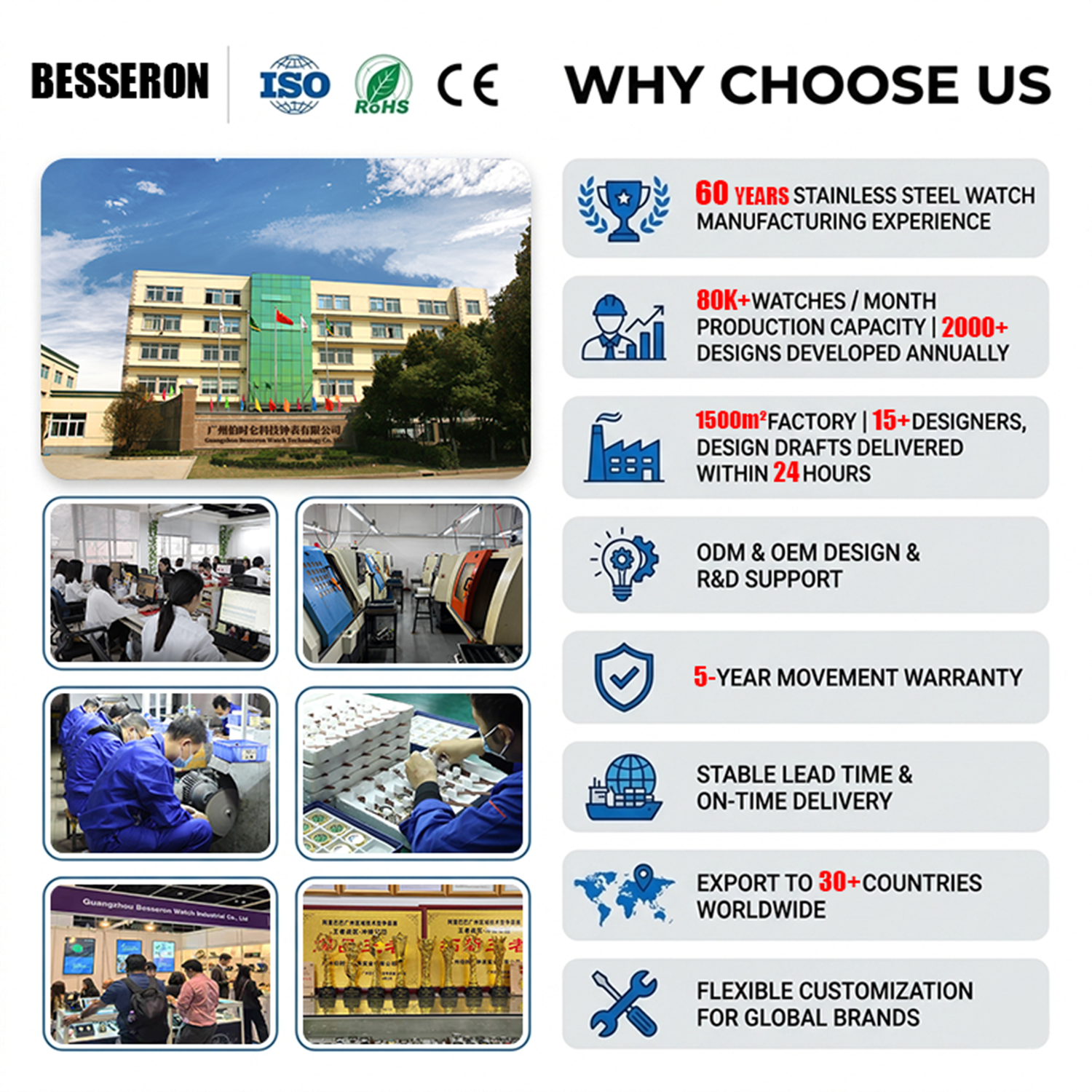
Not every factory can serve an independent brand well. Use this checklist when evaluating manufacturers, and treat it as a risk screen rather than a wish list.
A reputable OEM will answer all seven questions in writing, without hedging. If a factory cannot show you a water-resistance test report or a reference project from a brand like yours, move on. The cheapest quote is rarely the cheapest watch — rework, delayed shipments and specification drift all carry hidden costs that surface later.
Q1: What is the minimum order for a custom minimalist quartz watch? A: Boutique-friendly manufacturers typically quote 100–200 pieces per model for a first order. This lets you launch with one or two colourways, validate demand, and reorder in larger quantities once the line proves itself.
Q2: How long does sampling take? A: Standard sample production takes 15–25 working days after design approval, and you should allow another 2–4 weeks for revisions if changes are requested. Full first-order timelines (sample to delivered goods) are usually 60–75 days.
Q3: Can we print our logo on the dial? A: Yes. Dial printing (pad printing or metal-stamped logo plates) is a standard customization. Applied metal logos are available at slightly higher cost for a more premium look. You will approve a logo sample before production.
Q4: What water resistance should a dress watch have? A: 3 ATM covers hand-washing and rain; 5 ATM is the recommended standard for everyday wear and gives buyers confidence. Claims are tested, not cosmetic — ask for the batch test report.
Q5: Can we mix multiple designs in one order? A: Most OEM factories allow mixed-model or mixed-colourway orders within a single MOQ. This is ideal for testing two dial colours or a men's/unisex sizing split without doubling your commitment.
Ready to build your boutique watch line? Our Guangzhou-based OEM/ODM watch factory specialises in small-batch custom production for independent brands, with CAD previews, physical samples and a dedicated project manager from brief to delivery. [Request a Quote] and receive a free sample kit and specification sheet for your design.

