
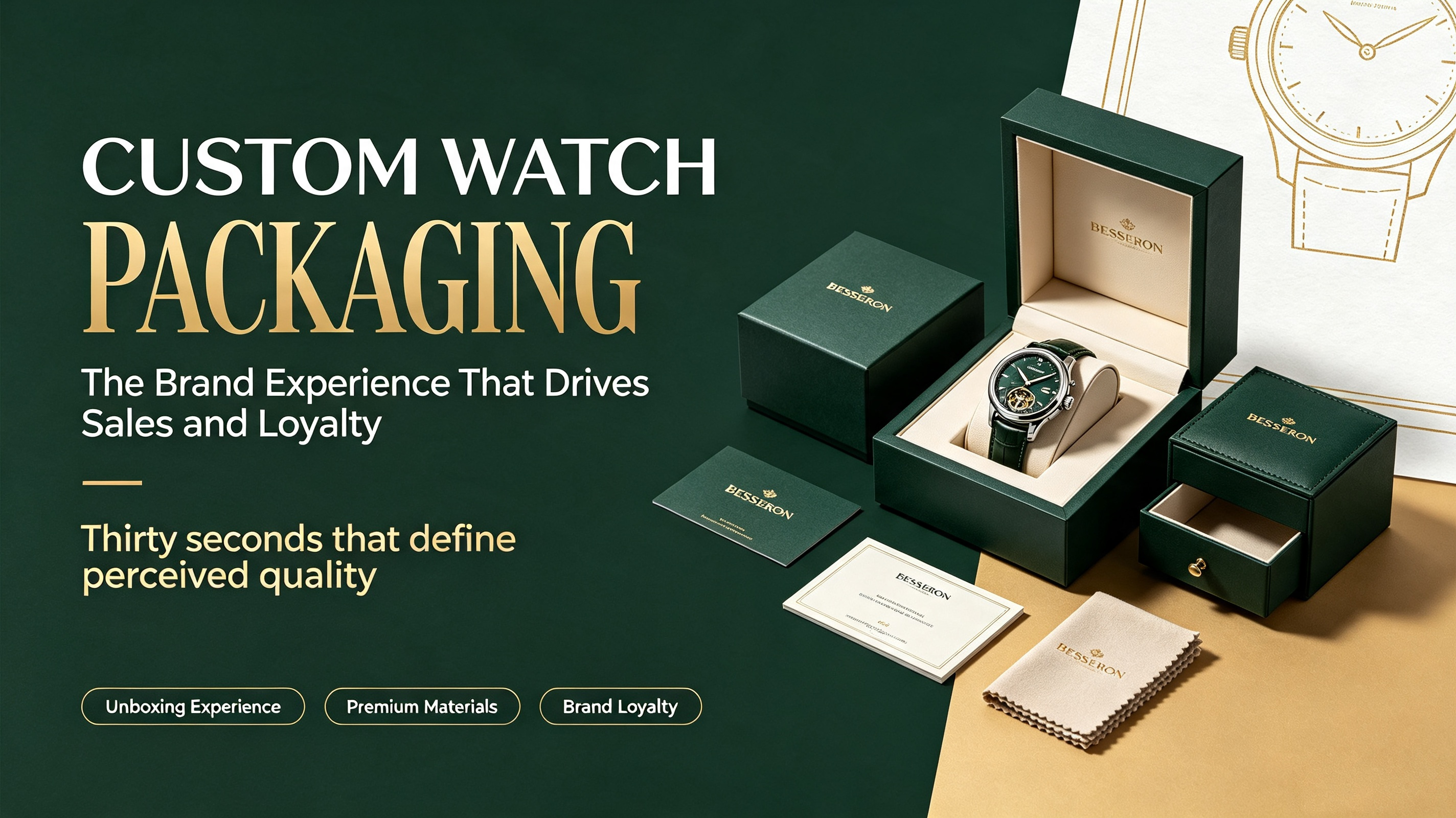
The most undervalued moment in a watch brand's customer journey lasts approximately thirty seconds. It begins when the customer lifts the lid of the shipping box. It ends when the watch is on their wrist and the packaging has been set aside — either carefully, to be kept, or casually, to be discarded. In those thirty seconds, the customer forms a judgment about your brand's quality, attention to detail, and worthiness of the price they paid. That judgment either confirms their purchase decision or plants the first seed of doubt.
Custom watch packaging is not simply a container. It is the physical manifestation of your brand promise. It is the first tactile experience a customer has with your product. And for brands selling through social media — where unboxing videos are among the highest-performing content formats — it is a marketing asset as much as a protective enclosure.
This guide provides watch brand founders with a complete framework for packaging strategy, from material selection and structural design through cost optimization and content integration.
Consider the economics. A watch brand selling 2,000 units per year at an average retail price of 900,000 in annual revenue. If packaging quality reduces the return rate by just two percentage points — from 6% to 4% — the brand saves $18,000 in return processing costs and preserves 40 customer relationships that would otherwise have ended in disappointment. That savings alone typically exceeds the entire annual packaging budget.
Beyond return reduction, premium packaging generates revenue through brand perception. Multiple independent studies have found that consumers rate product quality 20% to 30% higher when the product is presented in premium packaging versus standard packaging — even when the product itself is identical. For a 90 to $135 in retail value. The return on packaging investment is not marginal; it is fundamental to the brand's pricing power.
For a private label watch manufacturer launching a brand on Instagram or TikTok, packaging takes on additional significance. The unboxing video is one of the most effective content formats for organic social media growth. A watch that arrives in a beautifully designed box, with thoughtful details and premium materials, generates unboxing content that viewers want to watch and share. A watch that arrives in a generic black box with foam insert generates content that viewers scroll past. The packaging is literally the first frame of the unboxing video that may reach tens of thousands of potential customers.
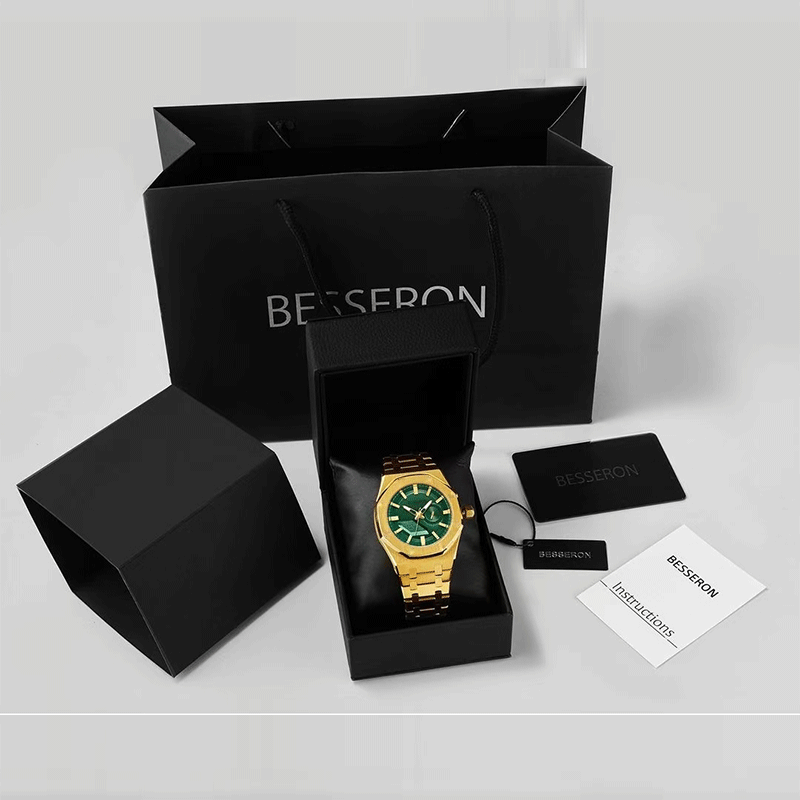
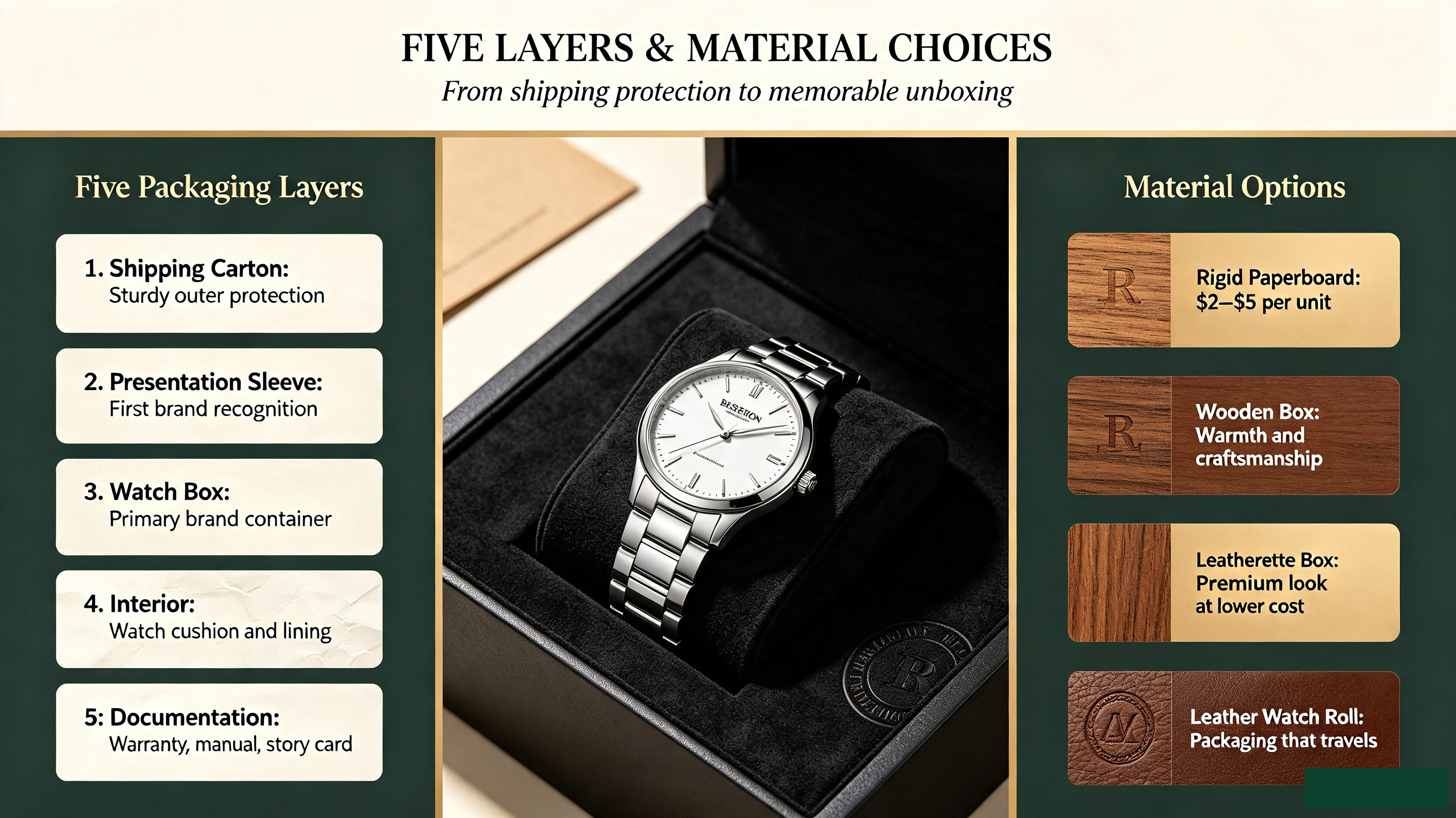
Professional watch packaging is a system, not a box. It comprises five distinct layers, each serving a functional and experiential purpose.
Layer One: The shipping carton. This is the outer box that protects the watch during transit. It should be plain and sturdy. The customer sees it for approximately three seconds before opening it.
Layer Two: The presentation sleeve. This is the branded outer layer — typically a paperboard sleeve printed with the brand logo, pattern, or artwork. The sleeve slides off to reveal the watch box. It creates the first moment of brand recognition and builds anticipation.
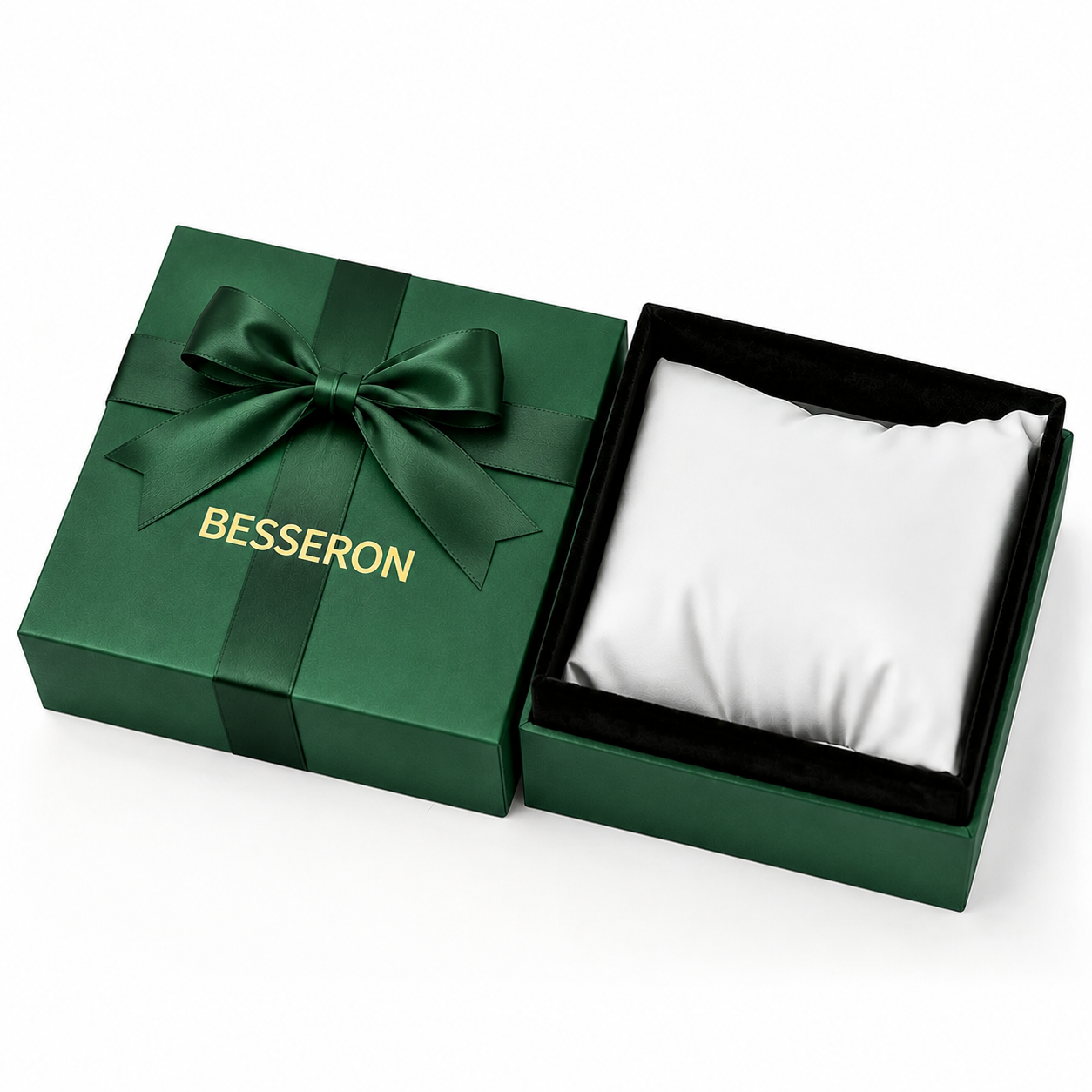
Layer Three: The watch box. This is the primary container. It should be rigid, substantial in weight, and satisfying to open. The box material, color, texture, and opening mechanism communicate brand positioning before the customer sees the watch.
Layer Four: The interior. This includes the watch cushion or holder, the inner lining material, and any compartments for additional straps, warranty cards, or brand materials. The interior should hold the watch securely and present it at the most flattering angle.
Layer Five: The documentation and accessories. This includes the warranty card, instruction manual, brand story booklet, polishing cloth, and any additional items included in the box. These items should be designed with the same attention to detail as the packaging itself.
Material choices define the tactile experience of packaging. The customer's fingertips register texture, density, and temperature within milliseconds of contact.
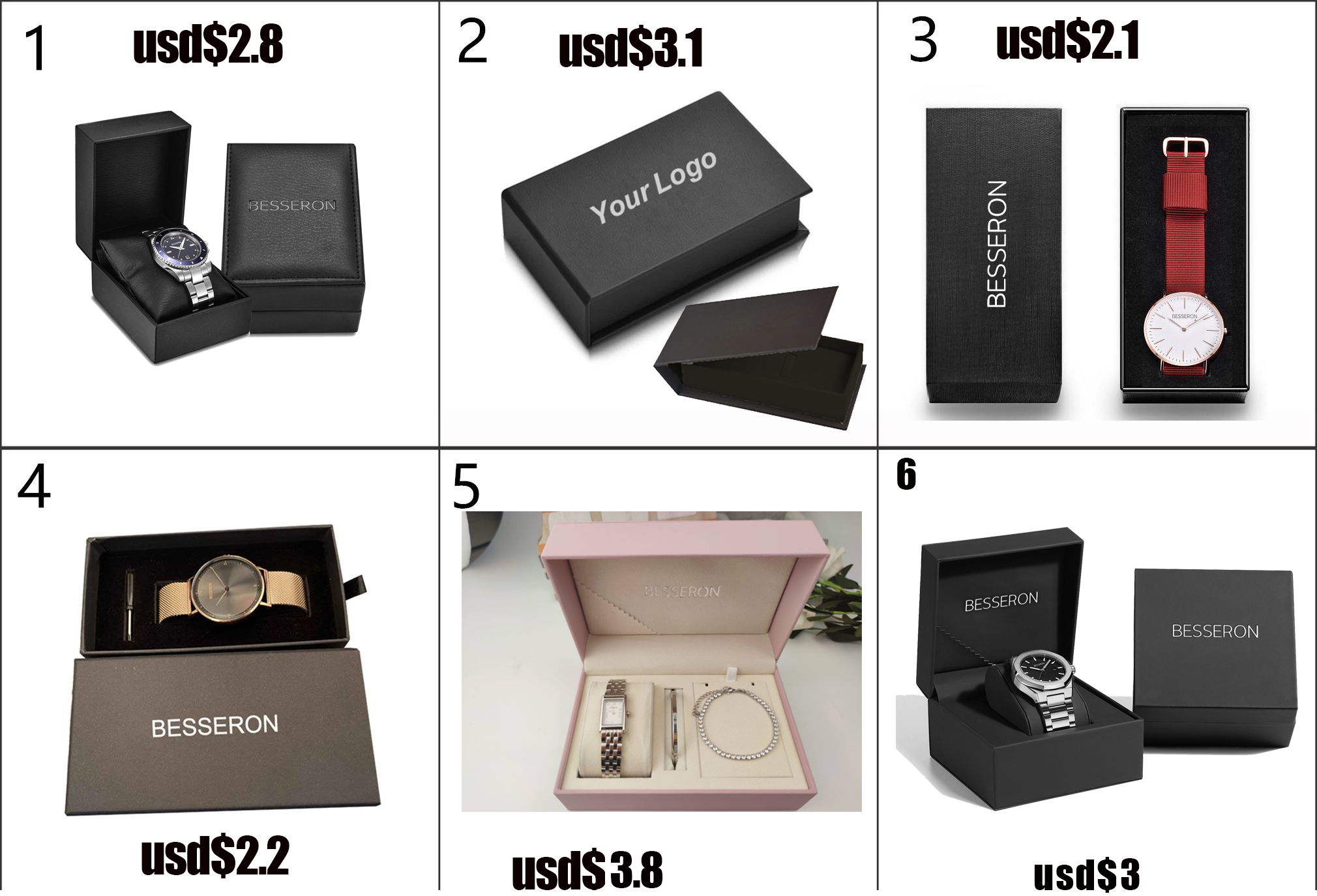
Rigid paperboard boxes — constructed from 2mm to 3mm greyboard wrapped in coated paper — are the standard for mid-range watch packaging. They offer a good balance of perceived quality and cost, with extensive customization options for color, texture, and printing. A well-made rigid box costs 5 per unit at production volumes of 200 to 500 units.
Wooden boxes convey warmth, craftsmanship, and environmental consciousness — particularly when paired with FSC certification. They are heavier and more expensive than paperboard, costing 12 per unit. Wooden boxes are appropriate for heritage-positioned brands and brands emphasizing natural materials and sustainability.
Leather and faux-leather watch rolls represent the premium tier of watch packaging. A leather watch roll serves a dual purpose: it is both packaging and a functional travel accessory. This dual functionality extends the packaging's useful life from thirty seconds to years. Leather rolls cost 20 per unit depending on leather quality and construction.
Leatherette-covered boxes — rigid boxes wrapped in synthetic leather material — offer the aesthetic of leather at a lower cost, typically 8 per unit. They are popular for brands in the 600 retail segment.
FSC-certified and recycled packaging has become a competitive differentiator, particularly for brands targeting the San Francisco, Silicon Valley, and environmentally conscious consumer segments. FSC-certified packaging costs approximately 10% to 20% more than non-certified equivalents, a premium that sustainability-oriented consumers are demonstrably willing to absorb.
The interior of the watch box determines the first moment of product discovery. When the customer lifts the lid, the watch should be presented at an angle that catches the light, with the dial perfectly visible and the strap or bracelet arranged naturally.
Watch cushions hold the watch in position. They should be firm enough to maintain shape but soft enough to avoid marking the strap or bracelet. Velvet, microfiber, or suede-finish cushions in a color that contrasts with the watch case create visual impact. A black or dark grey cushion with a stainless steel watch, or a cream cushion with a rose gold watch, makes the watch the undisputed focal point.
Interior lining covers the inner surfaces of the box. Velvet, flocked paper, or microfiber in a color that complements the brand palette creates a cohesive visual experience. The lining should be smooth and even, with no visible adhesive or wrinkles.
Secondary compartments — for an additional strap, spring bar tool, or polishing cloth — add perceived value and practicality. A brand that ships a watch with a leather strap installed and an additional NATO or rubber strap in a compartment beneath the cushion communicates that it understands how customers actually use their watches.
Every surface of the packaging is an opportunity to reinforce brand identity. The most effective watch packaging uses multiple branding touchpoints without any single one feeling excessive.
Debossing and foil stamping on the box exterior provide a premium tactile element. A brand logo debossed into the box lid in blind (no color) or foil-stamped in gold, silver, or a brand accent color communicates quality before the box is opened. Foil stamping costs approximately 0.80 per box depending on the size of the stamped area.
Interior lid printing — a brand logo, motto, or founding year printed inside the box lid — is visible when the customer opens the box and reinforces brand identity at the moment of product discovery.
Custom warranty cards designed to match the packaging aesthetic complete the brand experience. A warranty card printed on heavy stock with foil stamping costs pennies more than a generic card but communicates professionalism.
Brand story booklets provide an opportunity to tell the founder's story, explain the watch's design philosophy, and create emotional connection. A well-written, well-designed 8-to-12-page booklet adds 1.50 per unit and is one of the highest-ROI elements a brand can include.
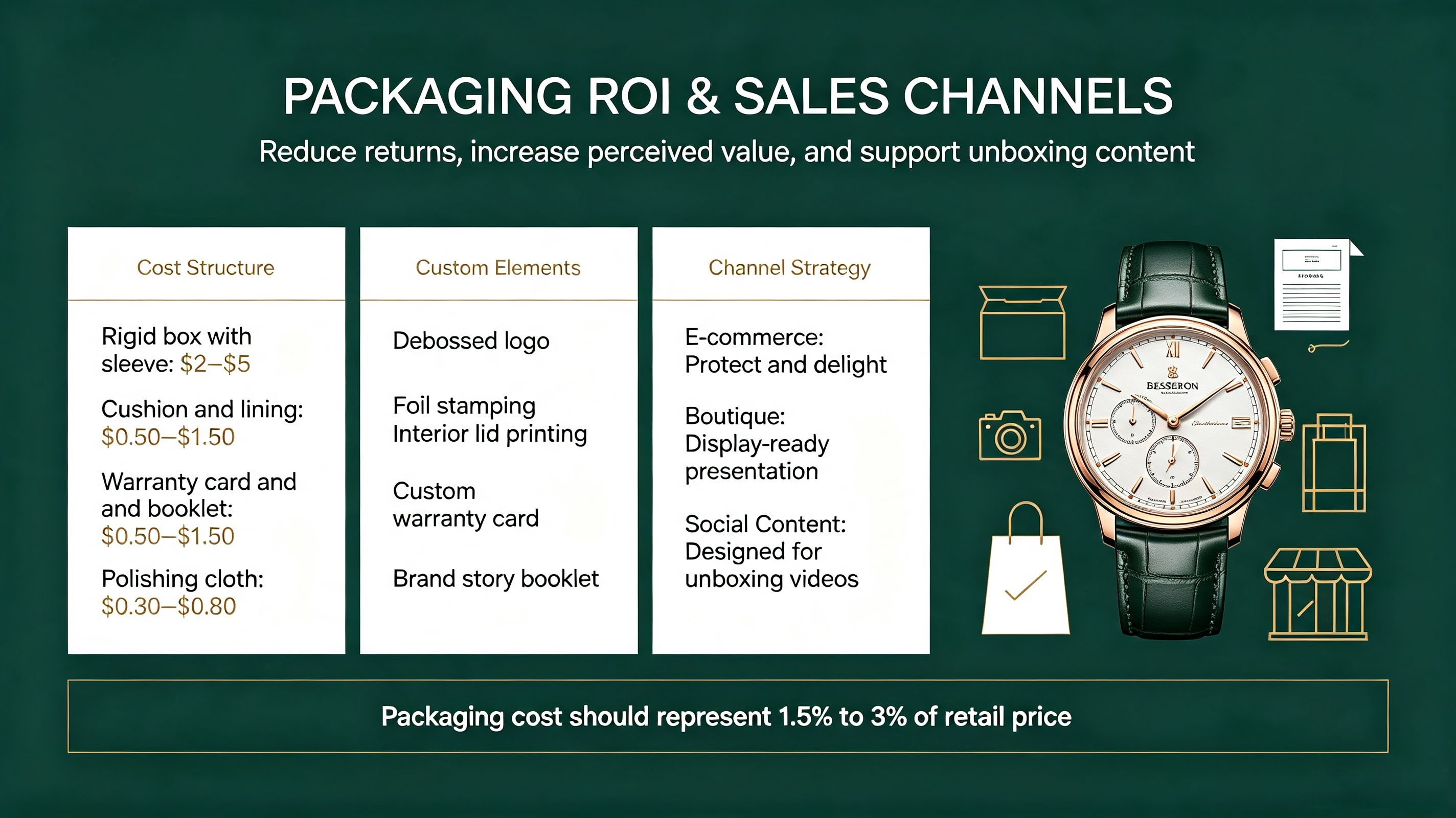
A typical packaging cost for a watch brand in the 600 retail segment ranges from 12 per unit, broken down approximately as follows: rigid box with sleeve (5), watch cushion and interior lining (1.50), warranty card and brand booklet (1.50), polishing cloth (0.80), and secondary compartment or additional elements (3).
The question every brand founder should ask is not "how much does this packaging cost" but "how much additional perceived value does it create versus how many returns does it prevent." At BESSERON, we work with clients to design packaging that maximizes brand impact within their target cost structure, drawing on relationships with specialized watch packaging suppliers who understand the specific requirements of watch presentation.
Packaging requirements differ by sales channel. An e-commerce brand shipping directly to consumers needs packaging that protects the watch during transit and creates a memorable unboxing experience. A wholesale brand selling to boutiques needs packaging that presents the watch effectively in a display case and includes point-of-sale materials. A brand doing both needs packaging that works in both contexts.
At BESSERON, our OEM watch , ODM watch , and Private Label watch programs include packaging design and production as an integrated service. We help clients define their packaging requirements based on their sales channels, brand positioning, and budget, and we manage production from design through delivery.
Q: How much should I budget for watch packaging per unit?
A: For a brand in the 600 retail segment, allocate 10 per unit for packaging. This should cover a rigid paperboard or leatherette box, a sleeve, interior cushion and lining, a warranty card, and a brand booklet. For a brand in the 1,200 segment, allocate 20 per unit. The packaging cost should represent approximately 1.5% to 3% of the retail price. Spending less than 1% risks packaging that undermines the brand's perceived value. Spending more than 4% is unlikely to generate proportional returns.
Q: Can you design and produce packaging as part of the watch manufacturing order?
A: Yes, most custom watch manufacturers offer packaging design and production as part of their service. At BESSERON, we manage the complete packaging process: design consultation, material selection, sampling, production, and delivery coordinated with your watch order. We work with specialized watch packaging suppliers who understand the specific dimensional and protective requirements of timepiece presentation.
Q: What is the minimum order quantity for custom watch packaging?
A: Custom packaging typically has a minimum order of 200 to 500 units due to the setup costs involved in printing plates, die-cutting tools, and foil stamping dies. For brands launching with smaller volumes (50 to 100 units), semi-custom options are available: using a standard box structure with custom printing and foil stamping, which reduces the MOQ to match the watch production quantity.
Q: How do I make my packaging stand out in unboxing videos?
A: Focus on the moments that get the most screen time in unboxing videos: the sleeve slide-off (use textured paper or a ribbon pull), the lid opening (ensure smooth, slow-open hinge action), the watch reveal (ensure the watch is perfectly positioned and lit by the box angle), and the surprise element (an unexpected detail like a hidden compartment, a founder's note card, or a secondary strap). Every second of an unboxing video is content. Design your packaging to make every second visually compelling.
Q: Is sustainable packaging worth the cost premium?
A: For brands targeting the Silicon Valley, San Francisco, or environmentally conscious market segments, yes — the premium is justified. FSC-certified packaging, recycled materials, and plastic-free construction communicate values that align with these consumers' purchasing criteria. For brands in other market segments, sustainable packaging is becoming a baseline expectation rather than a differentiator. The brands that invest now will be ahead of the curve as sustainability requirements become standard across the industry.
Ready to create packaging that elevates your brand? Contact BESSERON to discuss custom packaging design and production for your OEM, ODM, or Private Label watch manufacturing project.

