
Sustainability has moved from the periphery to the center of consumer purchasing decisions, and the watch industry is no exception. A 2024 survey of US watch buyers found that 47% of consumers under 45 consider a brand's environmental practices when making a purchase decision in the 1,500 price range. Among purchasers in the San Francisco Bay Area and Silicon Valley — where sustainability consciousness intersects with high disposable income — that figure rises to 62%.
For watch brand founders, these numbers present both an opportunity and a risk. The opportunity lies in capturing the growing segment of consumers who actively seek out brands that align with their environmental values. The risk lies in making sustainability claims that cannot be substantiated — greenwashing, in the increasingly scrutinized language of consumer protection — and facing the legal and reputational consequences that follow.
This guide provides watch brand founders with a practical framework for integrating genuine sustainability into their manufacturing operations. It covers materials, processes, certifications, and communication strategies, with specific attention to the regulatory environment that governs environmental claims in the United States market.
The environmental footprint of a wristwatch is concentrated in its material supply chain. Stainless steel production is energy-intensive, generating approximately 1.9 tons of CO2 per ton of steel produced. Leather strap production involves the environmental impacts of cattle farming — estimated at approximately 30 kilograms of CO2 equivalent per square meter of finished leather. Watch packaging, often comprising multiple layers of plastic, foam, and coated paper, adds further environmental burden.
The cumulative impact is significant at scale. A watch brand selling 5,000 units per year with conventional materials and packaging generates an estimated 35 to 50 tons of CO2 equivalent annually from its product supply chain alone — before accounting for shipping, retail operations, or end-of-life disposal.
Brand founders who address these impacts early in their development process gain a structural advantage over competitors who are forced to retrofit sustainability into established supply chains. They can select materials, design packaging, and communicate their environmental story from the ground up rather than attempting to modify existing products and narratives.
The most impactful sustainability decisions in watch manufacturing are material decisions. The materials that make up your watch — case, dial, strap, crystal, and packaging — represent the majority of its environmental footprint and the most visible elements of your sustainability story.
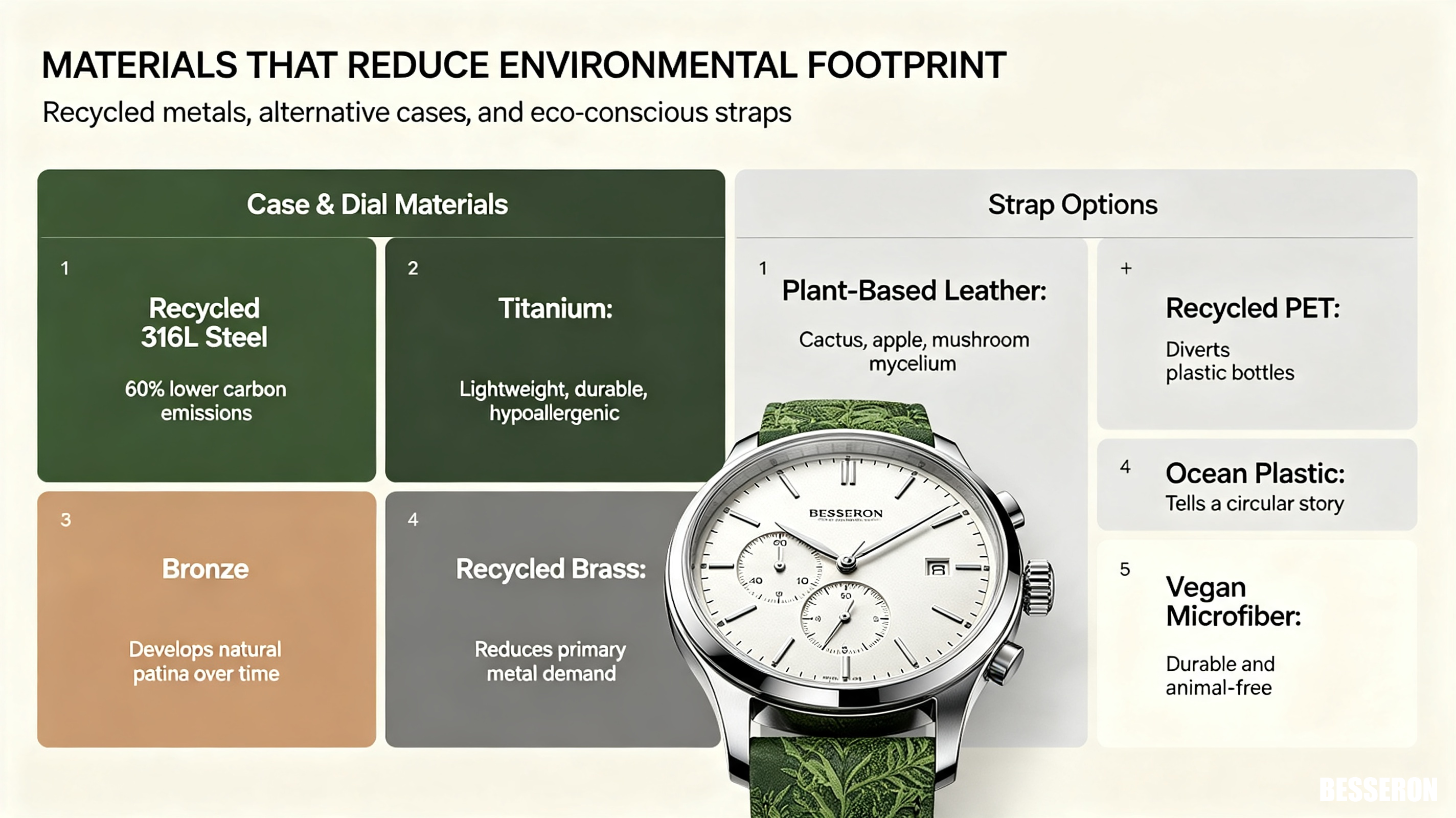
Recycled 316L stainless steel offers the same mechanical properties and corrosion resistance as virgin 316L — identical hardness, identical polishability, identical hypoallergenic characteristics — with approximately 60% lower carbon emissions in production. The recycled material is melted and re-formed into bar stock suitable for CNC machining or cold extrusion, producing cases that are metallurgically indistinguishable from virgin-material cases.
For watch brands targeting the 1,200 retail segment, recycled 316L represents the most immediately actionable sustainability improvement. It requires no change to case design, no adjustment to watch manufacturing processes, and no compromise in quality. The only difference is the material's provenance and its environmental impact. At BESSERON, we offer recycled 316L stainless steel as a standard option for OEM watch and ODM watch case production, supported by material traceability documentation from certified recycling sources.
Grade 5 titanium offers an appealing sustainability profile alongside its well-known performance advantages. Titanium is lighter than steel, stronger by weight, completely hypoallergenic, and highly corrosion-resistant. From an environmental perspective, titanium's durability means a longer product lifespan, reducing replacement frequency and the associated manufacturing impacts.
CuSn8 bronze — an alloy of copper and tin — offers a different kind of sustainability story. Bronze develops a natural patina over time, creating a watch that evolves with its owner rather than one that is discarded when it shows wear. The patina process extends the emotional lifespan of the product, which translates into extended physical lifespan and reduced consumption.
Dial sustainability is an emerging frontier. While traditional brass dials with galvanic plating are already quite durable, brands seeking to differentiate on sustainability have begun exploring alternative materials. Recycled brass dials use post-industrial brass scrap as the base material, reducing primary metal demand. FSC-certified wood veneer dials use sustainably harvested wood as a visual element, though they are appropriate only for specific design languages.
Watch straps represent a disproportionate share of the sustainability conversation because they are the most frequently replaced component of a watch and the component most visible to the consumer at the point of sale.
Vegan leather — typically polyurethane or microfiber-based — eliminates animal agriculture impacts but introduces petrochemical-derived materials that do not biodegrade. Plant-based leather alternatives, made from cactus (Desserto), apple waste, pineapple leaf fiber (Piñatex), or mushroom mycelium (Mylo), offer a more environmentally complete solution. These materials are renewable, biodegradable under industrial composting conditions, and free from the ethical concerns associated with animal leather. Their durability and feel have improved significantly over the past three years, and they are now suitable for watch straps in all but the most demanding applications.
Recycled PET fabric straps, made from post-consumer plastic bottles, offer a sport-casual aesthetic with strong sustainability credentials. Each strap diverts approximately three to five plastic bottles from landfill or ocean disposal. These straps are popular for dive watches and outdoor-oriented designs, though they are less appropriate for dress watches where leather remains the expectation.
Recycled ocean plastic has emerged as a material with particular resonance for dive watch brands. Straps incorporating recovered ocean-bound plastic tell a story that directly connects the product to the environmental cause it supports. The material's visual texture — often a speckled pattern that reveals its recycled origin — becomes a design feature rather than a compromise.
Watch packaging has historically been an environmental embarrassment. Oversized boxes, multiple layers of foam and plastic, non-recyclable mixed-material constructions, embedded magnets that complicate recycling — the traditional luxury watch box was designed for the unboxing experience with no consideration for its post-unboxing fate.
Sustainable packaging approaches the problem differently. The goal is to deliver an unboxing experience that feels premium and on-brand while ensuring that every component of the packaging can be recycled, composted, or reused.
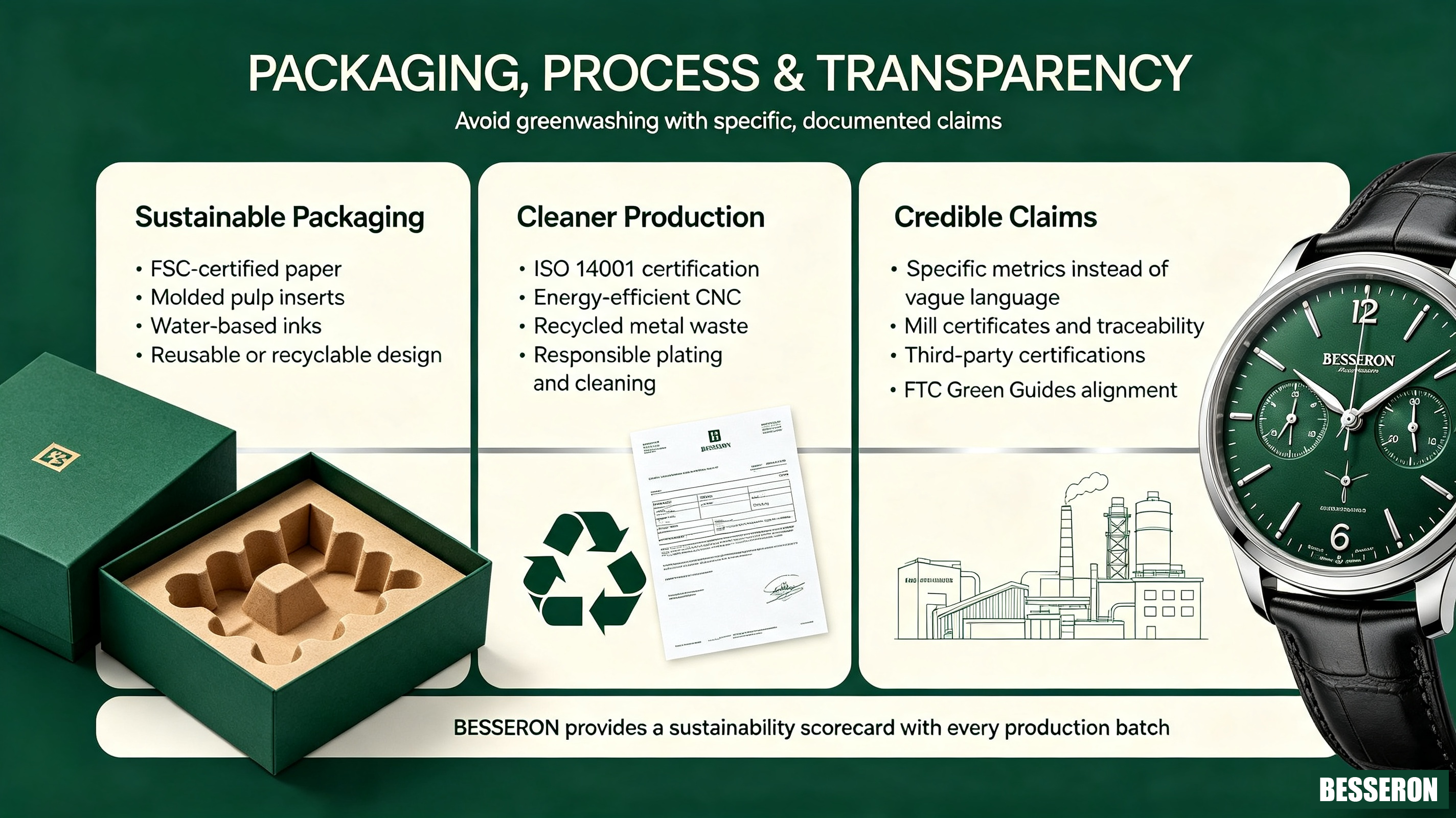
FSC-certified paper packaging uses cardboard and paperboard from forests managed to the standards of the Forest Stewardship Council. The certification ensures that the paper source does not contribute to deforestation and that the forestry operation meets social and environmental criteria.
Molded pulp inserts, made from recycled paper or agricultural waste fiber, replace the foam and plastic inserts that traditionally hold the watch in position. Molded pulp can be shaped to fit the watch precisely, can be dyed to brand colors using water-based inks, and is fully recyclable and compostable.
Multi-function packaging extends the useful life of the packaging beyond the unboxing moment. A watch box that doubles as a travel case, a watch roll that serves as an everyday storage solution, or a packaging sleeve that unfolds into a brand story poster — these approaches convert what would be waste into a retained brand touchpoint.
Beyond materials, the manufacturing process itself offers sustainability improvement opportunities that brands should evaluate when selecting a manufacturing partner.
Energy management in watch manufacturing involves both the source and the efficiency of energy used in production. CNC machining is electricity-intensive. A manufacturer that sources renewable energy or maintains energy management certification demonstrates commitment that goes beyond material choices.
Water and chemical management is particularly relevant for the plating and cleaning stages of watch production. Electroplating baths contain metal salts and acids that require careful treatment before discharge. Even basic cleaning solvents used in dial and case preparation must be managed to prevent environmental contamination. ISO 14001 environmental management certification provides third-party verification that a manufacturer maintains proper waste management and pollution prevention systems.
Waste reduction in watch manufacturing focuses on material yield optimization. CNC machining of watch cases from bar stock inevitably produces metal waste in the form of chips and swarf. Cold extrusion produces significantly less waste because the metal is formed near-net-shape rather than cut away. Manufacturers that recycle their metal waste back into the supply chain further reduce the environmental footprint.
The regulatory and reputational risks of overstated environmental claims are real and growing. The US Federal Trade Commission's Green Guides provide the framework for evaluating environmental marketing claims. A claim that a product is "eco-friendly" or "sustainable" without qualification is considered deceptive if it is not supported by evidence that the product has significant environmental benefits.
Specificity is the antidote to greenwashing. Instead of claiming that your watch is "sustainable," claim that "the case is manufactured from 80% recycled 316L stainless steel, verified by mill certificates." Instead of claiming that your packaging is "eco-friendly," claim that "all packaging components are FSC-certified and recyclable through standard municipal recycling streams."
Third-party certification converts environmental claims from marketing assertions into verifiable facts. Relevant certifications for watch brands include FSC for paper packaging, GOTS for organic textile straps, OEKO-TEX for textile safety, and Recycled Content Certification for recycled materials.
Transparency about limitations builds more credibility than silence about trade-offs. If your watch case is recycled steel but your strap is conventional leather, acknowledge both. Consumers are sophisticated enough to understand that sustainability is a journey, not a binary state. The brands that earn trust are those that honestly describe where they are on that journey.
At BESSERON, we view sustainability not as a marketing overlay but as a manufacturing discipline. Our approach is built on measurable, verifiable improvements across our production operations.
As our production director explains: "Sustainability in watchmaking is not about swapping a steel case for recycled steel. It is about rethinking the entire production footprint — from the energy that powers our CNC machines to the solvents we use for dial cleaning. We are ISO 14001 certified, and every OEM and ODM client receives a sustainability scorecard for their production batch. That scorecard quantifies the recycled content, the packaging recyclability, and the energy efficiency of the production run. It turns sustainability from a vague promise into a documented fact."
Our standard watch manufacturing options now include recycled 316L stainless steel for case production, FSC-certified packaging in custom designs, and partnerships with sustainable strap material suppliers offering plant-based leathers, recycled PET, and ocean-plastic-derived materials. For brands that want to go further, we develop custom sustainability programs that address the specific environmental priorities of their target market.
Q: Does using recycled stainless steel affect the quality or appearance of watch cases?
A: No. Recycled 316L stainless steel is metallurgically identical to virgin 316L. It offers the same hardness, the same corrosion resistance, the same polishability, and the same hypoallergenic properties. Under a microscope, a case made from recycled 316L is indistinguishable from one made from virgin material. The only difference is the environmental footprint, which is approximately 60% lower for recycled material. We provide mill certificates documenting the recycled content percentage for every production batch.
Q: What certifications should I look for in sustainable watch packaging?
A: At minimum, look for FSC certification for paper and cardboard components, which verifies that the material comes from responsibly managed forests. If your packaging uses textile elements, GOTS (Global Organic Textile Standard) certification verifies organic fiber content and environmentally responsible processing. For recycled content claims, look for certification from organizations like SCS Global Services or UL Environment. Avoid packaging that combines materials in ways that prevent recycling — for example, paper laminated with plastic film or cardboard with embedded magnets that contaminate the paper recycling stream.
Q: How much does sustainable manufacturing add to the cost per watch?
A: The cost premium varies by component. Recycled 316L stainless steel adds approximately 10% to 15% to the case material cost, which translates to roughly 4 per case. FSC-certified packaging typically adds 3 per unit. Plant-based leather straps add 8 per strap compared to conventional leather. The cumulative premium for a fully sustainability-optimized watch typically ranges from 20 per unit at the FOB level. For a watch retailing at 800, this represents 1% to 2.5% of the retail price — a modest premium that the growing segment of sustainability-conscious consumers is demonstrably willing to pay.
Q: Can I claim my watch is "sustainable" on my website and marketing materials?
A: Be extremely careful with unqualified sustainability claims. Under the FTC Green Guides, broad claims like "sustainable," "eco-friendly," or "green" should be supported by evidence that the product has significant environmental benefits across its lifecycle. The safer approach is to make specific, verifiable claims: "Case made from 80% recycled 316L stainless steel," "Packaging is 100% FSC-certified and recyclable," "Strap made from recycled ocean-bound plastic." Specific claims backed by documentation are both more credible to consumers and less risky from a regulatory perspective.
Q: How do I verify that recycled materials are actually recycled and not just claimed to be?
A: Require material traceability documentation from your manufacturer. This includes mill certificates showing recycled content percentages for metals and chain-of-custody certifications for paper and textile materials. Third-party certification bodies like SCS Global Services provide independent verification of recycled content claims. At BESSERON, we provide complete material traceability documentation with every order, including mill certificates for recycled metals and FSC chain-of-custody certificates for sustainable packaging.
Interested in building a sustainable watch brand? Contact BESSERON to discuss eco-friendly OEM, ODM, and Private Label watch manufacturing solutions with recycled materials, sustainable packaging, and complete environmental documentation.

