
In the competitive world of American horology, where brands from Manhattan to Beverly Hills battle for consumer trust, the difference between a disposable fashion accessory and a generational heirloom is measured in microns. For the professional procurement officer or the technical founder of a Silicon Valley design label, the vetting process for high end watch manufacturers goes far beyond catalog photos and price lists. It is a forensic examination of metallurgy, optical engineering, surface finishing science, and quality control architecture.
At BESSERON WATCH MANUFACTURER, we understand that our most demanding clients speak the language of specifications. They ask about Vickers Hardness values, not just "scratch resistance." They inquire about PVD coating thickness in microns, not just "gold color." This technical guide is designed for those buyers—the ones who know that the true value of a luxury watches manufacturer lies in its mastery of materials and its refusal to compromise on process integrity.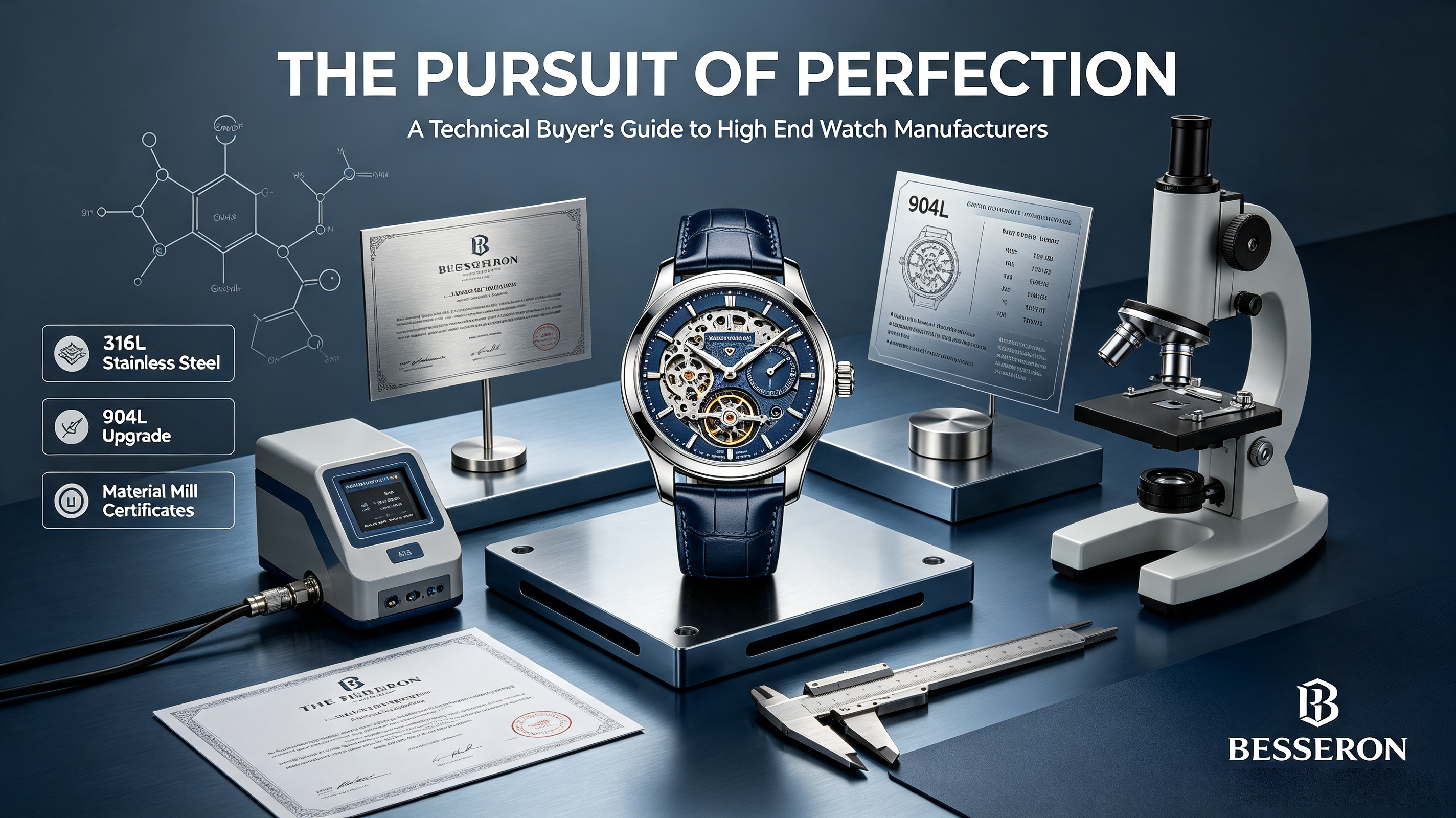
The foundation of every high-end timepiece is its case material. For quality watch manufacturers targeting the US market, 316L stainless steel is not merely an option—it is the entry ticket to the mid-to-high-end segment.
316L derives its superior properties from its precise alloy formulation. The "L" designation stands for "Low Carbon," which is crucial because it prevents "Intergranular Corrosion"—a form of degradation that occurs when carbon reacts with chromium at the grain boundaries of the steel during welding or high-temperature processing. For watch cases, this means:
At BESSERON, every shipment of raw 316L steel arrives with a Material Mill Certificate verifying its exact chemical composition. We reject any batch that deviates from our internal specification, which is intentionally tighter than the industry standard.
For brands positioning themselves in the "Ultra-Luxury" tier alongside the most prestigious Swiss houses, BESSERON offers 904L Stainless Steel as an upgrade option.
904L contains significantly higher levels of nickel (23-28%), chromium (19-23%), and copper (4-5%). This formulation provides:
As high end watch manufacturers, we guide our clients through this material decision based on their target retail price point and brand positioning. For a 800 microbrand, 316L offers the optimal balance. For a $1,500+ private label, 904L delivers the differentiation that justifies the premium.
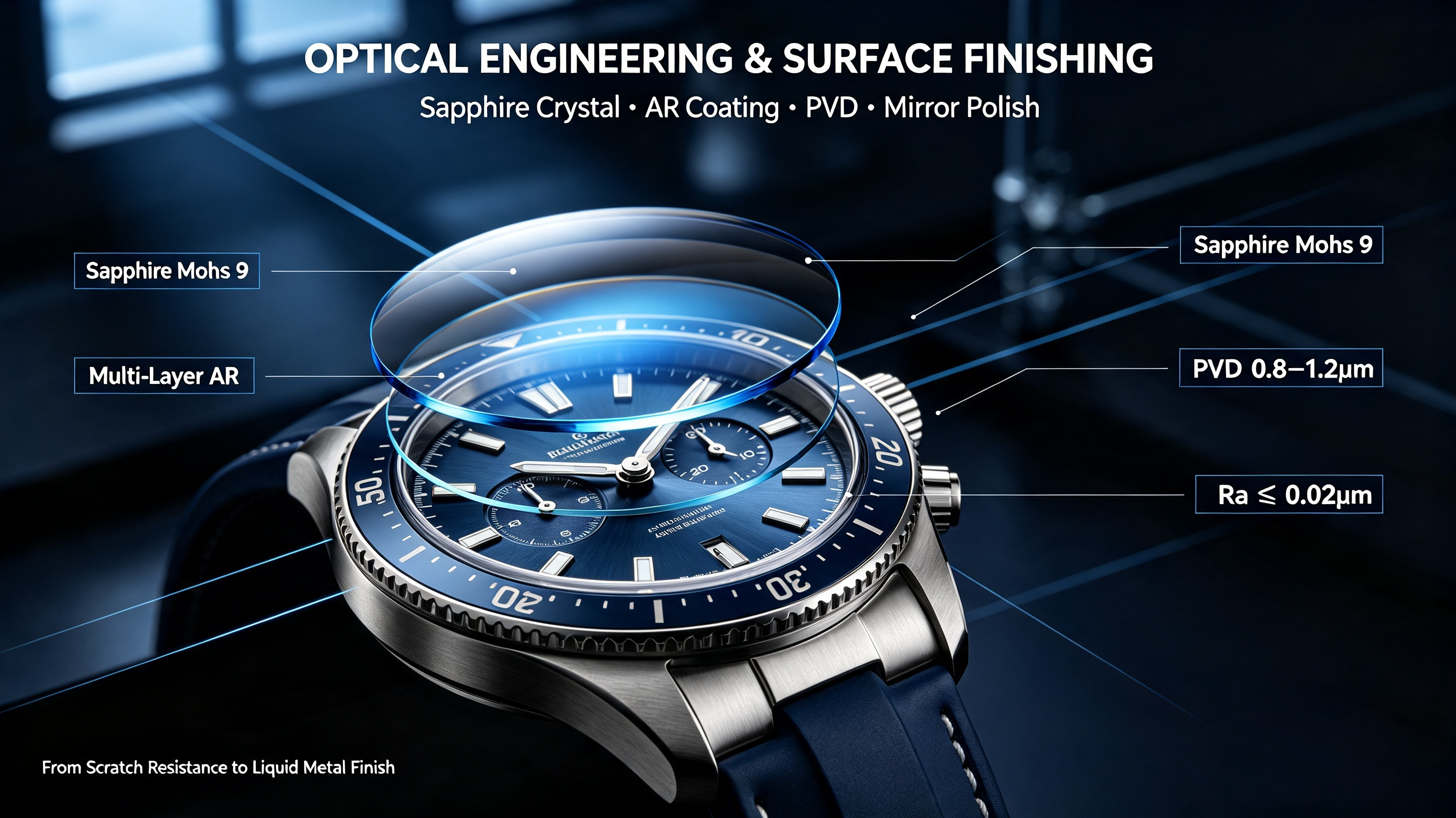
Nothing undermines the luxury perception of a timepiece faster than a scratched crystal or excessive glare that obscures the dial. Professional quality watch manufacturers understand that the crystal is both a protective shield and an optical instrument.
We offer a tiered AR coating strategy based on your brand's price point:
At BESSERON WATCH MANUFACTURER, we believe that finishing is where engineering becomes art. Our Master Finisher, with over 30 years of hands-on experience in the polishing workshops of the Pearl River Delta, explains the discipline:
"Our lead engineer emphasizes that in high-end watch manufacturing, 'Finishing' is not decoration—it is dimensional precision. When we execute a 'Mirror Polish' on a 316L case, we are not simply making it shiny; we are removing micro-scratches until the surface roughness (Ra) measures less than 0.02 microns. When we apply 'Satin Brushing,' we are using specialized abrasive belts at precisely controlled angles to create parallel hairlines that are uniform to within ±0.5 degrees. This level of control ensures that every watch in a 1,000-piece batch is optically identical—a non-negotiable requirement for brands selling through boutique retail chains in Manhattan."
This obsession with measurable quality is why BESSERON has earned worldwide recognition as a luxury watches manufacturer trusted by the most discerning B2B clients.
One of the most frequent complaints from B2B buyers who switch to BESSERON from lower-tier suppliers is the "Rapid Fading" of gold and rose gold watches. The root cause is almost always an inferior plating process.
For technical buyers, the "Cleanroom" is the single most important differentiator between a true high end watch manufacturer and an assembler of parts. Dust under the crystal is the #1 cosmetic defect in the watch industry and the #1 cause of consumer returns for microbrands.
This investment in assembly infrastructure is what allows BESSERON to guarantee a "Zero Visible Dust" standard for every watch that ships to the US.
"Quality Control" is often a marketing slogan. At a professional quality watch manufacturer, it is a documented, auditable process with defined gates and rejection criteria.
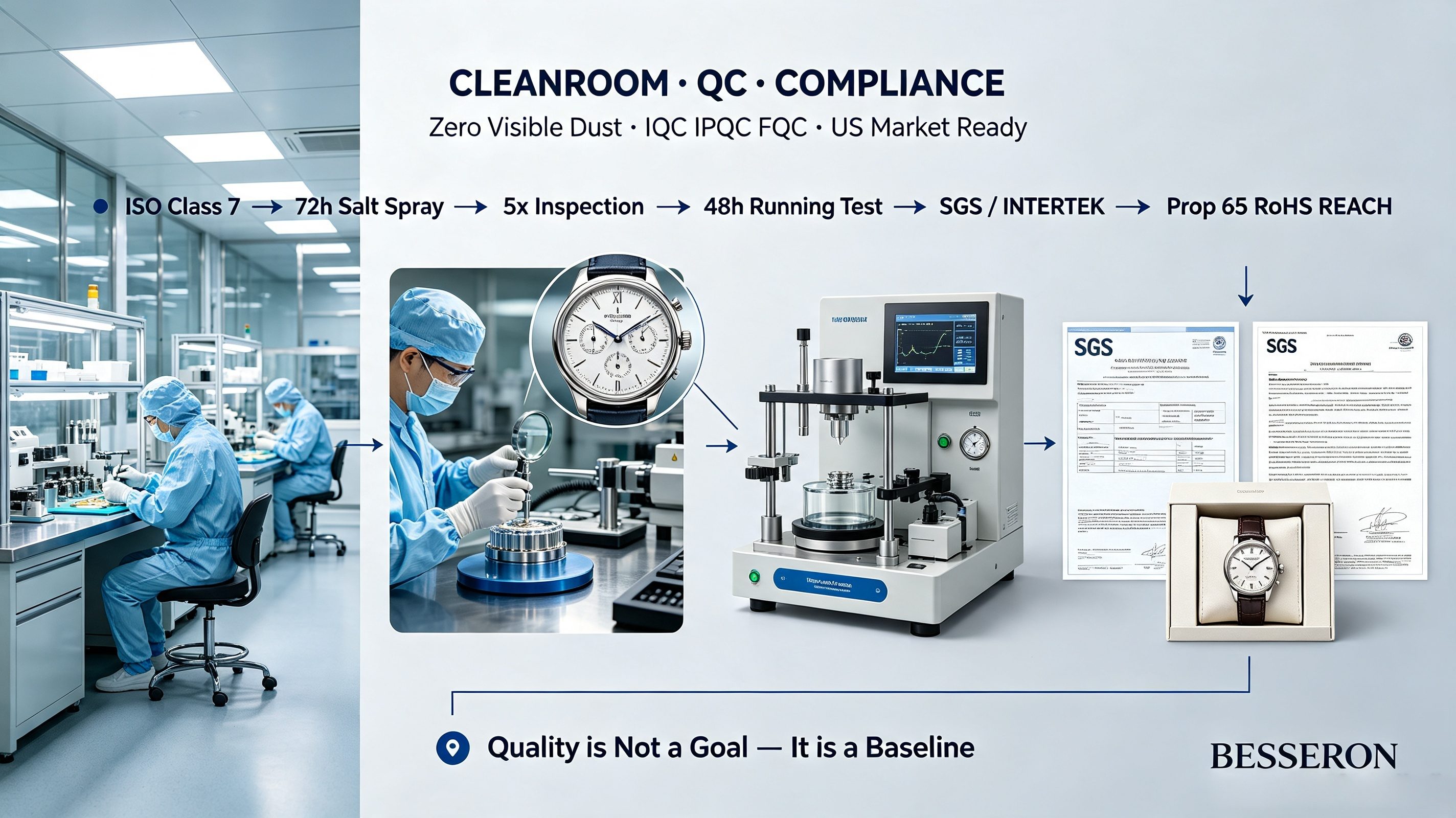
Any batch that exhibits a defect rate above 0.5% is subjected to 100% re-inspection before release.
For US brands, "Material Quality" extends beyond aesthetics to legal safety. California's Proposition 65 is the most stringent consumer safety law in the United States, and failure to comply can result in litigation with penalties exceeding $2,500 per violation per day.
BESSERON ensures material compliance through:
We provide our B2B clients with a complete compliance documentation package, giving them the confidence to sell through any retail channel in California, New York, or anywhere in the United States.
In the luxury watch market, there are no shortcuts. A brand's reputation is built over years and can be destroyed by a single batch of products that fail to meet the promised standard. This is why the most successful brands in Manhattan, Beverly Hills, and Silicon Valley choose their manufacturing partners not by the lowest quote, but by the highest commitment to material integrity and process excellence.
BESSERON WATCH MANUFACTURER embodies that commitment. From 316L stainless steel metallurgy and Sapphire Crystal optics to ISO 9227 salt spray testing and Prop 65 compliance, we provide the technical depth that professional quality control buyers demand. When your brand's future depends on perfection, partner with a luxury watches manufacturer that treats quality not as a goal, but as a baseline.
Q1: What is the surface roughness (Ra) of your mirror-polished 316L cases? A1: Our mirror polishing process achieves a surface roughness of Ra ≤ 0.02 microns, measured using a Mitutoyo profilometer. This is comparable to the finishing standards of high-end Swiss manufacturers and ensures the "Liquid Metal" aesthetic that luxury consumers expect.
Q2: How do you verify the authenticity of your Sapphire Crystal? A2: Every Sapphire Crystal batch is tested using a thermal conductivity meter. Sapphire has a distinct thermal profile compared to mineral glass. Additionally, we verify the Mohs hardness through scratch testing with a tungsten carbide stylus (Mohs 8), which cannot scratch true sapphire.
Q3: Can you provide individual Timegrapher reports for each watch in our order? A3: Yes. For our premium mechanical lines using the Miyota 9015 or Seiko NH35, we can provide individual timegrapher readouts showing daily rate (seconds/day), amplitude, and beat error for every single unit. For larger orders, we typically provide a comprehensive batch statistical report.
Q4: How do you ensure color consistency across different batches of PVD gold watches? A4: We use a spectrophotometer to measure the CIELAB color values of our PVD coatings. Every production batch is referenced against a "Master Gold Standard" panel, ensuring that the color of batch #100 matches batch #1 to within a Delta E of ≤ 1.5—a difference imperceptible to the human eye.
Q5: What is your policy if a batch fails your internal FQC standards? A5: If a batch exhibits a defect rate exceeding our 0.5% threshold, we conduct a 100% re-inspection and rework of the entire batch. The client is informed immediately, and we absorb the cost of the delay. BESSERON never ships a batch that does not meet our agreed-upon quality specifications.

