
Every independent watch brand founder eventually faces the same turning point. You have the vision. You have the brand identity mapped out. You may even have preliminary sketches of your first three collections pinned to your studio wall in Manhattan's Garment District. But unless you can translate those sketches into timepieces that meet the expectations of buyers accustomed to shopping on Fifth Avenue, none of it matters.
The single most consequential decision you will make as a watch brand owner is not your logo, not your packaging, not even your price point. It is choosing the right luxury watch manufacturer.
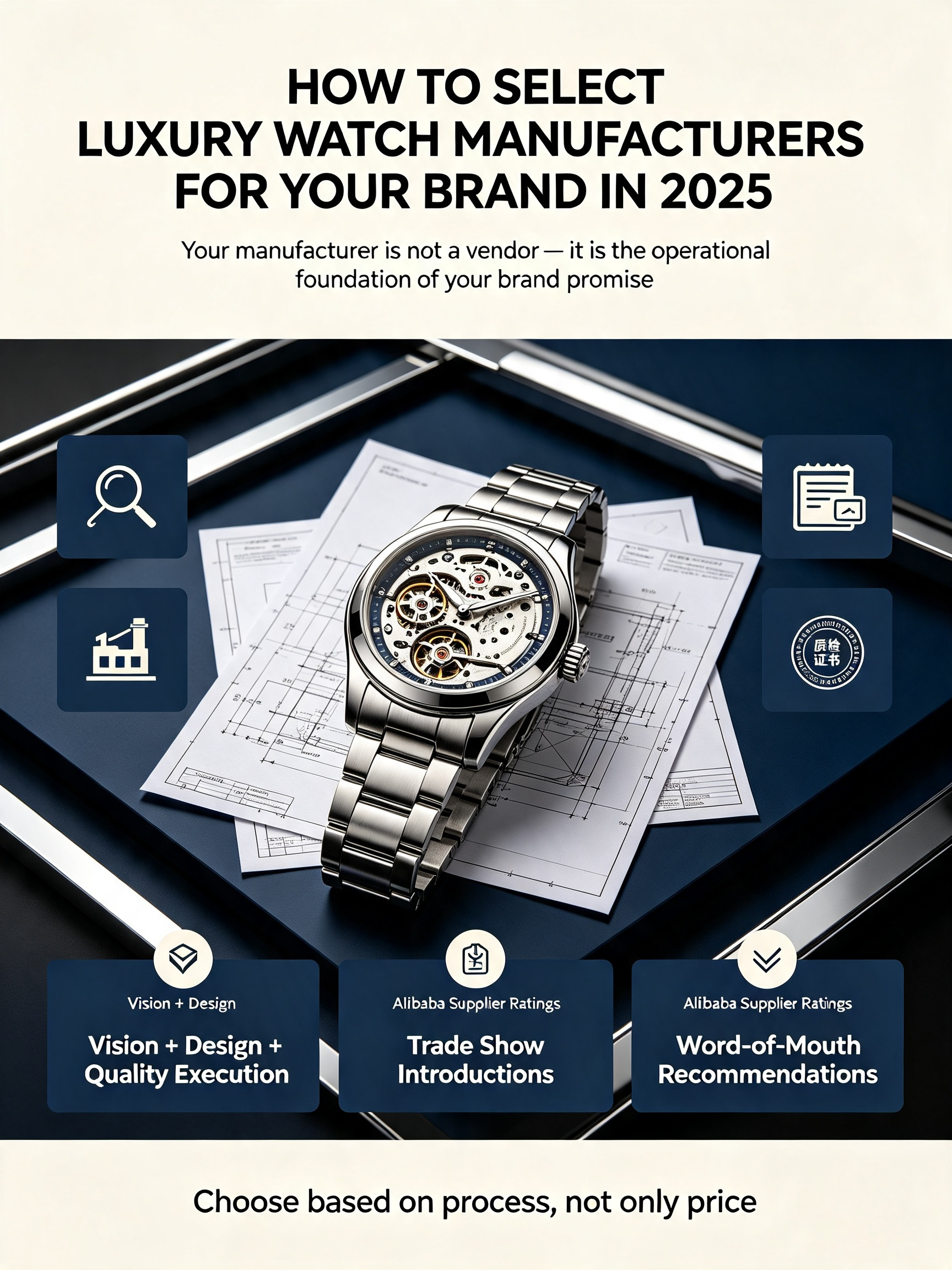
Yet most first-time brand founders approach this decision with surprisingly little structured guidance. They rely on trade show introductions, Alibaba supplier ratings, and word-of-mouth recommendations from other brand owners who may have entirely different quality requirements. This article is designed to change that. It provides a systematic framework for evaluating luxury watch manufacturers, built from fifteen years of OEM and ODM manufacturing experience serving brands that retail on Madison Avenue, in Beverly Hills boutiques, and through premium direct-to-consumer channels.
Consider the case of a Manhattan-based brand that launched in 2023 with a $1,200 dress watch. The founder had spent eighteen months perfecting the design: a 39mm cushion case, a sector dial with applied Breguet numerals, a display case back revealing a decorated Miyota 9015 movement. The photography was stunning. The launch event at a SoHo gallery sold out. But within six weeks, returns began arriving.
The issue was not design. The issue was that the manufacturer had used a standard crown tube with rubber gaskets rated for 30 meters, but had not pressure-tested every case individually. On paper, the watch was a 5ATM piece. In reality, one in seven units fogged up after hand-washing. The brand's Trustpilot score dropped from 4.8 to 3.1 in three months. The founder spent $47,000 on replacement units and brand reputation repair.
This outcome was entirely preventable. A manufacturer with ISO 9001-certified processes and individual pressure-testing protocols would have caught every defective unit before it left the factory floor. The lesson is clear: in the luxury watch business, your manufacturer is not simply a vendor. Your manufacturer is the operational foundation of your brand promise.
When you are selling to buyers who walk into a Beverly Hills boutique expecting Swiss-level finish quality, the margin for manufacturing error is effectively zero. A single visible flaw on a display model can cost you a wholesale account worth six figures annually.
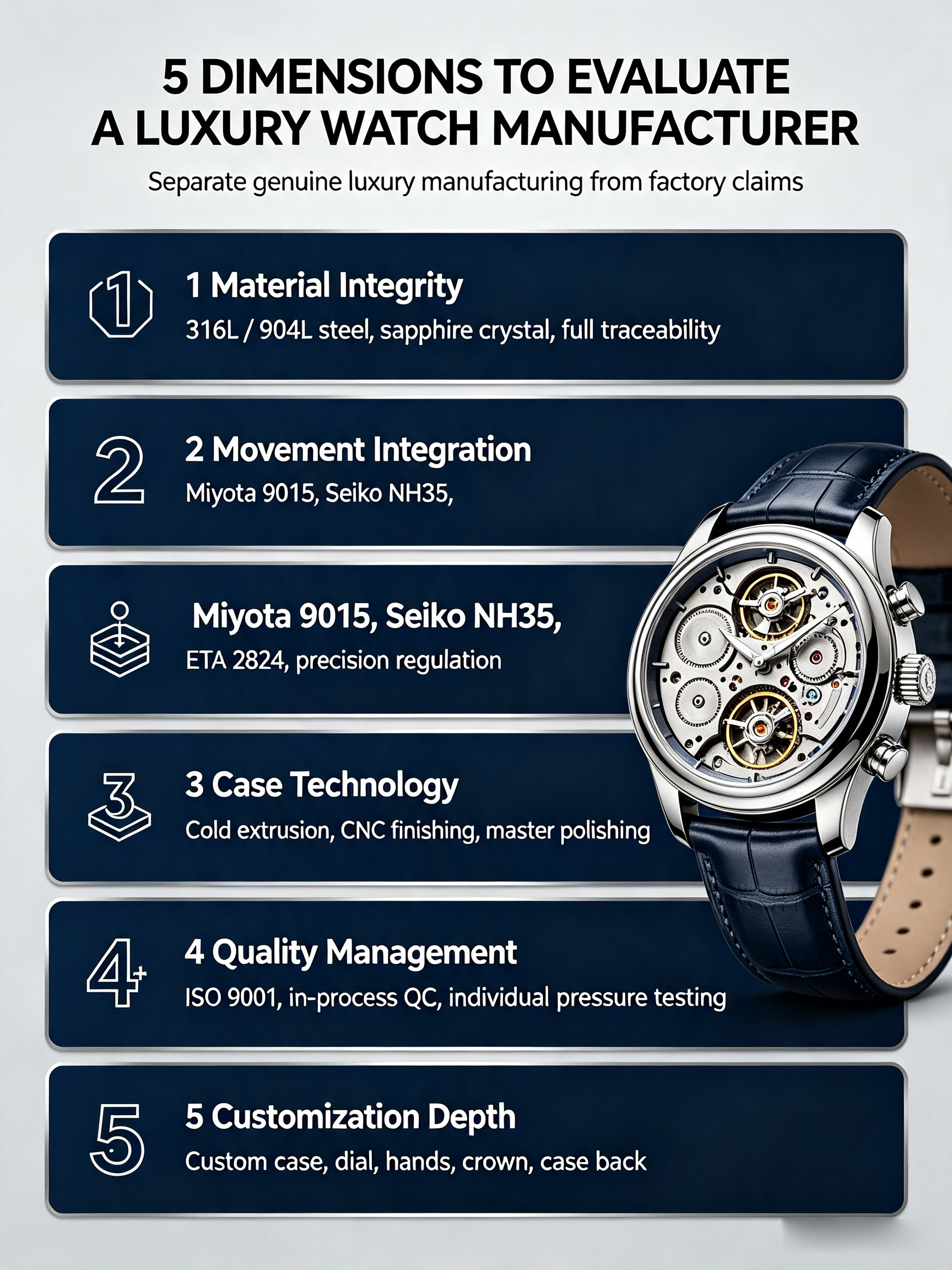
After auditing dozens of watch manufacturing facilities serving the mid-to-high-end US market, we have identified five dimensions that consistently separate genuine luxury manufacturers from factories that merely claim the label.
The visual language of a luxury watch begins with the materials. When your customer picks up a timepiece on Rodeo Drive, they are not consciously analyzing metallurgy. But their fingertips register density, thermal conductivity, and surface texture within the first second of contact. This is why material integrity is the starting point of any manufacturer assessment.
316L surgical-grade stainless steel remains the industry standard for mid-to-high-end watch cases. It offers superior corrosion resistance compared to standard 304 stainless steel, maintains its luster through years of wear, and possesses the weight that consumers associate with quality. Some manufacturers will quote you for 316L but deliver a mixed alloy that contains a lower nickel and molybdenum content. Over 12 to 18 months, cases made from substandard material will develop micro-pitting, especially in coastal markets like Los Angeles and Miami where salt air accelerates corrosion.
Request material certificates from any prospective manufacturer. Specifically, ask for mill test reports that trace the steel back to a certified mill — not a warehouse intermediary. If the manufacturer hesitates or offers a generic "certificate of compliance" rather than a mill-specific report, treat this as a red flag.
For brands targeting the upper tier of the market, 904L stainless steel has become increasingly common. Originally developed for industrial chemical processing, 904L offers even greater corrosion resistance and takes a higher polish than 316L. Rolex famously uses 904L across its entire line, which has educated the market on the material's prestige. However, 904L is more difficult to machine and requires specialized tooling. Not every manufacturer has the capability to work with it reliably.
Beyond the case material, evaluate the manufacturer's sourcing for every component: sapphire crystal origin and grade, gasket material specifications, luminous compound brand and grade. A manufacturer that cannot provide full material traceability for all components is not a luxury manufacturer regardless of what their marketing materials claim.
The heart of any luxury watch is its movement, and the relationship between movement and case is a precision engineering problem that separates professional manufacturers from assemblers.
When a manufacturer integrates a Miyota 9015 — one of the most widely used automatic movements in the 1,500 retail segment — several tolerance relationships must be managed simultaneously. The dial thickness affects hand stack clearance above the cannon pinion. The case back inner profile determines rotor clearance. The crown stem length must be cut precisely to achieve proper winding feel and case-back seal compression. A manufacturer that gets any of these wrong will produce watches that either fail immediately or develop problems within the first year of ownership.
"As our lead movement technician often reminds new clients," says the engineering team at BESSERON, "a Miyota 9015 in a poorly fitted case is worse than a reliable quartz movement. The automatic winding will feel gritty, the date change won't snap cleanly, and the rotor will scrape audibly against the case back. The consumer notices all of these things even if they cannot articulate the source of their dissatisfaction."
When evaluating manufacturers, ask specifically about their movement regulation process. A quality manufacturer will regulate each movement to within ±10 seconds per day before casing, and will provide the timing machine printout for every watch in the production batch. For brands using Seiko NH35 or ETA 2824 movements, the same precision standards apply, though the regulation tolerances differ by caliber.
Luxury watch cases are not simply machined from solid blocks of steel. The truly distinctive cases — such as the tank watch profiles popular in Manhattan business circles or the integrated bracelet sports cases that dominate the Los Angeles market — require advanced manufacturing technologies.
Cold extrusion is a forming process that presses metal into near-net shape under extreme pressure, achieving grain structure refinement that improves both strength and surface finish. For complex case geometries, cold extrusion followed by precision CNC finishing produces a superior result compared to pure CNC machining from bar stock. The grain flow follows the contours of the case rather than being cut through, which yields better corrosion resistance and a more consistent polishing outcome.
One manufacturing director at BESSERON puts it this way: "Our lead engineer suggests that 316L cold extrusion is essential for the tank watch's profile to maintain crisp lug geometry through thousands of polishing cycles. Pure CNC from bar stock introduces micro-vibrations that inevitably round off the sharp edges that define a tank case. For a dress watch intended for Manhattan boutique shelves, those edges are the difference between 'premium' and 'ordinary.'"
When assessing a manufacturer's case-making capability, inquire about their primary forming technology, their CNC machine specifications (axis count matters for complex geometries), and — critically — their polishing department. Luxury case finishing requires skilled human polishers, not automated wheels. The best manufacturers employ polishing masters with decades of experience who can achieve a mirror finish across compound curves without distorting case lines.
A Watch manufacturer's quality management system (QMS) is the difference between a brand that grows sustainably and one that collapses under the weight of returns and warranty claims.
ISO 9001 certification is the baseline. Do not work with a watch manufacturer that lacks it. But ISO 9001 alone does not guarantee luxury-grade output. The standard certifies that a documented quality system exists; it does not prescribe the specific tolerance thresholds that define luxury manufacturing.
What you should look for is how the manufacturer applies their QMS to watch production specifically. Key indicators include:
Luxury brands do not sell off-the-shelf products. They sell distinctive design language, and that requires a manufacturer capable of deep customization.
A genuine OEM and ODM luxury watch manufacturer should be able to support you through the entire customization spectrum: custom case profiles with your own mold, custom dials with your choice of material and finishing technique, custom hands in your specific profile and finish, custom crowns with your logo engraving, custom case backs with deep-struck or laser-engraved artwork, and custom packaging that extends your brand experience from the moment the customer receives the package.
Beyond manufacturing capability, evaluate the manufacturer's design support. Can their engineering team review your CAD files and identify manufacturability issues before you invest in prototyping? Do they maintain a design library of ODM options that you can customize rather than starting from zero? Can they provide material samples — actual physical swatches of dial finishes, case polishing options, and strap leathers rather than PDFs and JPEGs?
Having assessed hundreds of watch manufacturing relationships over the years, certain patterns consistently signal trouble.
The sample-to-production gap. A manufacturer sends you a review sample that is flawless. The finishing is immaculate, the movement runs at +3 seconds per day, and the lume glows evenly. You place a 500-unit order. The production units arrive with visible dial dust, erratic timing, and inconsistent polishing. This is the single most common failure mode in watch manufacturing, and it occurs because the manufacturer's sample workshop operates at a higher standard than their production line. Before placing any production order, ask to inspect a random unit pulled from a current production run — not a sample made specifically for you.
Vague pricing breakdowns. A quotation that reads "stainless steel case: included" without specifying alloy grade, finishing standard, and per-unit cost for each finishing stage is not a real quotation. It is an invitation for cost-cutting during production. Every component and every process step should have a defensible per-unit cost.
Unwillingness to disclose sub-suppliers. Your watch manufacturer may not make their own crystals, movements, or straps. That is normal. But they should be willing to tell you exactly where these components come from. If a manufacturer is cagey about their crystal supplier or strap workshop, assume they are using the cheapest available source, which will change without notice.
Communication gaps during sample development. If you send a design revision and wait four days for a response, this is what your entire production relationship will look like. A professional OEM and ODM manufacturer serving the US market should respond within 24 hours, in clear English, with specific technical answers rather than vague reassurances.
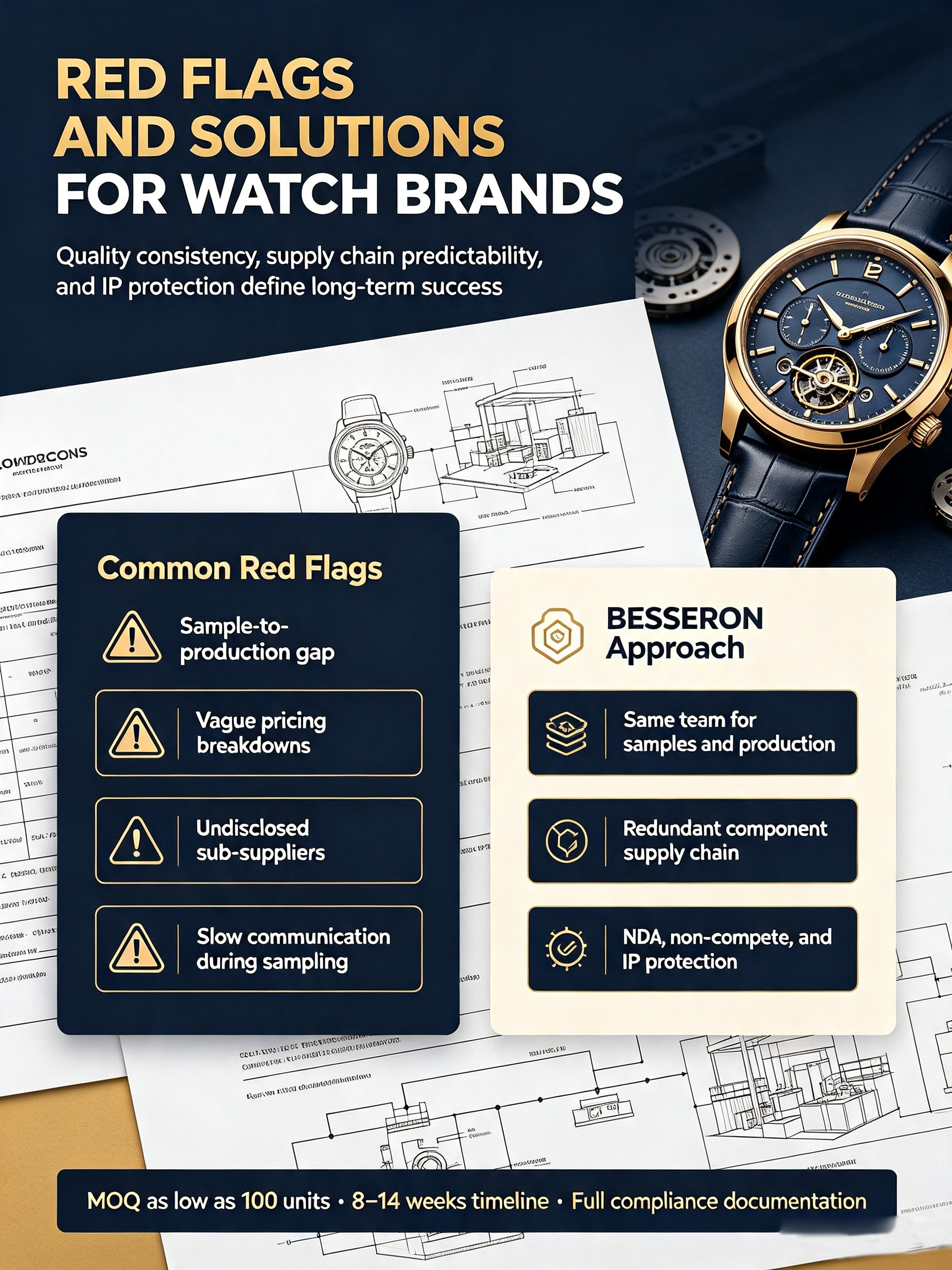
Every watch brand founder we work with shares three fundamental concerns: quality consistency across production batches, supply chain predictability, and protection of brand intellectual property. Our watch manufacturing operation in Guangzhou has been structured specifically to address these concerns for US-based watch brands.
Quality Consistency. We do not separate our sample-making and production operations. The same polishing masters, the same assembly technicians, and the same QC inspectors handle both. Every production watch passes through individual pressure testing at its rated depth, individual timing regulation on a Witschi timing machine, and a 72-hour power reserve verification for automatic movements. We provide the timing printout and pressure test record for every watch in your order.
Supply Chain Predictability. Our component supply chain is structured with redundancy. We maintain relationships with multiple certified steel mills, multiple crystal suppliers, and multiple movement distributors to ensure that a disruption in any single supply channel does not delay your production. For brands whose volumes justify it, we hold safety stock of your specific components.
IP Protection. We execute comprehensive non-disclosure and non-compete agreements with every OEM watch and ODM watch client. Your case mold is your asset. Your dial design file is your property. We do not repurpose client molds for other brands, and we maintain strict digital and physical separation between client projects. Our factory operates under documented IP protection protocols that exceed standard industry practice.
A brand that selects the wrong manufacturer typically loses twelve to eighteen months before they realize the scope of the problem. During that period, they absorb returns, warranty claims, negative reviews, and missed reorder windows. The direct financial cost of switching manufacturers mid-stream — including mold transfer fees, new sample development, and inventory write-offs — typically ranges from 60,000. The opportunity cost, measured in delayed growth and damaged market reputation, is often much larger.
The brands that succeed in the competitive US watch market are not necessarily the ones with the most innovative designs or the largest marketing budgets. They are the ones that invested the upfront effort to find and qualify a manufacturing partner capable of delivering consistent luxury-grade quality at scale.
Q: What is the minimum order quantity for a custom luxury watch with a new case mold?
A: For a new case mold, the typical MOQ ranges from 300 to 500 units depending on case complexity and finishing requirements. However, if you use an existing case platform (an ODM approach) and customize the dial, hands, crown, and case back, the MOQ can drop to 100 to 200 units. At BESSERON, we offer flexible Private Label and ODM programs with MOQs as low as 100 units for brands testing new designs or entering new market segments.
Q: How long does it take from design approval to delivery for a custom OEM watch?
A: A typical timeline is 8 to 14 weeks: 2 to 4 weeks for prototyping and sample development, 1 to 2 weeks for sample approval and revisions, and 4 to 6 weeks for production. Complex designs requiring new molds, multi-layer dials, or specialized finishing can extend this to 16 to 20 weeks. The single biggest factor affecting timeline is the clarity and completeness of your initial design specifications. The more detailed your CAD files and material specifications at the outset, the faster the process moves.
Q: How do I verify that a manufacturer uses real 316L stainless steel and not a lower-grade alloy?
A: Request material certificates from the steel mill (not just from the manufacturer). You can also request that an independent third-party inspection service like SGS or Bureau Veritas perform X-ray fluorescence (XRF) analysis on random samples from your production batch to verify the alloy composition against the 316L specification. At BESSERON, we provide mill certificates as standard documentation with every production order and welcome third-party material verification.
Q: Can you integrate Swiss movements like ETA 2824 or Sellita SW200 into a custom watch made in China?
A: Yes, and this is an increasingly common requirement from brands targeting the $1,500+ retail segment. We source ETA and Sellita movements through authorized distribution channels and apply the same precision casing and regulation standards we use for Miyota and Seiko calibers. The key consideration is lead time: Swiss movements typically require 8 to 12 weeks of advance ordering, which must be factored into your production timeline.
Q: What certifications and compliance documentation do I need to import luxury watches into the United States?
A: At minimum, you need: correct HTS classification (typically 9102.11 for mechanical wristwatches), Prop 65 compliance documentation if your product is sold in California (covering any potential lead, cadmium, or phthalate content in components), and country-of-origin marking compliant with US Customs regulations. If your watch includes leather straps, additional documentation may be required under the Lacey Act for animal-derived materials. BESSERON provides a complete compliance documentation package with every order, including Prop 65 certificates, material composition declarations, and HTS classification guidance.

