How Watches Are Made Step by Step: Inside OEM Watch Manufacturing Process
For global watch brands, microbrands, distributors, and e-commerce operators, understanding how watches are manufactured step by step is not just technical knowledge—it is a strategic advantage.
In today’s competitive horology market across the US, Europe, and Australia, brands that understand the OEM/ODM manufacturing pipeline can:
- Reduce development risks
- Improve communication with suppliers
- Shorten time-to-market cycles
- Increase product success rate
- Control cost and quality more effectively
This guide breaks down the complete OEM watch manufacturing process, from concept design to final assembly, based on real industrial practices used by experienced watch factories with 16+ years of production expertise.
1. Why Understanding Watch Manufacturing Matters for Brand Owners
For B2B buyers, especially microbrands and private label startups, working with a watch factory without understanding production logic often leads to:
- Misaligned expectations on design feasibility
- Delays caused by unclear specifications
- Increased prototype revisions
- Unexpected cost overruns
- Quality inconsistency in mass production
When brands understand the manufacturing system, communication becomes precise. For example:
Instead of saying “premium finishing,” buyers can specify:
- Brushed + polished finishing combination
- Ra surface roughness requirements
- PVD coating thickness standards
This level of clarity significantly improves OEM collaboration efficiency.
More importantly, experienced buyers gain risk control advantages:
- Better production planning aligned with component lead times
- Accurate launch scheduling for seasonal campaigns
- Lower defect rates due to early technical alignment
In real OEM projects, brands that engage deeply in early manufacturing discussions often achieve higher production stability and fewer revisions, especially in first-time sampling stages.
Every watch begins with a concept—but in OEM manufacturing, design must balance creativity with engineering feasibility.
Concept Development & Market Positioning
Before CAD modeling begins, professional OEM factories evaluate:
- Target market (luxury / fashion / sports / minimalism)
- Price positioning
- Movement type (quartz / automatic / hybrid)
- Material strategy (316L steel, titanium, ceramic, etc.)
This ensures the design aligns with both brand identity and production feasibility.
CAD Engineering & Digital Prototyping
Modern OEM watch development relies heavily on CAD systems.
Key advantages include:
- 3D visualization of final product
- Structural stress simulation
- Early detection of design weaknesses
- Fast iteration cycles without physical tooling
For example:
- Lug thickness can be tested for stress tolerance
- Case geometry can be optimized for wrist ergonomics
- Dial layering can be validated for assembly compatibility
Compared to traditional wax modeling, CAD-based development reduces time-to-prototype by 50–70%.
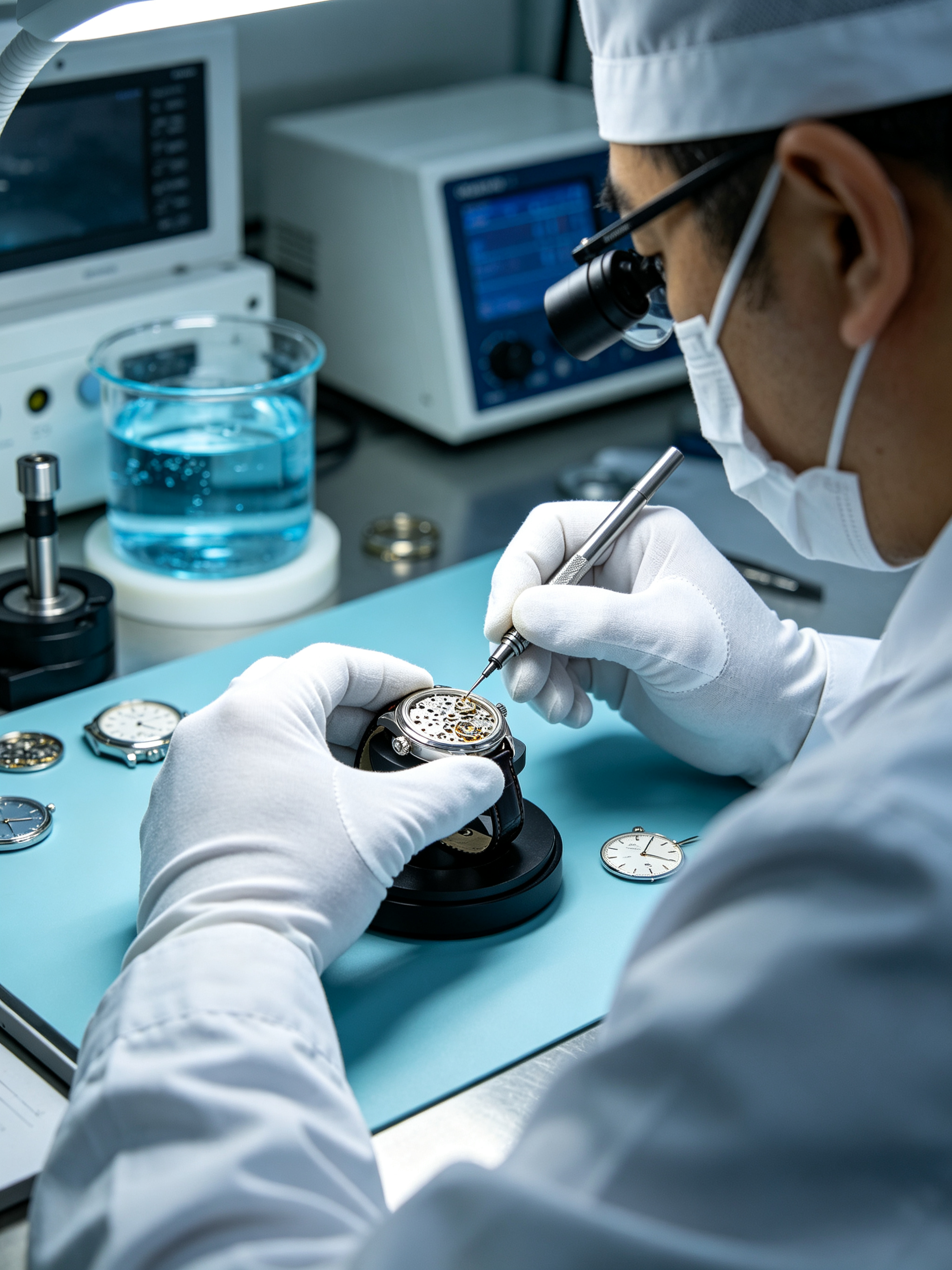
OEM Watch Value in Design Stage
Early OEM involvement ensures:
- Manufacturable design decisions
- Reduced prototype failure rate
- Faster sampling cycles
- Lower development cost
This is where experienced factories significantly outperform inexperienced suppliers.
The watch case is the structural foundation of the entire product.
CNC Machining Process
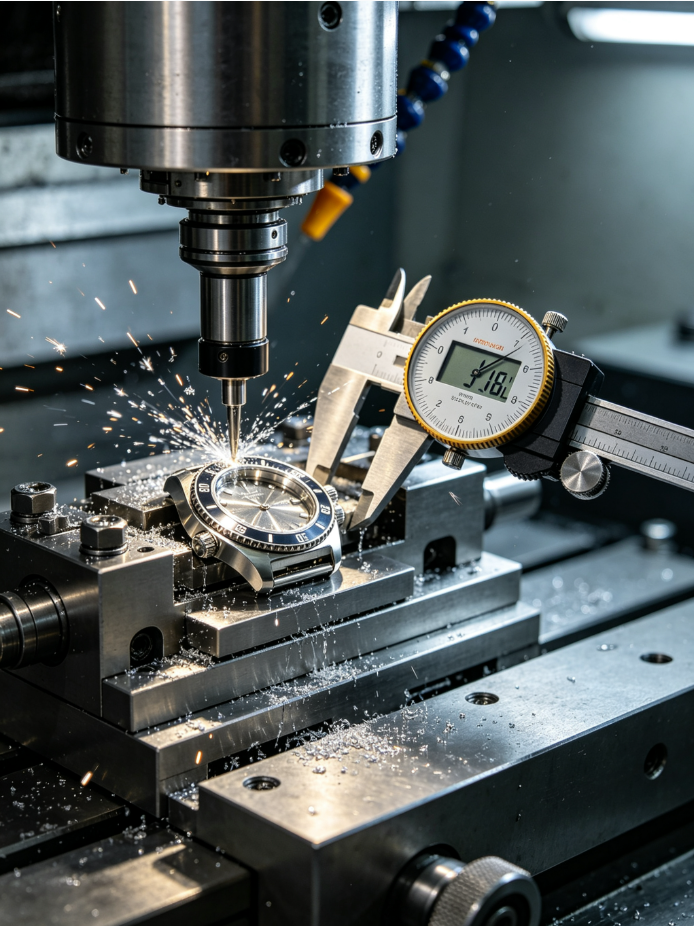
High-precision CNC machines are used to shape raw materials into cases with extreme accuracy.
Key industrial standards:
- Tolerance: within microns (μm level)
- Multi-axis CNC machining (up to 5–12 axis systems)
- Complex toolpath programming for curves and bevels
Materials commonly used:
- 316L stainless steel
- Titanium alloy
- Brass (fashion models)
Surface Finishing
After machining, the case undergoes multiple finishing processes:
- Brushing (linear texture)
- Polishing (mirror shine)
- Sandblasting (matte finish)
Advanced factories also apply:
- PVD coating (black, gold, rose gold)
- IP plating for color durability
OEM Watch Value in Case Production
Experienced factories ensure:
- Consistent finishing across batches
- Reduced micro-defects
- Better scratch resistance
- Stable plating color consistency
This directly affects brand perception and product lifespan.
The dial is the most visually critical component of a watch.
Dial Base Production
Dial plates are typically made from:
- Brass
- Aluminum alloy
- Stainless steel
Each dial is cut and shaped using high-precision stamping tools.
Surface Decoration Techniques
Depending on design, dials may include:
- Sunburst brushing
- Geneva stripes
- Guilloché engraving
- Matte sand textures
- Laser engraving
Each process requires different machinery precision and tooling control.
Printing & Lume Application
Dial printing involves multiple layers:
- Logo printing
- Index marking
- Minute track alignment
Luminous material (Super-LumiNova or equivalent) is applied using:
- Automated pad printing
- Controlled viscosity mixing
- Multi-layer coating techniques
OEM Watch Value in Dial Production
Professional OEM factories ensure:
- Perfect logo alignment accuracy
- Consistent color batch matching
- High lume brightness uniformity
- Zero misalignment in indices
Dial quality often defines brand positioning in the market.
5. Watch Movement Selection & Assembly Engineering
The movement is the “engine” of the watch.
Common Movement Types
Swiss Movements
- High precision
- COSC-grade options
- Premium positioning
Japanese Movements (Miyota / Seiko)
- Stable performance
- Cost-efficient reliability
- Popular in microbrands
Chinese Movements
- Highly customizable
- Supports complex functions (tourbillon, GMT, etc.)
- Ideal for OEM innovation projects
Assembly Compatibility Engineering
Each movement requires specific:
- Case thickness design
- Crown positioning
- Dial height calibration
- Caseback gasket thickness
Even a 0.2mm mismatch can cause:
- Waterproof failure
- Crown instability
- Mechanical friction issues
OEM Watch Value in Movement Integration
Experienced OEM factories:
- Match movement + case system precisely
- Reduce failure rate in waterproof testing
- Ensure long-term mechanical stability
6. Final Assembly & Quality Control (QC)
This stage determines whether a watch is market-ready.
Clean Assembly Environment
Professional factories use controlled environments:
- Dust-free assembly rooms
- Anti-static workstations
- ISO-level cleanliness standards
This protects movement stability and dial integrity.
Assembly Process
Key steps include:
- Movement installation
- Dial alignment
- Hand-setting calibration
- Case sealing
- Bracelet/strap assembly
Each step requires torque-controlled precision tools.
Quality Control System
A full QC system typically includes:
- Waterproof testing (3ATM–50ATM depending on model)
- Time accuracy testing
- Shock resistance test
- Magnetic resistance check
- Visual inspection under magnification
OEM Value in QC Systems
Experienced factories implement:
- Multi-stage inspection checkpoints
- Statistical defect tracking
- Batch consistency control
- Long-duration aging tests
This ensures stable mass production quality.
7. Why 16+ Years of OEM Watch Experience Matters
In watch manufacturing, experience directly determines production success rate.
Key Advantages of Mature Factories
1. Higher First-Sample Success Rate
Experienced factories reduce redesign cycles significantly.
2. Stable Mass Production
Consistency across 1,000–10,000 units is critical for brand scaling.
3. Material & Process Knowledge
Understanding:
- PVD color stability
- Steel heat treatment behavior
- Lume performance degradation
4. Risk Reduction
Avoid common issues such as:
- Crown leakage
- Dial misalignment
- Coating inconsistency
Industrial Insight
Factories with long-term production experience often maintain:
- Standard operating procedures (SOPs)
- Historical defect databases
- Optimized production workflows
This institutional knowledge is one of the biggest advantages in OEM partnerships.
8. OEM vs ODM: What Brand Owners Should Know
OEM (Original Equipment Manufacturing)
- Client provides design
- Factory produces accordingly
- Best for established brands
ODM (Original Design Manufacturing)
- Factory provides design solutions
- Client selects and customizes
- Best for startups and microbrands
Most successful watch brands use a hybrid approach:
- ODM for fast entry
- OEM for long-term brand identity building
FAQ: Watch Manufacturing for Brand Owners
Q1: What is the typical MOQ for custom watches?
Most OEM factories offer:
- 100–300 units for entry models
- 500–1000 units for standard production
Higher quantities reduce unit cost significantly.
Q2: How long does the watch production process take?
Typical timeline:
- Design & CAD: 7–15 days
- Sampling: 15–30 days
- Mass production: 30–60 days
Yes. Customization includes:
- Dial design
- Case shape
- Strap material
- Logo engraving
- Packaging design
Q4: Which movement is best for microbrands?
- Japanese movements: best balance of cost and reliability
- Swiss movements: premium positioning
- Chinese movements: high customization flexibility
Q5: What is the biggest risk in watch manufacturing?
The most common risks include:
- Poor supplier communication
- Incomplete technical specifications
- Inexperienced OEM factories
Working with experienced manufacturers significantly reduces these risks.
Final Conclusion & Call to Action
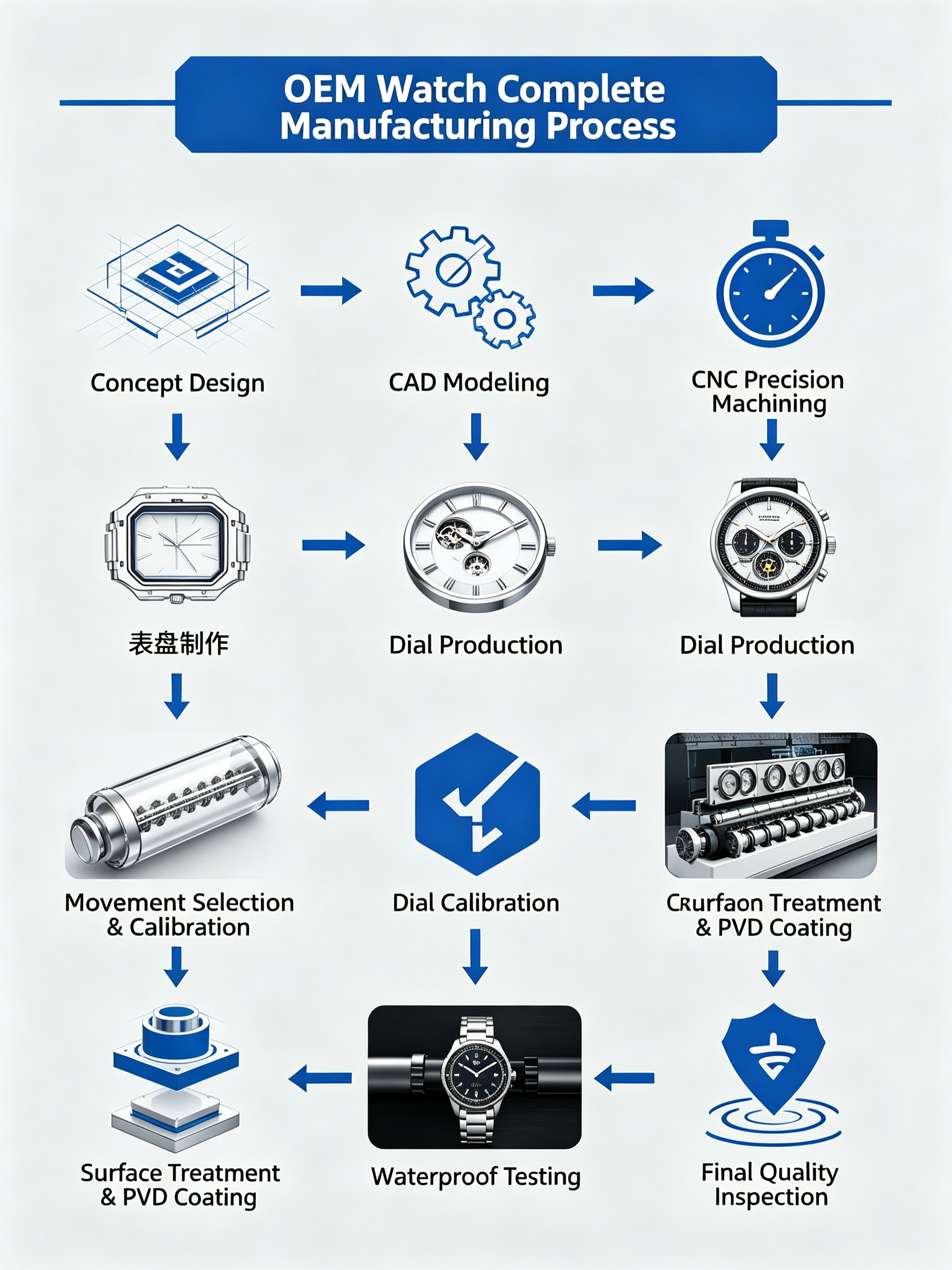
Understanding how watches are made step by step allows brand owners to make smarter sourcing decisions and reduce unnecessary production risks.
With over 16 years of OEM/ODM manufacturing experience, professional watch factories can support brands from concept to mass production with:
- Engineering precision
- Stable quality control systems
- Flexible customization capabilities
- Scalable production capacity
If you are building a watch brand, launching a microbrand, or developing a private label collection, the right OEM partner will determine your product success rate in the market.
Start your custom watch project today—turn your concept into a manufacturable, market-ready timepiece with professional OEM support.


