
When a US watch brand founder begins the supplier selection process, two manufacturing countries inevitably dominate the conversation: Japan and China. The choice between them is rarely as simple as the industry narrative suggests. Japan is not universally "better," and China is not universally "cheaper." The correct answer depends on your brand's specific requirements: the retail price point you are targeting, the design complexity you need, the production volume you can commit to, and the type of customization your brand identity demands.
This article provides a structured, data-driven comparison between Japanese and Chinese watch manufacturers across the dimensions that matter most to US-based watch brand founders. It is informed by direct experience manufacturing watches in China, sourcing movements from Japan, and integrating both supply chains for brands that sell in markets ranging from Manhattan boutiques to Silicon Valley direct-to-consumer channels.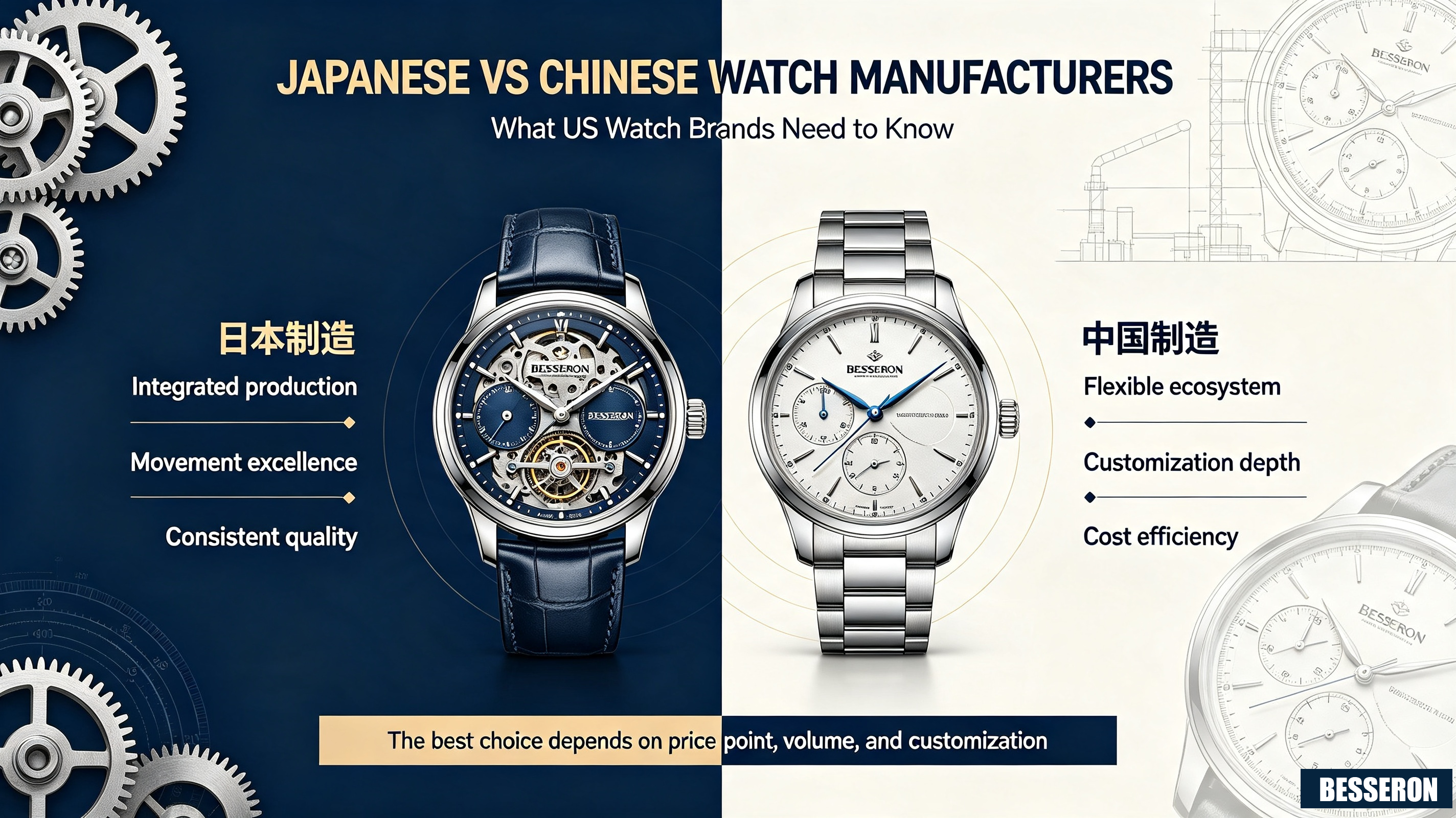
Japan's watch manufacturing industry is dominated by the integrated production model. Companies like Seiko and Citizen design and manufacture their own movements, cases, dials, and bracelets within vertically integrated facilities. This structure produces exceptional consistency. A Seiko watch manufactured today will look, feel, and perform nearly identically to an equivalent model manufactured five years ago.
The limitation of the Japanese model, from a US brand founder's perspective, is that it is not designed for external brand customization. Japanese manufacturers primarily serve their own brands. When they do accept OEM or ODM work from external clients, the customization flexibility is typically narrower and the minimum order quantities are higher than what US independent brands require.
China's watch manufacturing industry is structured differently. It is a horizontally specialized ecosystem: separate factories specialize in cases, dials, hands, straps, and assembly. A watch manufacturing company like BESSERON operates as the integrator, coordinating these specialized suppliers to produce complete OEM and ODM watches to client specifications. This horizontal structure provides significantly greater customization flexibility. A brand founder can specify a case from one supplier, a dial from another, and a hand set from a third — all coordinated by the manufacturing partner.
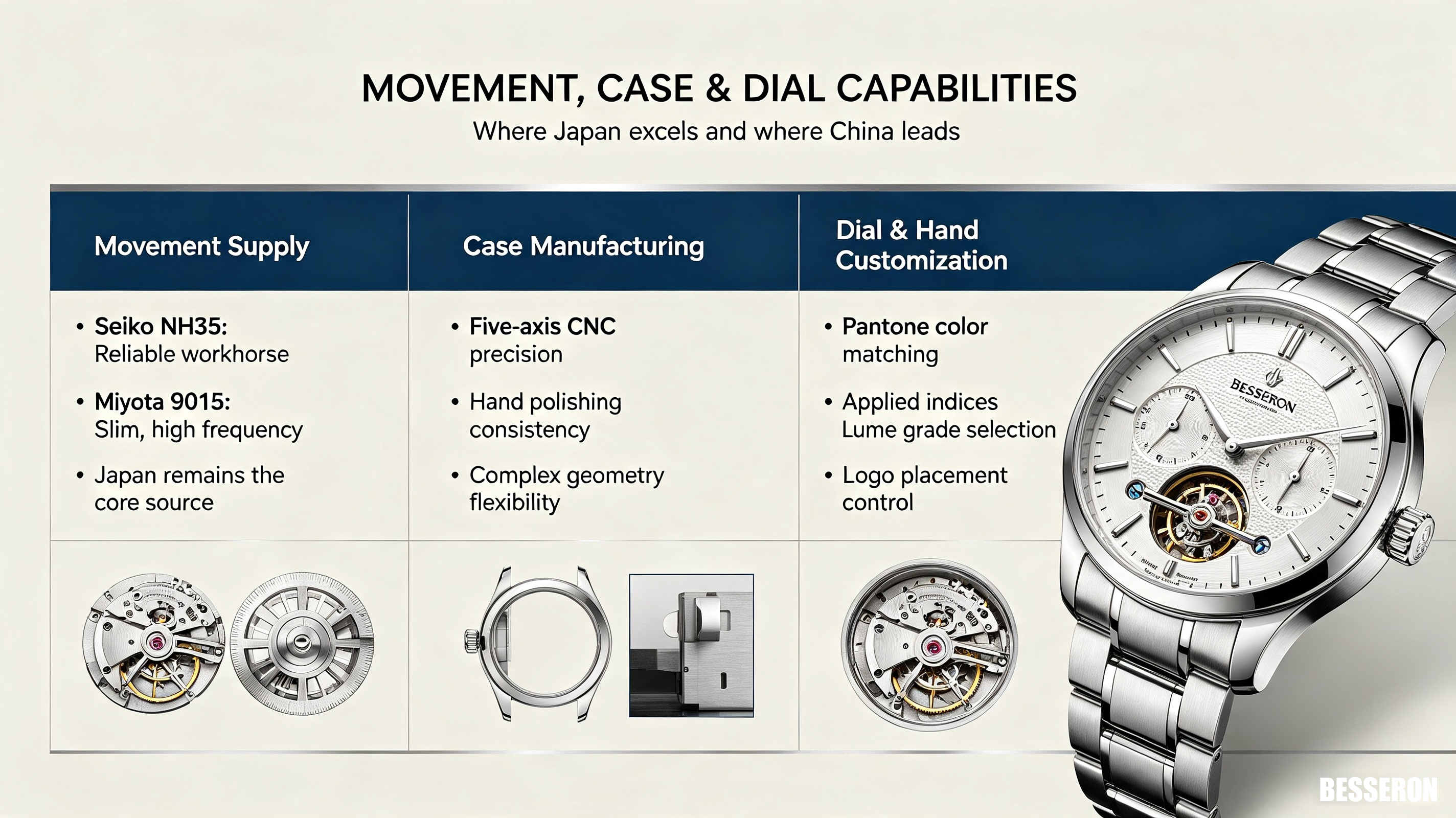
The most significant objective advantage that Japanese watch manufacturing offers is movement supply. Japan produces the two most widely used automatic movements in the 1,200 retail segment: the Seiko NH35 and the Miyota 9015.
The Seiko NH35 is the workhorse of the independent watch industry. It is a 24-jewel automatic movement with hacking seconds, hand-winding capability, and a 41-hour power reserve. It is reliable, serviceable, and costs approximately 50 at wholesale. The NH35 powers thousands of watch models across hundreds of brands, from entry-level dive watches to mid-range dress pieces. Its ubiquitous presence means that any competent watchmaker can service it, and spare parts are never more than a week away.
The Miyota 9015 occupies the tier above the NH35. It is thinner (3.9mm vs 5.32mm for the NH35), runs at a higher frequency (28,800 vibrations per hour vs 21,600), and delivers superior accuracy when properly regulated. The 9015 costs approximately 85 at wholesale and is the standard choice for dress watches and thinner sports watches in the 1,200 retail segment. The Miyota 9015's slim profile makes it particularly suitable for the 10-11mm case thickness that design-focused brands targeting the Manhattan and Silicon Valley markets increasingly demand.
Both movements are Japanese-designed and primarily Japanese-manufactured. A Chinese watch manufacturer does not compete with Japan on movement production; instead, the best Chinese OEM and ODM watch manufacturers integrate Japanese movements into their products with the same precision as any Japanese assembler.
"As our movement technician explains to every new client," notes a BESSERON engineer, "we source Miyota 9015 movements directly from authorized distributors in Japan. Every movement is timed and regulated in our workshop to plus or minus ten seconds per day before assembly. We treat the movement as the heart, and the case, dial, and hands as the body. Both must be equally perfect for a watch that sells on Madison Avenue."
Fifteen years ago, a watch case manufactured in Japan was materially superior to a watch case manufactured in China. The Japanese advantage in CNC machining precision and polishing consistency was significant. Today, that gap has effectively closed at the quality tier relevant to 1,200 retail watches.
A Chinese factory equipped with five-axis CNC machines from DMG MORI or Citizen Cincom — the same equipment brands used in Japanese and Swiss factories — and staffed by polishing masters with fifteen to twenty years of experience can produce cases that are indistinguishable from Japanese-manufactured equivalents. The critical variable is not the country of manufacture but the specific factory's quality management system and quality standards.
A watch case produced at BESSERON passes through the same quality gates regardless of whether the design originated in Japan or China: CNC machining with ±0.01mm tolerance on critical dimensions, multi-stage hand polishing by experienced craftspeople, individual dimensional verification using coordinate measuring machines, and surface finish verification against reference standards. The country in which the factory is located does not determine the quality of the output. The factory's commitment to quality determines the quality.
For brands that require complex case geometries — integrated bracelet designs, cushion cases, or unusual lug profiles — Chinese manufacturers often offer an advantage in tooling flexibility and willingness to develop custom solutions. Japanese manufacturers, with their focus on in-house brand production, are generally less interested in developing one-off case molds for external clients ordering fewer than a thousand units.
Japan's dial and hand manufacturing is closely tied to its movement and case production. A Seiko dial is designed for a Seiko movement in a Seiko case. The integration is seamless, but the customizability for external clients is limited.
China's dial manufacturing industry is a specialized sector in its own right. Dial factories that produce exclusively for external watch brands have developed expertise in the full spectrum of customization: galvanic plating in dozens of color variants, lacquered dials with precise Pantone matching, applied indices in custom profiles, pad printing at resolutions that reproduce the finest typography, and lume application using Super-LumiNova grades sourced directly from RC Tritec in Switzerland.
For a US brand founder building a design-driven watch company, the difference is significant. A Chinese OEM and ODM manufacturer can produce a dial that matches your specific Pantone color, with your specific index profile, with your specific logo in the exact size and position you specify, and with lume in the grade and color you choose. A Japanese manufacturer offering OEM services may restrict you to a palette of existing color options and standard index packages.
The stereotype that Japanese manufacturing quality exceeds Chinese manufacturing quality is a generalization that obscures more than it reveals. Both countries are capable of producing watches at every quality tier. The relevant question is not "which country has better quality control" but "which specific manufacturer has a quality management system that meets your requirements."
ISO 9001 certification is the baseline standard for quality management in both countries. Japanese manufacturers additionally reference JIS (Japanese Industrial Standards) for specific manufacturing processes. Chinese manufacturers serving international clients typically maintain both ISO 9001 and, increasingly, ISO 14001 environmental management certification.
The practical difference that US brand founders should investigate is not the certification on the wall but the QC process on the factory floor. Does the manufacturer individually pressure-test every watch, or only batch-sample? Does the manufacturer regulate every movement, or only spot-check? Does the manufacturer provide the QC documentation — timing machine printouts, pressure test records, inspection reports — for every watch in your order?
"Our approach to QC is the same regardless of where the components originate," explains a BESSERON quality manager. "If we are building a watch with a Japanese Miyota movement in a Chinese-manufactured case, every unit passes through individual pressure testing, individual timing regulation, and a fourteen-point visual inspection. The QC standard is defined by the product specification, not by the component origin."
If there is a single dimension where Chinese watch manufacturers offer a clear advantage for US brand founders, it is customization depth. The Chinese manufacturing ecosystem was built to serve external clients. Its structure, its pricing models, and its operational processes are designed around the assumption that every client's requirements will be different.
This manifests in practical ways. A Chinese OEM and ODM manufacturer will generally accept lower MOQs for custom elements — 100 units for a custom dial, 300 units for a custom case mold — than a Japanese manufacturer serving external clients. A Chinese manufacturer will generally offer more finishing options, more dial material choices, and more hand profile variations within a given project. And critically, a Chinese manufacturer will generally provide faster turnaround on design changes and sample iterations because their production planning is structured around client-driven variability rather than in-house brand consistency.
For a US brand founder who needs to test market response with a 100-unit initial order, iterate on the design based on customer feedback, and scale to 500 units for the second production run, the Chinese manufacturing model is structurally better aligned with that workflow.
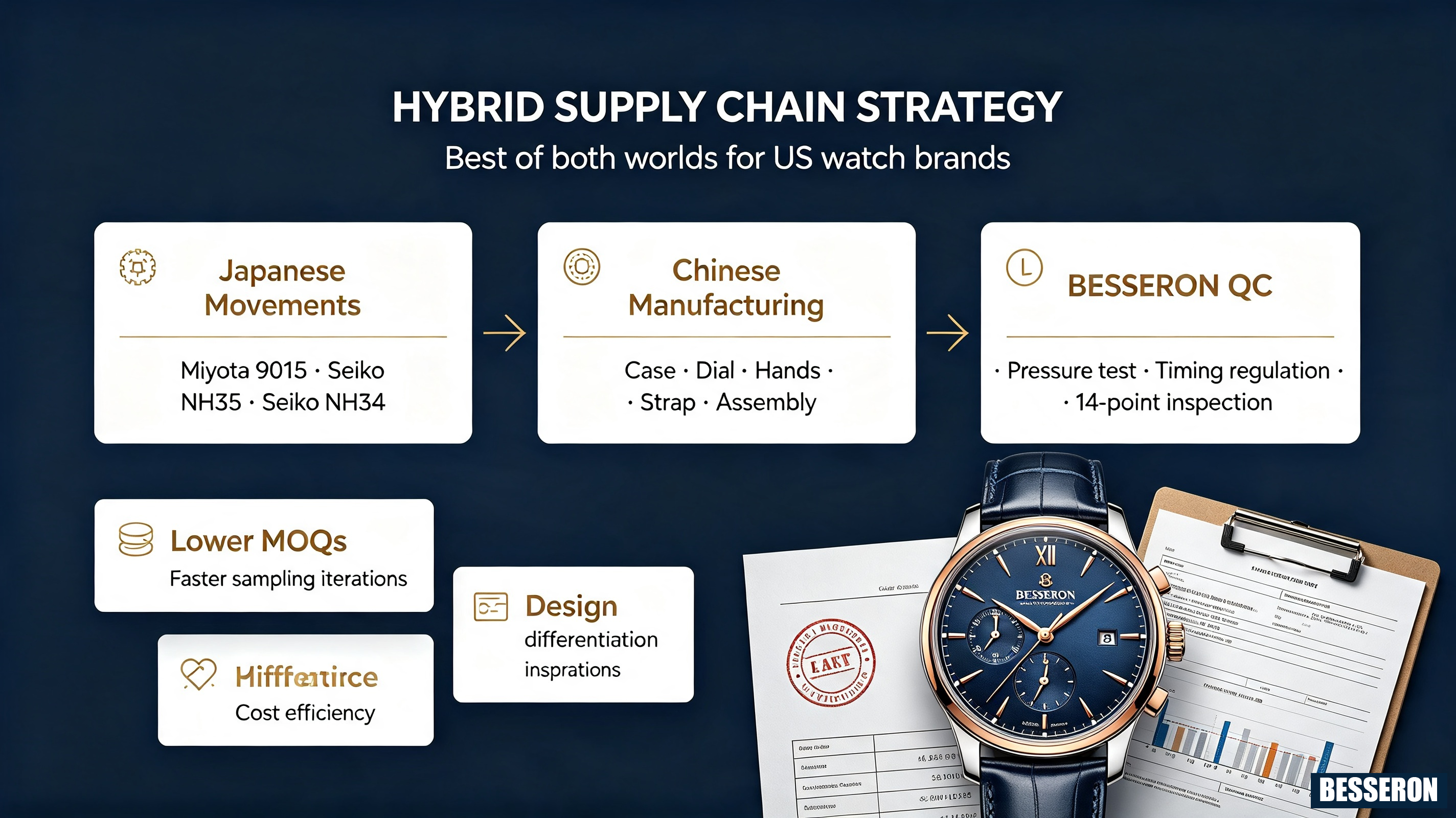
The most sophisticated US watch brands do not choose between Japanese and Chinese manufacturing. They build hybrid supply chains that leverage the strengths of each ecosystem.
The dominant hybrid model works as follows. Movements are sourced from Japan: Miyota 9015 for slim automatic watches, Seiko NH35 for robust sports watches, and occasionally Seiko NH34 for GMT complications. Case manufacturing, dial production, hand manufacturing, strap sourcing, and final assembly are performed in China by an experienced OEM and ODM manufacturer like BESSERON. The result is a watch that combines the proven reliability of Japanese movement engineering with the customization flexibility and cost efficiency of Chinese case and dial manufacturing.
This hybrid approach is not a compromise. It is the optimal supply chain architecture for a US brand selling automatic watches in the 1,200 retail range. The Japanese movement provides the accuracy and reliability that customers expect. The Chinese manufacturing provides the design differentiation, finishing quality, and production scalability that brands need.
At BESSERON, we have built our manufacturing operation around the hybrid model because we believe it delivers the best outcome for US watch brands. We source Japanese movements — Miyota 9015, Miyota 8215, Seiko NH35, and Seiko NH34 GMT — through authorized distribution channels with full traceability and warranty support.
Every movement is inspected upon receipt, timed and regulated in our workshop, and cased with precision checks for dial clearance, hand stack height, crown stem length, and rotor clearance. The completed watch is then individually pressure-tested and timing-verified before it enters final QC. This process ensures that the movement performs to its rated specification regardless of the case and dial configuration into which it is installed.
For brands that require Swiss movements — ETA 2824, Sellita SW200, or their derivatives — we source through authorized channels and apply the same precision casing and regulation standards.
Q: Are Chinese-manufactured watch cases as good as Japanese ones?
A: At the quality tier relevant to 1,200 retail watches, yes — provided you are working with a reputable Chinese OEM and ODM manufacturer. The CNC equipment, polishing expertise, and QC standards in top-tier Chinese watch factories are comparable to their Japanese counterparts. The key is selecting a manufacturer with ISO 9001 certification, verifiable QC processes, and a track record serving US and European brands. Avoid manufacturers that cannot provide material traceability or that resist third-party inspection.
Q: Can I use a Japanese movement in a watch manufactured in China?
A: Absolutely, and this is increasingly the standard approach for US independent watch brands. A Chinese OEM and ODM manufacturer like BESSERON sources Japanese movements through authorized distribution, integrates them into custom cases and dials, and provides the same precision regulation and testing that a Japanese assembler would deliver. The combination of Japanese movement engineering with Chinese customization flexibility is often the optimal solution for brands in the 1,200 retail segment.
Q: What are the typical MOQ differences between Japanese and Chinese watch manufacturers?
A: Japanese manufacturers offering OEM services typically require MOQs of 500 to 1,000 units with limited customization options. Chinese OEM and ODM manufacturers typically offer MOQs starting at 100 to 300 units for OEM projects and as low as 50 to 100 units for ODM and Private Label projects. For brands in the validation and early growth stages, the Chinese MOQ structure is significantly more accessible.
Q: How do I verify the authenticity of Japanese movements supplied by a Chinese watch manufacturer?
A: Request the movement serial numbers and distributor documentation. Authorized Miyota and Seiko distributors provide traceable documentation for every movement batch. You can also verify movement authenticity through visual inspection: genuine Miyota 9015 and Seiko NH35 movements have specific finishing, engraving, and component characteristics that are well-documented. A reputable manufacturer will welcome third-party verification and provide documentation proactively.
Q: What about Swiss movements — can you integrate those in a watch manufactured in China?
A: Yes. ETA 2824, Sellita SW200, and Sellita SW330 (GMT) movements can be sourced through authorized distribution channels and integrated into watches manufactured in China. The primary considerations are lead time (Swiss movements typically require 8 to 12 weeks advance ordering) and cost (Swiss movements add 250 to the FOB cost compared to Japanese equivalents). At BESSERON, we source Swiss movements for clients whose brands target the $1,500-plus retail segment and for whom a "Swiss movement" designation has marketing value.

