
The independent American watch brand has become one of the most dynamic forces in the global timepiece market. From a minimalist studio in San Francisco's Mission District to a watchmaker's workshop overlooking Venice Beach, entrepreneurs are building brands that speak to specific aesthetics, communities, and price points that the Swiss establishment never addressed. Behind many of these brands stands a manufacturing ecosystem that few founders understood before they began: China's watch manufacturing industry.
The narrative around Chinese watch manufacturing has undergone a profound transformation over the past decade. The story that US brand founders hear at trade shows and on industry forums no longer matches the stereotype of cheap quartz watches and loose crown stems. What has emerged instead is a sophisticated OEM and ODM manufacturing sector capable of producing timepieces that hold their own on the shelves of premium retailers from Abbot Kinney Boulevard to Melrose Avenue.
This guide provides a complete framework for US watch brand founders who are evaluating Chinese manufacturing partners for customized, mid-to-high-end watch production. It covers the full journey from initial concept to delivery at your US warehouse, with specific attention to the questions that first-time founders are often afraid to ask.
To understand why Chinese OEM and ODM watch manufacturing has become relevant to US brand founders, it helps to understand the structural shift that has occurred over the past fifteen years.
Between 2005 and 2015, China's watch manufacturing sector invested heavily in CNC machining technology. Five-axis CNC machines that had previously been concentrated in Swiss and German factories became standard equipment in manufacturing clusters around Shenzhen and Guangzhou. The same brands of equipment — DMG MORI, Citizen Cincom, STAR — now operate in Chinese facilities. The difference in machining capability between a well-equipped Chinese factory and its Swiss counterpart is, for all practical purposes in the 800 FOB price range, negligible.
Alongside equipment investment came a generation of engineers and technicians trained in modern precision manufacturing. The polishing masters, CNC programmers, and quality control specialists working in top-tier Chinese watch factories today have often spent their entire careers in the industry. They are not learning on the job; they are refining systems that have been iterating for twenty years.
The result is that the value proposition of Chinese watch manufacturing has shifted from "cheap" to "capable at scale with customization flexibility." For a US brand founder launching a 1,200 retail watch, a Chinese OEM and ODM manufacturer can now deliver Swiss-comparable case finishing, Japanese or Swiss movement integration, fully customized dials, and complete packaging solutions — typically at 40% to 60% of the FOB cost of an equivalent Swiss-made product, with significantly lower minimum order quantities and faster turnaround.
Before you begin contacting manufacturers, you must understand which partnership model aligns with your brand's stage, budget, and goals. These three terms are often used interchangeably but represent fundamentally different approaches.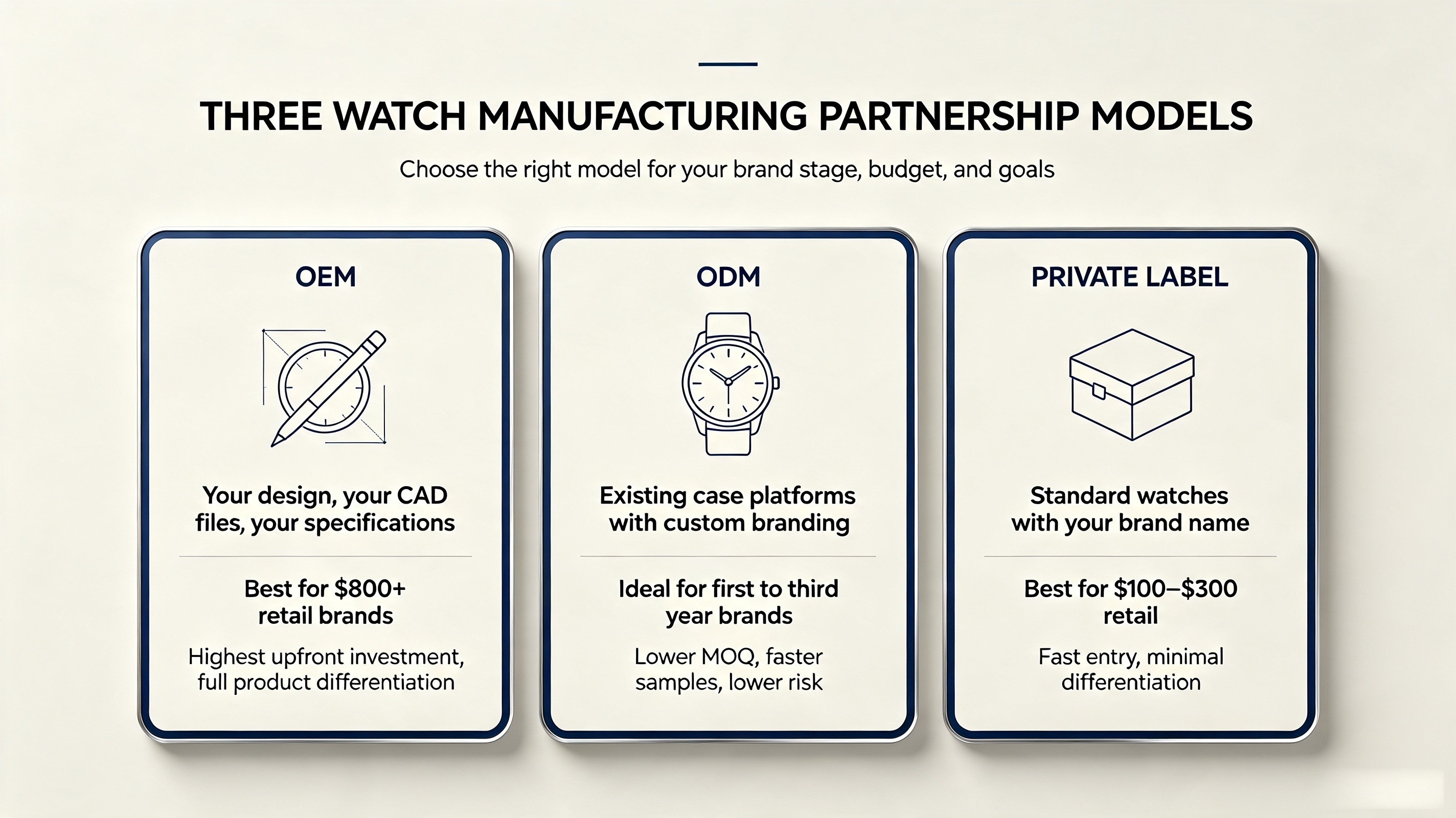
In an OEM arrangement, you supply the design. You provide CAD files, technical drawings, material specifications, and component requirements. The manufacturer follows your specifications exactly.
This model is appropriate for brands that have already developed their design language, have access to industrial design resources, and want complete control over the final product. It also carries the highest upfront investment: new case molds typically cost 3,500 depending on complexity, and you will need to invest in prototyping and sample iterations before production begins.
The advantage of OEM is that your product is genuinely yours. No other brand will have the same case geometry, the same dial layout, or the same crown profile. For brands positioning themselves in the $800+ retail segment, this differentiation is often essential.
In an ODM arrangement, the manufacturer provides a library of existing designs — case shapes, dial templates, hand styles, crown profiles — that you can customize with your brand elements. You select from the manufacturer's catalog and apply your logo, color choices, material preferences, and finishing options.
This model dramatically reduces upfront investment and time to market. Since the manufacturer already has molds and tooling for their ODM case platforms, you can often move from initial contact to production-ready samples in four to six weeks rather than twelve to sixteen. MOQs are typically lower because the manufacturer can batch your order with other clients using the same case platform.
ODM is ideal for brands in their first to third year of operation, brands testing new product categories, and brands that compete primarily on brand identity and marketing rather than on unique case design. A well-executed ODM watch with distinctive dial colors, custom hands, and thoughtful packaging can command 700 retail without any unique case tooling.
Private Label represents the most streamlined entry into the watch market. The manufacturer produces complete watches — case, dial, hands, movement, strap, and packaging — with your brand name applied. You may have some choices around dial color and strap material, but the core product is standard.
Private Label is primarily used by brands operating in the 300 retail range, often selling through social media channels, Amazon, or pop-up retail. It requires the least upfront investment and the shortest lead time, but it also offers the least differentiation. Your product will share its fundamental DNA with other brands using the same supplier.
At BESSERON, we work across all three models but have found that the majority of first-time US brand founders benefit most from the ODM approach: sufficient customization to build genuine brand identity, but without the cost and complexity of full OEM case development.
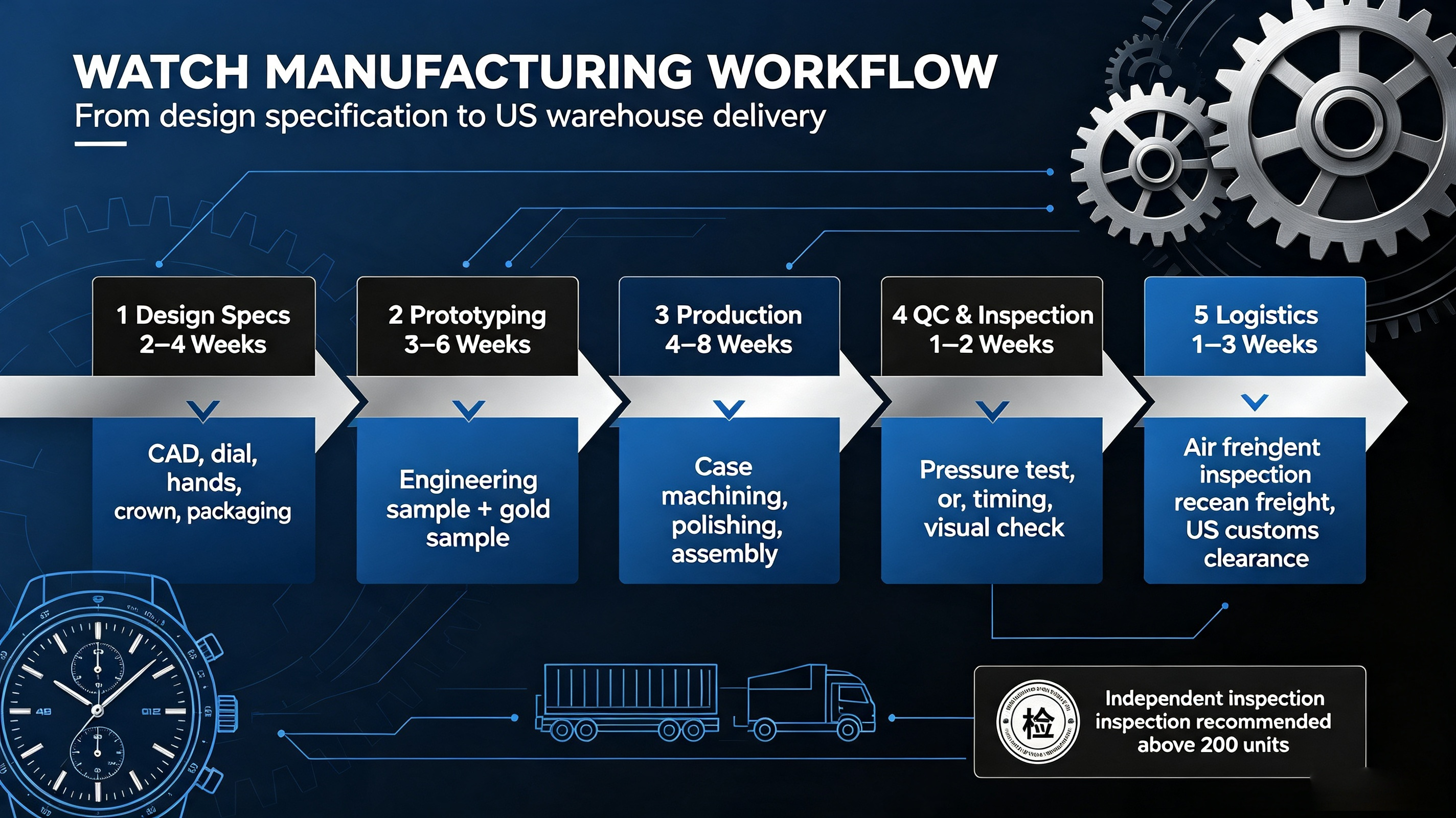
Understanding the workflow before you begin will save you months of frustration. Here is how a professional OEM and ODM manufacturing engagement unfolds, from first contact to delivery at your US warehouse.
This is the phase where most delays originate. The quality and completeness of your design specification directly determines how smoothly the rest of the process runs.
For an ODM project, you need to provide: your case platform selection from the manufacturer's catalog, your dial design requirements (color, finish, index style, logo placement, and any text or markings), your hand style selection, your crown preference, your case back preference (solid or display, engraving requirements), your strap or bracelet selection, and your packaging concept.
For an OEM project, you additionally need to provide: 3D CAD files of your case design in STEP or IGES format, 2D technical drawings with tolerances, material specifications for every component, and surface finishing requirements with reference standards.
One piece of practical advice from the manufacturing side: "Our production director always tells first-time brand founders," says a BESSERON project manager, "do not just send a mood board. Send us your target retail price, your ideal customer profile, and we reverse-engineer the spec from there. That is what a genuine ODM partnership looks like. A mood board tells us what you want the watch to look like. A target retail price and customer profile tells us what the watch needs to be."
Once the design specification is locked, the manufacturer produces pre-production samples. A professional manufacturing engagement includes at minimum two sample stages.
The first sample, sometimes called the prototype or engineering sample, is produced to verify that the design is manufacturable. This sample may use standard finishing rather than production finishing. It exists to test fit, function, and proportions. You should expect to identify issues at this stage: the crown might feel slightly stiff, the dial color might read differently in person than on screen, and the hand length might need adjustment by half a millimeter.
Based on your feedback, the manufacturer produces a second sample, sometimes called the gold sample or pre-production sample. This sample should represent exactly what production units will look and feel like. It should use production finishing, production dial printing, and a regulated movement. The gold sample is your contractual reference standard. Every production unit should match it.
Novice brand founders sometimes try to skip from first sample directly to production. This is almost always a mistake. The cost of rushing past the gold sample stage is invariably paid in returns, warranty claims, and disappointed customers.
With the gold sample approved, production begins. A well-managed watch manufacturing operation will provide milestone updates at defined intervals: case machining complete, polishing underway, dial production complete, movement casing in progress, final QC underway.
Production duration depends on order volume and complexity. A 500-unit ODM order with standard finishing typically requires four to six weeks of production time. A 300-unit OEM order with a new case mold, multi-layer dial, and complex finishing can require eight to ten weeks.
Before your watches leave the factory, they should pass through a final QC gate. In a professional manufacturing engagement, this includes individual pressure testing for water-resistant models, individual timing verification on a Witschi timing machine, and visual inspection against the gold sample standard.
For orders above 200 units, we recommend commissioning an independent pre-shipment inspection through SGS, Bureau Veritas, or Intertek. This adds approximately 800 to your production cost and provides an independent verification that your watches meet specification before they ship. For a $60,000 production order, this is one of the best investments you can make.
The final phase involves shipping your watches from the factory in Guangzhou or Shenzhen to your US destination. Air freight typically takes five to seven days door to door. Ocean freight takes three to five weeks but costs substantially less per unit for larger volumes.
US Customs clearance requires correct HTS classification. Mechanical wristwatches generally fall under HTS code 9102.11. You will need to provide a commercial invoice, packing list, and any required compliance documentation — including Prop 65 certificates if your watches will be sold in California. Your manufacturer should provide all necessary compliance documentation as part of the order.
After working with dozens of US watch brands across their manufacturing journeys, certain patterns have become clear. The manufacturers that produce consistently excellent results share several characteristics.
They ask questions before they quote. A manufacturer that responds to your initial inquiry with a price list before asking about your target customer, your intended retail price point, and your design vision is a manufacturer that treats watchmaking as a commodity business. Great manufacturers treat every OEM and ODM engagement as a design partnership. They want to understand what you are building before they tell you what it will cost.
They are transparent about their sub-supplier network. No watch manufacturer produces every component in-house. Movements come from Miyota, Seiko, ETA, or Sellita. Crystals come from specialized glass manufacturers. Straps come from dedicated strap workshops. A great manufacturer is completely transparent about their sub-supplier relationships. They can tell you the origin of every component in your watch and why they chose each supplier. If a manufacturer is vague about where their components come from, you will eventually discover that the answer is "the cheapest available source."
They maintain consistent quality across batch sizes. Some manufacturers produce excellent samples and excellent large production runs, but their quality degrades on smaller orders because the A-team works on the big accounts. The best Chinese watch manufacturers run a single production standard regardless of order size. The same polishing team, the same assembly line, and the same QC gate apply to every order.
BESSERON was founded to solve the specific challenges that US-based watch brand founders face when working with overseas manufacturers. Our OEM, ODM, and Private Label watch manufacturing operation in Guangzhou is structured around three principles that directly address the most common pain points we observed in the industry.
Communication without compromise. Every BESSERON client is assigned a dedicated bilingual project manager who serves as a single point of contact from design specification through delivery. Response times are measured in hours, not days. Technical questions receive technical answers, not vague reassurances. Weekly production updates with photos keep you informed of your order's progress without requiring you to chase status.
Design partnership, not order-taking. Our in-house design team reviews every client specification and provides manufacturability feedback before prototyping begins. We identify potential issues — dial clearance conflicts, hand stack height problems, finishing feasibility concerns — at the design stage, when they cost nothing to fix, rather than at the sample stage, when they cost time and money.
Compliance handled comprehensively. Every BESSERON production order includes a complete compliance documentation package: Prop 65 certificates for California retail, material composition declarations, HTS classification guidance, and country-of-origin documentation. We treat compliance as an integral part of the manufacturing process, not an afterthought.
Q: What is the typical cost to develop a new OEM watch with a custom case mold?
A: A custom stainless steel case mold typically costs between 3,500 depending on case complexity, number of parts, and whether the mold is for cold extrusion or CNC machining. Beyond the mold cost, expect to invest 3,000 in prototyping and sample iterations. The total development cost for a new OEM watch — including mold, three rounds of samples, and design engineering — typically ranges from 8,000 before production begins. This investment is specific to your brand; the mold is your asset.
Q: Can I start with an ODM design and later develop my own OEM case?
A: Yes, and this is a path that many successful brands follow. They launch with ODM case platforms to test market response with minimal upfront investment. Once they have validated demand and refined their brand identity, they invest in OEM case development for their second or third collection. A manufacturer that offers both ODM and OEM capabilities can support you through this transition without requiring you to change suppliers and establish new quality standards.
Q: How do I protect my watch designs and brand intellectual property when working with a Chinese manufacturer?
A: Start with a comprehensive NNN agreement (Non-Disclosure, Non-Use, Non-Circumvention) executed before you share any design files. Register your brand trademark in China through the Madrid Protocol system. Ensure your manufacturing contract explicitly states that all molds, tooling, design files, and intellectual property created for your project belong to you. At BESSERON, we operate under strict IP protection protocols: client molds are stored separately, design files are access-controlled, and we never repurpose one client's designs for another brand.
Q: What payment terms are standard in the Chinese watch manufacturing industry?
A: The most common structure for first-time partnerships is 30% deposit with order confirmation and 70% balance before shipment, after pre-shipment inspection approval. For established relationships, 30% deposit with 70% against copy documents is common. Trade Assurance through Alibaba is available for qualifying orders and provides an additional layer of buyer protection. At BESSERON, we work with clients to structure payment terms that balance production cash flow requirements with buyer security.
Q: What happens if there are quality issues with the production batch?
A: A professional manufacturer's QC system should catch issues before shipment. In the event that a problem is discovered after delivery, the manufacturer should have a defined warranty process. At BESSERON, we provide a 24-month manufacturing warranty covering material defects and workmanship issues. Warranty claims are processed within five business days of receiving the defective unit, with replacement or credit at the client's election. We maintain safety stock of common components to ensure rapid warranty fulfillment without requiring new production runs.

