OEM Watch Manufacturing Guide: Partnering for Global Brand Success
Original Equipment Manufacturer (OEM) watch manufacturing is a strategic partnership where a specialized factory produces timepieces according to the exact specifications, designs, and branding requirements of another brand. For global watch brands, especially emerging microbrands based in Europe, North America, and Australia, leveraging an OEM partner is often essential for transforming unique design concepts into market-ready, high-quality products without the prohibitive costs of establishing in-house manufacturing capabilities. These partnerships allow brands to focus on design innovation, marketing, and sales while relying on the manufacturer's expertise in precision engineering, material sourcing, assembly, and quality control. The right OEM relationship becomes a cornerstone of a brand's operational efficiency and product integrity.
Why Global Brands Choose OEM Watch Partners:
- Cost Efficiency: Eliminates massive capital investment in machinery, factory space, and specialized labor.
- Access to Expertise: Taps into decades of horological manufacturing knowledge and technical skill.
- Scalability: Allows brands to scale production up or down based on market demand without fixed overhead constraints.
- Speed to Market: Leverages established supply chains and optimized production processes for faster launch cycles.
- Focus: Enables brands to concentrate resources on core competencies like design, branding, and customer engagement.
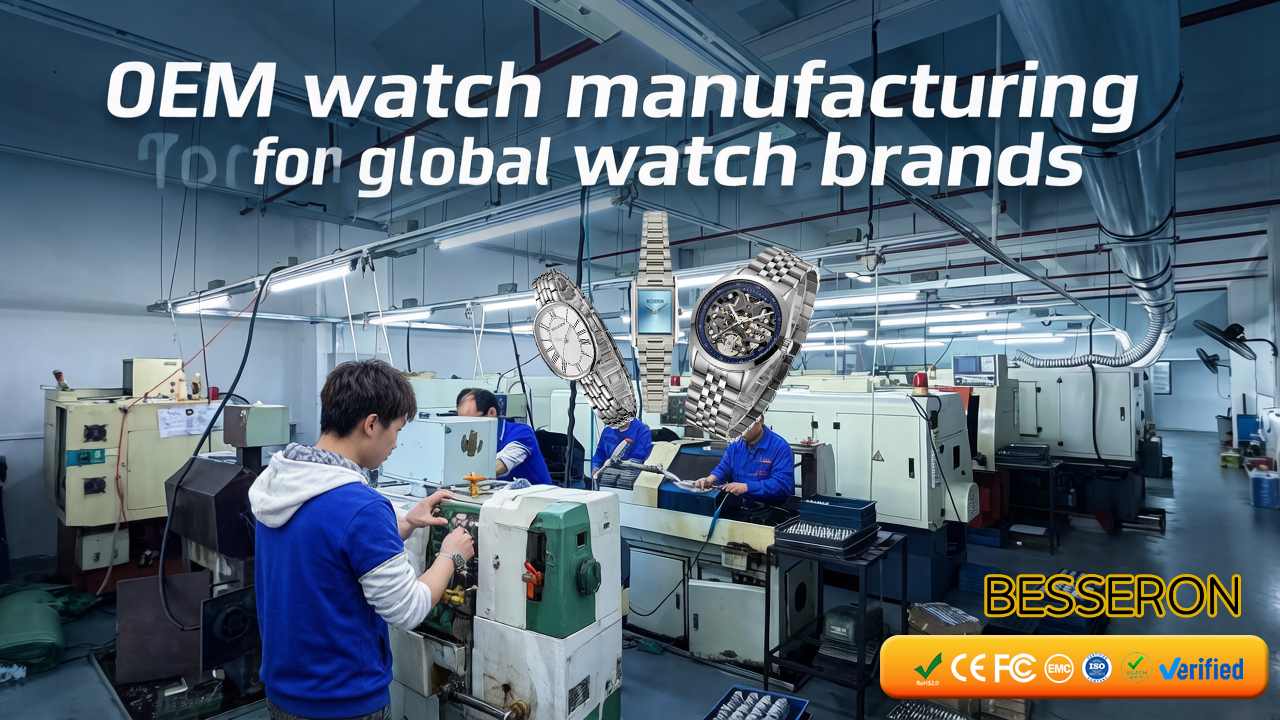
The Production Process: From Concept to Timepiece
A successful OEM watch manufacturing journey hinges on a well-defined and collaborative production process. Understanding each stage is crucial for brands to effectively communicate their vision and manage expectations with their manufacturing partner.
- Design Consultation & Feasibility Study: The process begins long before production. Brands present their concepts (often via CAD designs, sketches, or mood boards) to the OEM. The manufacturer's engineering team then assesses the design for technical feasibility, material suitability, cost implications, and potential manufacturing challenges. This stage involves crucial dialogue to refine the design for optimal production without compromising the brand's aesthetic or functional goals. Prototyping tools like 3D printing may be used early on to visualize components.
- Component Sourcing & Procurement: Once the design is finalized and approved, the OEM procures allMovements:** Sourcing high-quality quartz (e.g., Miyota, Ronda) or mechanical movements (e.g., Seiko NH series, Sellita, ETA) based on brand specifications and budget. Some OEMs offer customization options on standard movements (e.g., rotor decoration).
- Cases & Bezels: Sourcing materials (stainless steel 316L, titanium, brass, ceramics) and manufacturing cases through processes like CNC machining, casting, polishing, and finishing (PVD, DLC, plating).
- Crystals: Procuring sapphire (scratch-resistant), mineral glass (cost-effective), or Hesalite) crystals, often with anti-reflective coatings.
- Dials & Hands: Manufacturing dials (metal, enamel, meteorite) with applied indices, printing, lume application (Super-LumiNova, BGW9), and matching hand sets.
- Straps/Bracelets: Sourcing leather, stainless steel bracelets (milled or folded), nylon NATOs, rubber straps, or developing custom designs.
- Packaging: Designing and producing branded boxes, warranty cards, and instruction manuals. Reliable OEMs have established relationships with trusted suppliers for each component type, ensuring consistent quality and timely delivery.
- **Pre-Production Prototyping-production prototypes is created. These are functional samples built using the actual production methods and materials. This stage is critical for:
- Finalizing aesthetics (color matching, finishing).
- Testing functionality (movement operation, water resistance, crown operation).
- Verifying assembly processes.
- Allowing the brand to sign off on the final product before mass production.
- Manufacturing & Assembly: With prototypes approved, full production commences. This involves:
- Component Fabrication: CNC machining cases, stamping dials, cutting crystals, etc.
- Finishing: Applying surface treatments like polishing, brushing, bead-blasting, PVD/DLC coating, or plating.
- Dial & Hand Assembly: Applying lume, setting indices, attaching hands.
- Movement Preparation: Inspecting and regulating movements if necessary.
- Final Assembly (Casing Up): Carefully placing the movement into the case, attaching the dial and hands, setting the crown, and sealing the case back. This is often done in cleanroom environments.
- Water Resistance Testing: Subjecting the cased-up watch to pressure tests to ensure it meets the specified rating (e.g., 3ATM5ATM, 10ATM).
- Quality Control (QC) Check 1: Initial inspection post-assembly.
- Final Quality Control (QC) & Testing: After assembly, watches undergo rigorous final QC:
- Visual Inspection: Scrutinizing for cosmetic defects (scratches, dust under crystal, misaligned markers/hands, printing flaws).
- Functional Testing: Verifying timekeeping accuracy, chronograph functions (if applicable), crown operation, bezel rotation.
- Final Regulation: Fine-tuning mechanical movements for optimal accuracy.
- durability under various conditions.
- Packaging & Logistics: QC-passed watches are carefully packaged into their branded boxes with all accessories (warranty cards, manuals, adjustment tools). The OEM then coordinates logistics, handling customs documentation and shipping to the brand's designated locations globally. Reputable OEMs offer flexible shipping terms (FOB, CIF, DDP).
Material Selection: Balancing Aesthetics, Durability, and Cost
The choice of materials profoundly impacts a watch's look, feel, performance, longevity, and price point. An experienced OEM partner provides invaluable guidance on selecting the optimal materials for a brand's vision and target market.
Watch Cases & Bezels: * Stainless Steel (316L): The industry standard. Offers excellent corrosion resistance, durability, hypoallergenic properties, and a premium feel. Highly polishable and versatile for various finishes. Cost-effective for quality. * Titanium: Significantly lighter than steel, highly corrosion-resistant, and hypoallergenic. Offers a distinct modern, greyish hue. Can be more challenging to machine and finish, often resulting in a higher cost. * Brass: Often used as a base metal for plated finishes (gold, rose gold, gunmetal). Less cost-effective. * Ceramics: Extremely scratch-resistant, lightweight, and hypoallergenic. Offers a unique matte or polished finish. Brittle and susceptible to shattering from significant impact. Higher cost due to complex sintering process. * Carbon Fiber: Lightweight, strong, and provides a distinctive modern texture. Complex to machine precisely. Cost varies. * Plastics/Resins: Used for very specific, often fashion-forward or lightweight sports designs (e.g., G-Shock style). Cost-effective but generally perceived as lower-tier in traditional watch categories.
- Crystals:
- Sapphire Crystal: The choice. Extremely scratch-resistant (Mohs 9). Can be coated with anti-reflective treatment on the underside or both sides for superior clarity. Higher cost.
- Mineral Glass: More scratch-prone than sapphire (Mohs 5) but significantly more resistant than acrylic. Cost-effective. Can be hardened for improved scratch resistance.
- Acrylic (Hesalite): Scratch-prone but easy to polish. Offers a warm, vintage aesthetic. Lightweight and shatter-resistant. Lower cost.
- Straps & Bracelets:
- Stainless Steel Bracelets: Durable, comfortable (when well-designed),/milled (higher quality, cost) or folded links (lighter, more cost-effective). Finishes must match the case.
- Leather Straps: Offer classic elegance and comfort. Vast range in quality (full-grain, top-grain, genuine leather) and type (calfskin, ostrich, alligator - often embossed). Requires treatment for water resistance.
- Rubber/Silicone Straps: Excellent for sports/dive watches. Highly water-resistant, durable, and comfortable. Can be molded or vulcanized.
- Nylon Straps (NATO/Zulu): Casual, durable, and versatile. Numerous color/pattern options. Cost-effective.
- Titanium Bracelets: Offer the same benefits as titanium cases – lightweight and hypoallergenic. Higher cost.
An OEM manufacturer guides brands through these choices, considering the target price point, intended use (dress, dive, pilot, everyday), desired aesthetic, and required durability.
Quality Control: Ensuring Excellence at Every Step
Robust Quality Control (QC) is non-negotiable in watch manufacturing. It safeguards the brand's reputation and ensures customer satisfaction. A reputable OEM partner will have stringent, multi-stage QC protocols integrated throughout the production process.
- Incoming Component QC: All sourced components (movements, cases, dials, hands, crystals, straps) undergo inspection upon arrival at the factory. This checks for conformity to specifications, cosmetic defects, and functional integrity (e.g., testing a sample of movements).
- In-Process QC: During manufacturing and assembly, QC checks are performed at critical junctures (e.g., post-CNC machining, post-finishing, post-dial assembly, post-casing up). This allows for early detection and correction of issues.
- Pre-Shipment QC (Final Inspection): The most comprehensive check occurs after the watch is fully assembled and packaged (or just before packaging). This typically involves:
- 100% Visual Inspection: Every single watch is examined meticulously under bright light and magnification for any cosmetic flaws – case scratches, dial imperfections (dust, misaligned markers, printing errors), hand alignment, crystal clarity, bracelet/strap flaws, clasp function, and packaging defects.
- 100% Functional Testing: Checking timekeeping accuracy (often over a 24-48 hour period), power reserve (for automatics), crown operation (setting time, date, winding smoothness), bezel rotation (if applicable), button function (chronographs), and luminosity.
- Water Resistance Testing: A significant sample (often 100% for dive watches, or a large percentage for others) is tested using specialized equipment (dry or wet pressure testers) to verify it meets the declared water resistance rating.
- Regulation (Mechanical Watches): Fine-tuning the movement to ensure it runsances (e.g., -10/+20 seconds per day).
- QC Documentation: Detailed QC reports, often including photos of inspected watches, should be available for the brand's review. Some OEMs offer online portals for real-time QC tracking.
- International Standards: Leading OEMs adhere to international quality standards such as ISO 9001, which provides a framework for consistent quality management systems.
Brands should discuss QC procedures in detail with potential OEM partners, request sample reports, and understand their defect tolerance levels and corrective action processes.
Branding & Customization: Making the Watch Uniquely Yours
OEM manufacturing a brand's unique identity to life. A capable OEM partner offers extensive customization options to differentiate the brand's products in a crowded marketplace.
- Dial Customization: This is the most prominent branding element.
- Logo Application: Precision placement of the brand's logo, typically via metal appliqué (affixed plate), printing (pad, screen), or laser engraving.
- Dial Text & Printing: Customizing text (brand name, model name, place of design), depth ratings, and other information using various printing techniques.
- Color & Texture: Unique dial colors (sunray, matte, gradient) and textures (grainy, linen, carbon pattern) achieved through specialized painting or finishing processes.
- Index Design: Custom shapes for hour markers (applied or printed), often involving specific lume application.
- Hand Design: Creating unique hand shapes (sword, dauphine, mercedes) and matching lume color.
- Case & Case Back Branding:
- Engraving: Laser or mechanical engraving of the brand name, logo, or unique serial numbers on the case back or side.
- Medallions: Inserting a custom-designed metal medallion into the case back.
- Movement Customization (Limited): While modifying the core mechanics is complex, options include:
- Rotor Engraving/Decoration: Adding the brand logo or a unique pattern to the automatic rotor.
- Movement Finishes: Perlage, Geneva stripes, or blued screws applied to visible movement parts (requires exhibition case back).
- Crystal Etching: Subtly etching the brand logo onto the crystal (usually the underside).
- Strap/Bracelet Branding: Embossing or debossing the logo on leather straps, or engraving it on the buckle/clasp of bracelets and straps.
- Packaging: Fully customized boxes, pillow inserts, warranty cards, instruction manuals, and outer shipping cartons featuring the brand's logo, colors, and. Eco-friendly packaging options are increasingly requested.
The level of customization depends on the Minimum Order Quantity (MOQ) and budget. An experienced OEM guides brands on the feasibility and cost implications of specific customization requests.
Case Study: Launching a Microbrand Dive Watch - Oceana Co.
Background: Oceana Co., a startup microbrand based in Australia, envisioned a robust, affordable 200m dive watch with a unique textured dial and strong lume. They lacked manufacturing expertise and capital for tooling.
Challenge: Finding an OEM partner capable of producing a high-quality dive watch with custom elements at a feasible MOQ and cost, ensuring reliable water resistance and meeting launch deadlines.
Partner Selection: Oceana researched several OEMs, focusing on those with proven dive watch experience, transparent communication, clear QC processes (especially water resistance testing), and willingness to work with smaller MOQs. They selected an established OEM in Asia known for its dive watch specialization.
Collaboration & Process:
- Design Refinement: The OEM's engineers reviewed Oceana's initial designs. They suggested modifications to the case back gasket channel for enhanced water resistance and advised on optimal crown tube length and threading. They also provided material recommendations (316L steel, sapphire crystal with underside AR coating, ceramic bezel insert).
- Prototyping: The OEM created 3D renders followed by physical prototypes. Two iterations were needed to perfect the unique "wave pattern" dial texture and the custom hand shape.
- Material Sourcing: The OEM sourced a reliable Seiko NH35 automatic movement, high-grade 316L steel, Super-LumiNova BGW9 (blue emission) for the dial and hands, and a custom ceramic bezel insert with a lumed pip.
- Production & QC: Oceana opted for a 300-unit initial run. The OEM implemented strict QC:
- Incoming: Verified movement accuracy and lume brightness.
- Assembly: Ensured precise lume application and hand alignment.
- Water Resistance: 100% of watches underwent dry pressure testing to 250m (exceeding the 200m rating).
- Final QC: Every watch underwent 48-hour accuracy testing and thorough visual inspection. Oceana received detailed QC reports with photos.
- Branding: Custom elements included the Oceana logo applied on the dial, unique wave-textured dial, custom hour hand shape, logo engraving on the case back and clasp, and custom-designed recycled PET box packaging.
Outcome & Success:
- High Quality: Excellent customer feedback on build quality, lume performance, and water resistance reliability. Very low return rate (<1%).
- On-Time Delivery: Watches arrived at Oceana's warehouse in Australia 3 weeks ahead of the planned launch date.
- Brand Identity: The unique dial texture and hand design became strong brand identifiers.
- Scalability: The successful partnership allowed Oceana to launch a second model (a GMT) 9 months later with the same OEM, leveraging existing trust and processes.
Key Takeaways for Brands:
- Expertise Matters: Choosing an OEM with specific experience in your watch type (e.g., dive) is crucial.
- Communication is Key: Clear, frequent communication throughout the process prevents misunderstandings.
- Prototyping is Essential: Never skip the prototyping stage to validate design and function.
- Invest in QC: Rigorous QC, especially for critical features like water resistance, protects your brand reputation.
- Start Small: Microbrands can successfully launch with manageable MOQs by partnering with the right OEM.
Choosing the Right OEM Partner: Key Considerations for Global Brands
Selecting an OEM manufacturer is one of the most critical decisions for a watch brand. It requires thorough due diligence.
- Experience & Specialization: Does the OEM have a proven track record producing watches similar to your desired type (dive, dress, pilot, chronograph)? Ask for case studies and references.
- Technical Capability: Can they execute your specific design features? Inquire about their machinery (CNC capabilities, finishing techniques), access to specific movements, and experience with desired materials.
- Minimum Order Quantity (MOQ): What is the minimum number of units required per model? This is crucial for microbrands. MOQs can vary significantly (e.g., 100-300 units for basic models, higher for complex designs or lower per-unit costs). Understand the factors influencing MOQ (complexity, customization level).
- Communication & Responsiveness: Is the OEM proactive, clear, and responsive in communication? Do they have English-speaking staff? Time zone differences need to be manageable. Look for transparency and willingness to answer questions thoroughly.
- Quality Control Processes: Request detailed information on their QC protocols at every stage. Ask about defect rates, water resistance testing procedures, and how QC failures are handled. Do they provide QC reports?
- Pricing Structure & Transparency: Understand the cost breakdown. What is included (materials, labor, basic packaging, standard QC)? What are costs for extras (customization, premium packaging, expedited shipping)? Be wary of quotes significantly lower than others without clear justification.
- Lead Times: Get realistic estimates for each stage (prototyping, production, shipping). Understand factors that can impact timelines.
- Ethical & Compliance Standards: Does the factory adhere to ethical labor practices? Can they provide compliance documentation if required? Are they open to audits?
- Intellectual Property (IP) Protection: Ensure the contract includes strong confidentiality clauses and clear IP ownership terms for your designs. Trust is paramount.
Recommendation: Visit the factory if possible. If not, conduct extensive video calls, request detailed documentation, and start with a small, less complex order to test the partnership before committing to flagship products.
Q1: What does OEM mean in watch manufacturing? A: OEM stands for Original Equipment Manufacturer. It means a factory produces watches based entirely on another company's (the watch brand's) designs, specifications, and branding. The final product is sold under the watch brand's name.
Q2: What is the typical MOQ for custom OEM watch production? A: MOQs vary significantly based on the OEM, the complexity of the watch design, and the level of customization 100 to 500 units per watch model. Simpler designs or manufacturers catering specifically to microbrands might offer lower MOQs (e.g., 50-100 units), while highly complex designs may require higher MOQs (500+). Discuss your specific needs directly with potential partners.
Q3: How long does the entire OEM watch production process take? A: Lead times depend heavily on design complexity, customization level, component availability (especially movements), MOQ size, and the OEM's current workload. A typical timeline might be:
- Design Feasibility & Prototyping: 4-8 weeks
- Component Sourcing &-Production: 4-8 weeks
- Mass Production: 8-12 weeks (for MOQ of ~300 units)
- QC & Shipping: 2-4 weeks This totals roughly 4 to 8 months from design approval to delivery. Complex projects or delays in component sourcing can extend this.
Q4: Can OEM watch manufacturers help with watch design? A: Many OEMs offer design support services. While the core concept usually comes from the brand, OEM engineers can provide crucial input on technical feasibility, manufacturability, material selection, cost optimization, and component compatibility. They can translate brand sketches or ideas into technical drawings for production. Some.
Q5: How do OEMs watch ensure quality control? A: Reputable OEMs implement multi-stage QC:
- Incoming QC: Checking sourced components.
- In-Process QC: Checks during manufacturing stages.
- Final QC (Pre-Shipment): 100% visual inspection, functional testing (accuracy, power reserve, crown/button function), water resistance testing (on a sample or 100% basis), and regulation. They provide QC reports. Look for adherence to standards like ISO 9001.
Q6: What level of customization is possible with an OEM watch ?
A: Extensive customization is possible, including:
- Dial: Custom logo (appliqué, print, engrave), text, colors, textures, indices, hands.
- Case: Engraving, case shape (within tooling constraints), finishes.
- Case Back: Engraving, medallions.
- Movement: Rotor decoration (engraving, perlage).
- Crystal: Etching (underside).
- Straps/Bracelets: Buckle/clasp engraving, leather embossing.
- Packaging: Fully custom boxes, inserts, paperwork. Cost and MOQ can influence the feasibility of highly unique customizations.
Q7: What are the biggest challenges when working with an OEM watch ?
A: Common challenges include:
- Communication Barriers: Language and time zone differences.
- Quality Consistency: Ensuring the OEM maintains high standards batch after batch.
- Lead Time Management: Delays in component sourcing or production.
- Intellectual Property Protection: Safeguarding designs.
- Finding the Right Partner: Vetting manufacturers thoroughly. Clear communication, detailed specifications, regular updates, prototypes, and strong contracts help mitigate these.
Q8: How much does OEM watch manufacturing cost per unit?
A: Unit costs vary dramatically based on:
- Movement Type: Mechanical (especially Swiss) > Premium Quartz > Standard Quartz.
- Materials: Sapphire crystal, titanium, ceramic > Mineral crystal, 316L steel, brass.
- Complexity: Chronograph, GMT > Simple 3-hand. Number of components.
- Finishing: Polishing, PVD/DLC coating, intricate dial work add cost.
- Customization Level: Extensive custom branding increases cost.
- MOQ: Higher MOQs generally lower the per-unit cost. Expect a range from $50-$150 USD for a simple quartz watch (high MOQ) to $200-$500+ USD for a mid-range automatic with sapphire and customization (medium MOQ). Get detailed quotes based on your specific design.
Q9: Can OEMs handle shipping and logistics?
A: Yes, most established OEMs offer comprehensive logistics services. This includes:
- Professional packing for transit.
- Handling export documentation (commercial invoice, packing list).
- Arranging freight (sea or air).
- Coordinating customs clearance (often on a DDP - Delivered Duty Paid - basis, where the OEM covers duties/taxes to the destination country, simplifying it for the brand). Clarify shipping terms (FOB, CIF, DDP) and costs upfront.
Q10: How do I protect my watch design when working with an OEM?
A: Protection involves:
- Confidentiality Agreements (NDA): Sign a robust NDA before sharing sensitive design information.
- Clear Contract: Ensure the manufacturing contract explicitly states that all designs, tooling (if funded by you), and specifications are your exclusive intellectual property. The OEM cannot use them for others or sell similar designs.
- Tooling Ownership: If you pay for custom molds or tooling (e.g., for a unique case), stipulate in the contract that you own these assets.
- Due Diligence: Partner with reputable, established OEMs known for respecting IP.


