
For the aspiring entrepreneur, the journey to launch a private label watch brand is one of the most rewarding ventures in the luxury consumer goods sector. In the current global market, particularly across the United States and Australia, the "Microbrand" movement has proven that success is no longer reserved for heritage Swiss houses. Today, a watch brand builder can leverage high-end manufacturing capabilities in China to produce timepieces that rival heritage brands in quality, at a fraction of the traditional cost.
However, the transition from a passionate idea to a container of sellable inventory requires a meticulous, structured approach. As a premier watch manufacturer in China with a 60-year heritage, BESSERON has guided thousands of founders through this process. This comprehensive guide serves as a strategic blueprint for B2B buyers, outlining every critical stage of the watchmaking lifecycle—from niche selection to global logistics.
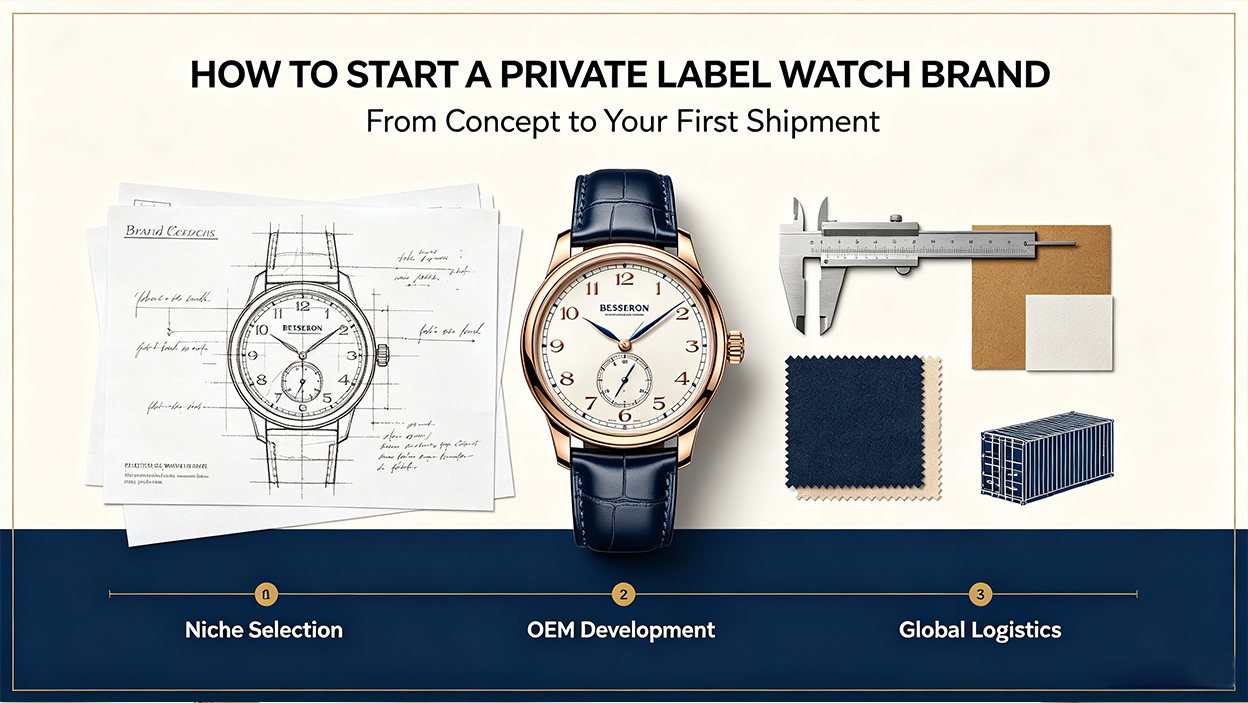
The first step in starting a watch brand is not design; it is data. The US market is highly segmented. Are you targeting the "Everyday Carry" (EDC) enthusiast, the "Quiet Luxury" minimalist, or the "High-Energy" sports fan?
Before contacting a private label watch manufacturer, you must decide on your core product line. The most successful entry points for 2024-2025 include:
Study the current top-selling microbrands on platforms like Shopify and Amazon. Identify their pain points—perhaps their water resistance is low, or they use mineral glass instead of sapphire. Positioning your brand as the "high-spec" alternative is the most effective way to gain early traction.
Once your niche is defined, the design phase begins. This is where your brand's unique "DNA" is established. For a watch brand builder, the goal is to create a silhouette that is familiar yet distinct.
A professional oem watch manufacturer like BESSERON requires a detailed technical brief. This includes:
In modern manufacturing, we move quickly from sketches to 3D CAD (Computer-Aided Design) files. This allows you to see the watch in high definition from every angle, ensuring the "Integrated" bracelet flows perfectly or the "Tank" proportions are historically accurate before any metal is cut.
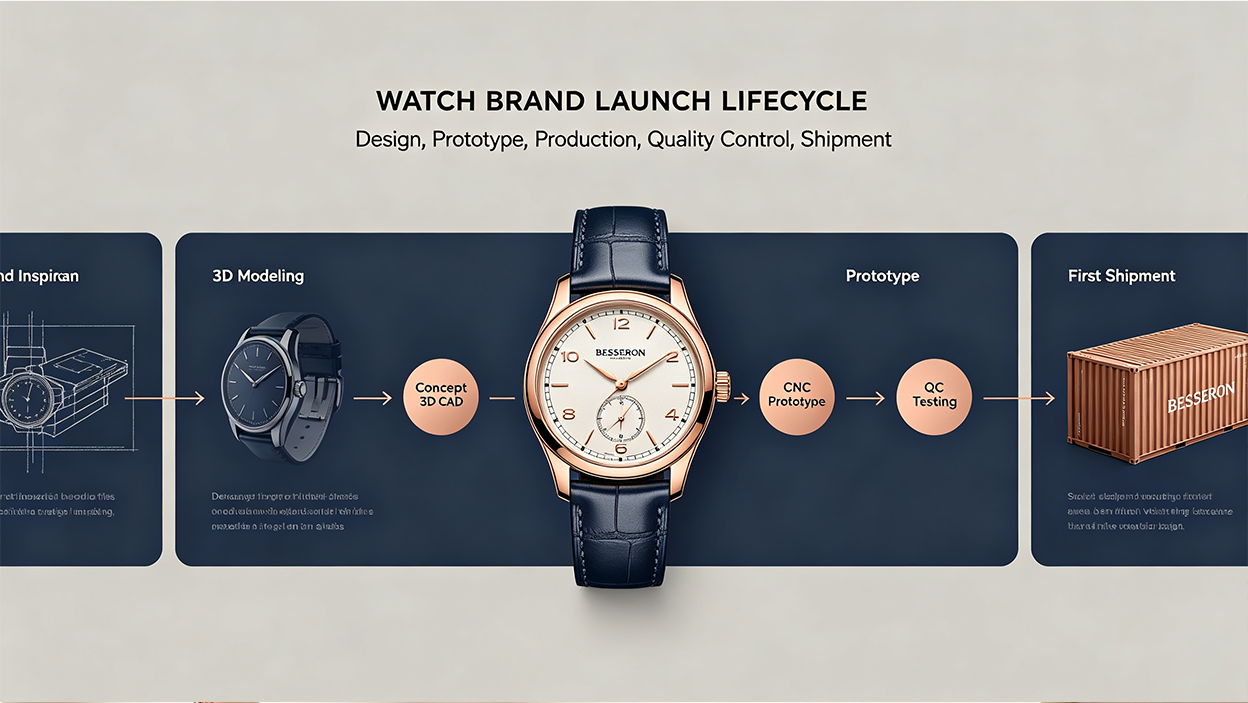
Selecting a watch manufacturer in China is the most consequential decision you will make. For US-based brands, the ideal partner must offer a combination of "Heritage Expertise" and "Modern Flexibility."
Before mass production, you must see and feel a physical prototype. This is the "Moment of Truth" for any watch brand builder.
The prototype is also your primary marketing tool. It will be used for professional photography, influencer gifting, and "Pre-Order" campaigns on social media.
As a custom automatic watch manufacturer, we cannot overstate the importance of the "Spec Sheet." In the US watch community, your specs are your reputation.
By building your brand on 316L Steel and Sapphire, you are positioning yourself in the "Mid-to-High-End" segment, allowing for better profit margins and a more loyal customer base.
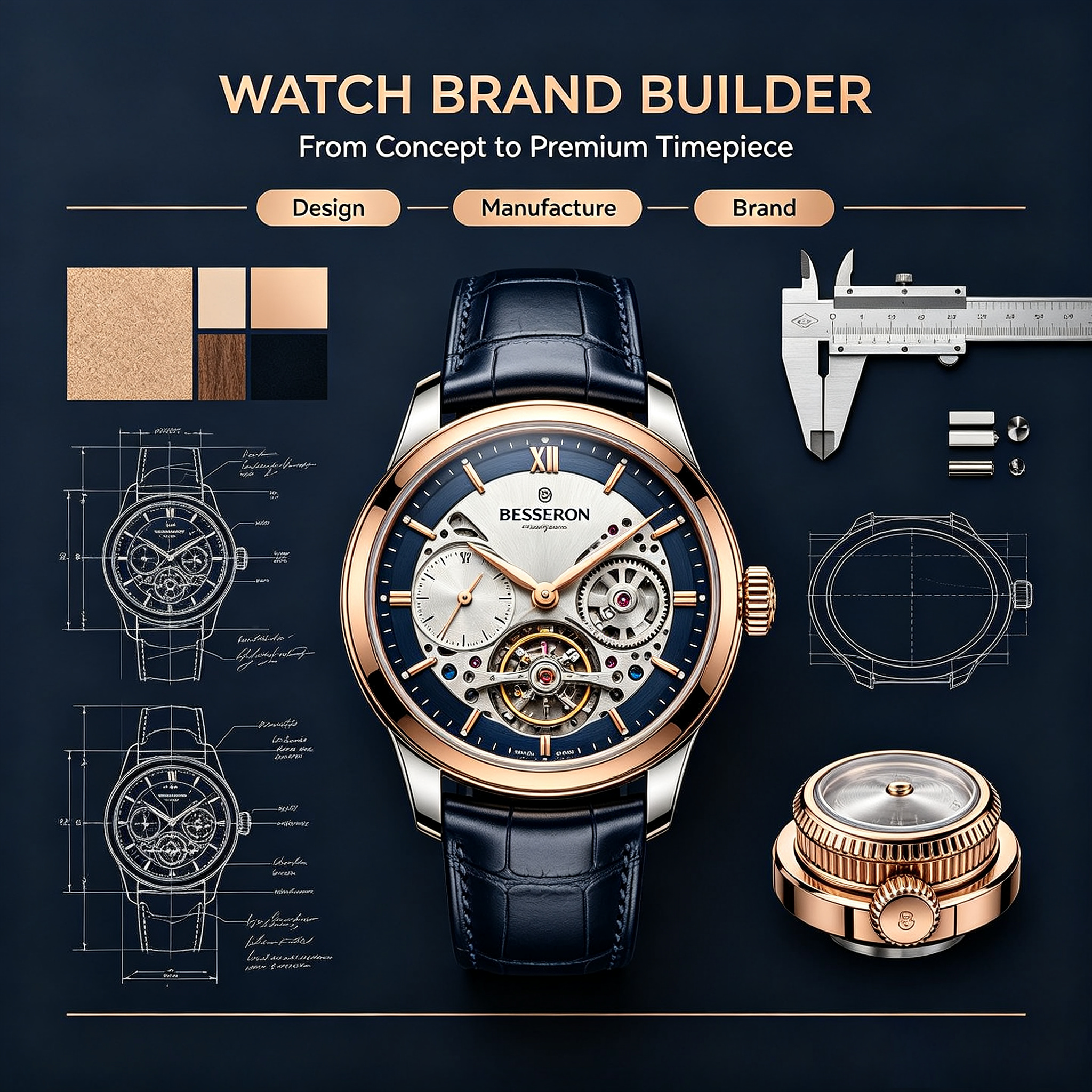
Once the prototype is approved, mass production begins. For a watch brand builder, this is the stage of maximum risk, which is why BESSERON employs a "Gate-to-Gate" quality control system.
Importing watches into the US (CBP) or Australia requires strict adherence to trade regulations. Partnering with a compliant watch manufacturer in China simplifies this process.
BESSERON provides all-round considerate services, handling the technical documentation so you can focus on your marketing strategy.
Your watch is ready. Now you must sell it. For modern watch brand builders, the "Visual-First" approach is key.
[BESSERON ADVANTAGE SECTION] BESSERON WATCH MANUFACTURER is a top-tier integrated watch manufacturing group, anchored by a 60-year time-honored watchmaking heritage. As a benchmark leading factory in the global custom watch segment, we have focused on customized watch manufacturing for over 25 years.
Serving worldwide brands, distributors, and emerging Watch Brand Builders, BESSERON offers a unique combination of "Legacy Expertise" and "Modern Innovation." Every timepiece we produce is constructed from 316L medical-grade stainless steel and features scratch-resistant sapphire glass as a standard configuration. By utilizing precision Japanese movements (Automatic or Quartz), we ensure that your brand is built on a foundation of reliability. Our OEM/ODM services are designed to be a one-stop solution, offering everything from initial R&D and 3D design to mass production and global compliance certification (BSCI/ISO). We have accumulated decades of genuine customer testimonials, gaining recognition for our Premium Quality and All-round Considerate Services. Whether you are an established brand or an emerging microbrand, BESSERON is the manufacturer that helps you build watch brands that sell.
Q1: What is the typical MOQ for starting a new watch brand with BESSERON? A1: For a full-custom OEM project, the standard MOQ is 300-500 pieces per model. However, for emerging microbrand watch manufacturers, we offer flexible options to split colors or dial styles within the same case design.
Q2: How much does it cost to develop a prototype? A2: Prototype costs generally range from $500 to $1,500 depending on the complexity of the case and the movement. This fee is often refundable or applied to your first mass production order.
Q3: Can I get my brand logo on the dial, crown, and case-back? A3: Absolutely. As a specialized custom logo watch manufacturer, we provide high-definition logo application across all three areas as part of our standard service.
Q4: Do you help with the US and Australian customs paperwork? A4: Yes. We provide a complete documentation package, including country-of-origin declarations, material safety reports, and BSCI compliance records to ensure a smooth import process.
Q5: What is the typical timeline from design to final shipment? A5: A typical journey takes about 4-6 months: 1 month for design and CAD, 1.5 months for prototyping, and 2-3 months for mass production and final QC.

