
The most common question that watch brand founders ask, and the one that generates the most misleading answers, is "How much does it cost to manufacture a custom watch?" The honest answer is that it depends on approximately forty variables. But the useful answer — the one that enables founders to plan budgets, set prices, and evaluate supplier quotes intelligently — is a structured breakdown of where costs originate, how they scale with volume, and where suppliers are most likely to obscure them.
This guide provides that structured breakdown. It is based on real FOB pricing data from the mid-to-high-end Chinese watch manufacturing sector, normalized to 2025 market conditions. It covers every significant cost component in a custom watch production order, from the movement to the shipping carton.
A custom automatic wristwatch manufactured by a Chinese OEM or ODM watch factory comprises approximately ten major cost components. Each component's share of the total cost varies with specification, volume, and customization depth. Understanding these cost relationships is the difference between negotiating from a position of knowledge and accepting whatever price the supplier quotes.
The movement is typically the single most expensive component in a custom automatic watch. At wholesale, current pricing for the most commonly used calibers is:
Movement cost is largely non-negotiable. Miyota, Seiko, ETA, and Sellita operate through authorized distribution channels with published pricing. A manufacturer offering a Miyota 9015 for 65 is not offering you a deal; they are installing a counterfeit or a reclaimed movement.
The case is the second-largest cost component and the one with the greatest variability. A standard 316L stainless steel case with brushing and minimal polishing, using an existing ODM platform, costs 20 at production volumes of 300 to 500 units. A custom OEM case with a proprietary mold, complex geometry, and mixed finishing (brushed and polished surfaces) costs 45 at similar volumes. A 904L stainless steel case costs 25% to 30% more than an equivalent 316L case. A titanium case costs 40% to 60% more than an equivalent 316L case.
The matching stainless steel bracelet typically costs 20 depending on link design complexity, finishing quality, and clasp type. A milled clasp with push-button release costs more than a stamped clasp, but the quality difference is immediately apparent to the customer.
Case mold investment is separate from per-unit production cost. A custom case mold for cold extrusion costs 3,500 depending on complexity. This is a one-time investment, and the mold is your property — it should be documented as such in the manufacturing contract.
Custom dial pricing depends on material, finishing, printing complexity, and index type. A brass dial with standard sunburst finishing, pad-printed logo and text, and printed indices costs 7. The same dial with applied metal indices costs 10. A dial with custom Pantone-matched lacquer color, applied indices, and Super-LumiNova lume costs 15. Special materials — mother-of-pearl, meteorite, carbon fiber, enamel — add 200-plus depending on material rarity and processing difficulty.
Custom hand sets cost 4 depending on profile complexity, finishing, and lume application. Standard dauphine, baton, or sword hands without lume are at the lower end; custom-profile hands with Super-LumiNova application are at the higher end.
Sapphire crystal with anti-reflective coating costs 6 for flat crystals and 10 for domed crystals. Mineral glass costs 2 and is appropriate only for watches below 300-plus segment should use sapphire as a baseline — the cost difference is too small to justify the quality compromise.
A standard stainless steel crown with logo engraving costs 2.50. A screw-down crown for dive watches costs slightly more. Custom crown profiles add mold costs of 800.
Gaskets cost pennies per unit but are disproportionately responsible for QC failures. Crown gaskets, case-back gaskets, and crystal gaskets should be specified by material (nitrile or silicone) and replaced on a defined schedule during production.
Leather straps from quality suppliers cost 8. FKM rubber straps cost 5. NATO and fabric straps cost 3. Exotic leather straps cost 40-plus depending on material and source.
Assembly labor, movement regulation, pressure testing, and final QC represent the manufacturer's value-add. The cost difference between a manufacturer that batch-tests water resistance and one that individually tests every watch is approximately 4 per unit — and it is worth every penny.
Packaging costs are covered in detail in our packaging guide, but in summary: rigid paperboard box with custom printing costs 5, leatherette box costs 8, and premium packaging with additional elements costs 20.
Watch manufacturing exhibits significant economies of scale, but they are not linear. The largest per-unit cost reductions occur between 100 and 500 units. Beyond 1,000 units, additional volume discounts are modest.
At 50 to 100 units, per-unit costs are 20% to 40% higher than at 500 units because setup costs (machine programming, material procurement, assembly line configuration) are amortized over fewer units.
At 300 to 500 units, per-unit costs stabilize at "standard" pricing, with setup costs fully amortized and production running at efficient batch sizes.
At 1,000-plus units, additional discounts of 5% to 15% may be available, primarily from material volume pricing rather than labor savings.
Sample and prototyping costs. Expect to spend 1,500 on samples before production begins, depending on the number of sample rounds required. This cost is often credited against the production order if you proceed, but confirm this policy with your manufacturer before committing.
Shipping and logistics. Air freight for a 200-unit order typically costs 800. Ocean freight for a 500-plus-unit order costs 600. Customs duties, brokerage fees, and destination handling add 4% to 8% to the invoice value.
Mold and tooling costs. Custom case molds, dial stamping dies, and custom hand profile tooling are one-time investments ranging from 8,000 depending on complexity. These costs should be clearly separated from per-unit production costs in supplier quotations.
QC and inspection costs. Independent pre-shipment inspection costs 800. Inbound QC equipment — a timing machine, a pressure tester — costs 500 if you choose to perform receiving inspection in-house.
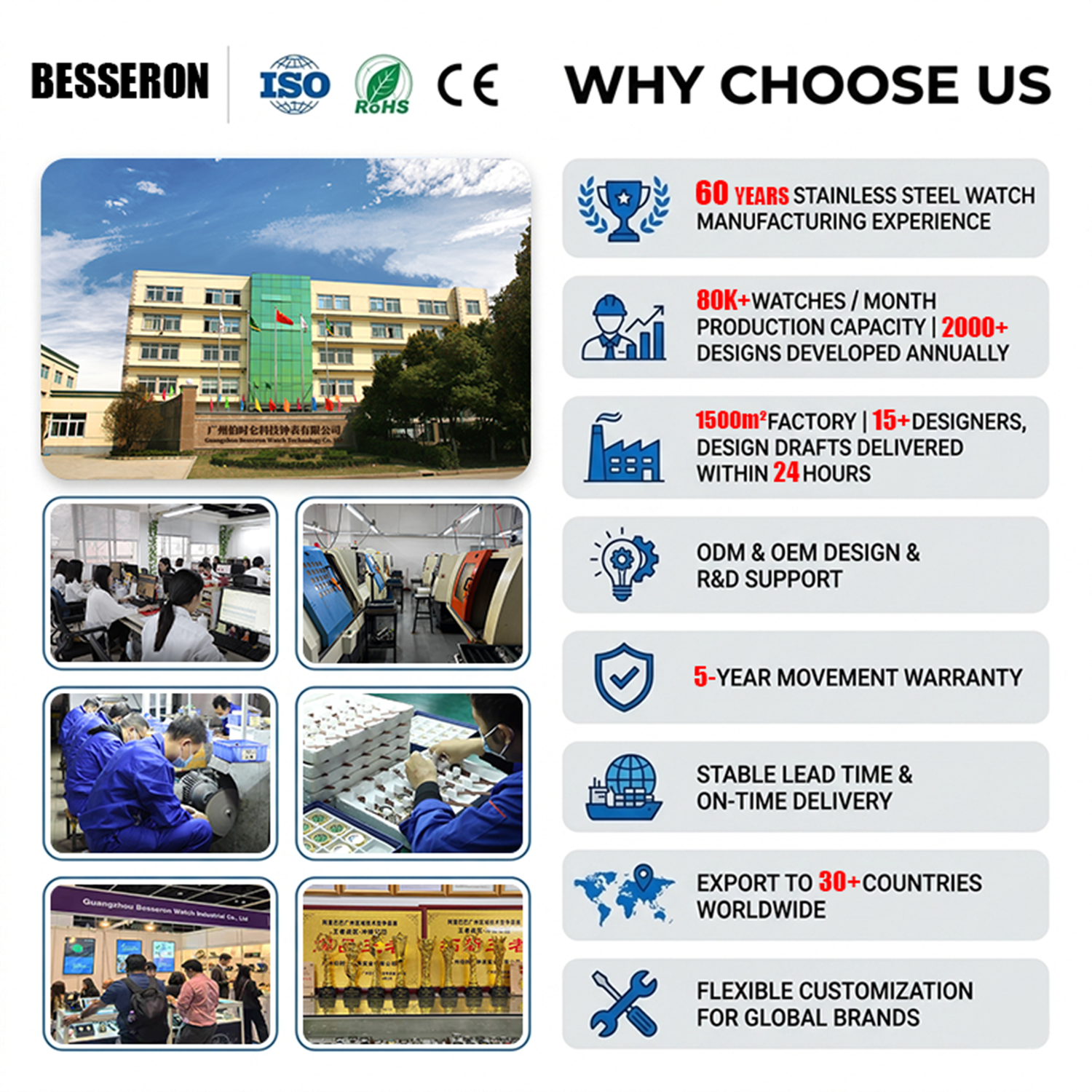
At BESSERON, our quotations break down costs by component. We believe that a brand founder who understands where their money is going makes better decisions — for their brand and for the production relationship. Every quotation includes a line-item breakdown of movement, case, dial, hands, crystal, crown, strap, assembly, and packaging costs. There are no bundled line items that obscure component-level pricing.
Q: What should a 300-unit order of custom automatic watches cost at the FOB level?
A: For a mid-range ODM watch with Seiko NH35 movement, 316L case with brushing and polishing, custom brass dial with applied indices, sapphire crystal, stainless steel bracelet, and custom packaging, expect an FOB cost of 100 per unit at 300 units. With Miyota 9015 movement and upgraded finishing, expect 130 per unit. These ranges are guidelines; actual pricing depends on your specific specifications and your manufacturer's cost structure.
Q: How much should I budget for sample development before production?
A: Budget 1,500 for two to three rounds of samples. The first sample round costs 600, and subsequent rounds cost 400 each depending on the extent of revisions. Many manufacturers credit sample costs against the production order, but this should be confirmed before committing.
Q: Why do some manufacturers quote significantly lower prices than others?
A: Price differences between manufacturers reflect differences in material quality (genuine 316L vs lower-grade alloy), QC rigor (individual testing vs batch sampling), finishing quality (experienced polishers vs automated finishing), and assembly precision (regulated movements vs factory-default timing). A manufacturer quoting 30% below the market for equivalent specifications is almost certainly cutting corners in ways that will manifest as quality problems. The lowest quote is rarely the best value.
Q: How do payment terms work for custom watch manufacturing orders?
A: Standard terms for first-time partnerships are 30% deposit with order confirmation and 70% balance before shipment, after pre-shipment inspection approval. For established relationships, 30% deposit with 70% against copy documents (payment after shipment but before delivery) is common. Alibaba Trade Assurance provides additional buyer protection for qualifying orders.
Q: What additional costs should I factor in beyond the FOB price?
A: Beyond the FOB price, budget for international shipping (air or ocean freight), US customs duties (typically 4% to 8% of invoice value), customs brokerage fees (400), destination port handling, domestic transportation to your warehouse, and inbound QC inspection (equipment and/or third-party inspection). Together, these add 12% to 20% to the FOB cost, converting it to a landed cost at your US warehouse.
Ready to get an accurate quotation for your custom watch project? Contact BESSERON for a transparent, component-level cost breakdown for your OEM, ODM, or Private Label watch manufacturing order.

