
The tactile experience of a watch — the first moment a potential customer lifts your timepiece from its display and feels its weight, its cool metal surface, the articulation of its bracelet links — is the moment when curiosity becomes desire. It happens before the customer checks the time, before they inspect the dial, before they even consciously register the brand name. Within the first two or three seconds of physical contact, the customer has formed a judgment about your watch's quality that every subsequent interaction will either confirm or contradict.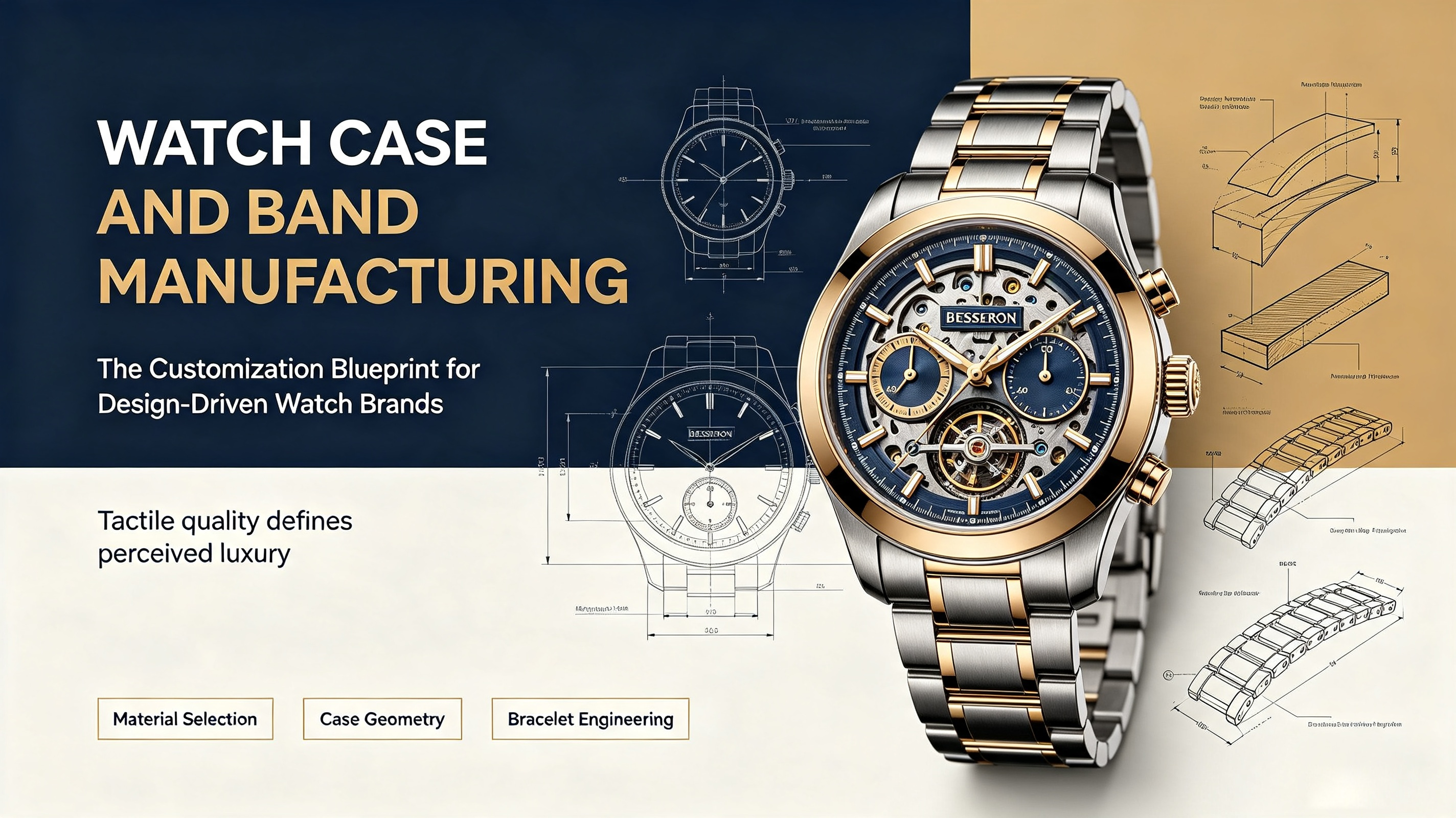
That judgment is shaped almost entirely by two components: the case and the band. Together, they represent approximately 60% to 70% of a watch's manufacturing cost, 80% of its tactile perception, and arguably the most powerful lever available to brand founders seeking to differentiate their products in a crowded market.
This blueprint provides watch brand founders with a comprehensive framework for customizing cases and bands. It covers material selection, case geometry, finishing technologies, bracelet engineering, and strap sourcing — all from the perspective of a brand founder who needs to translate design intent into manufacturable products that meet the expectations of discerning US customers.
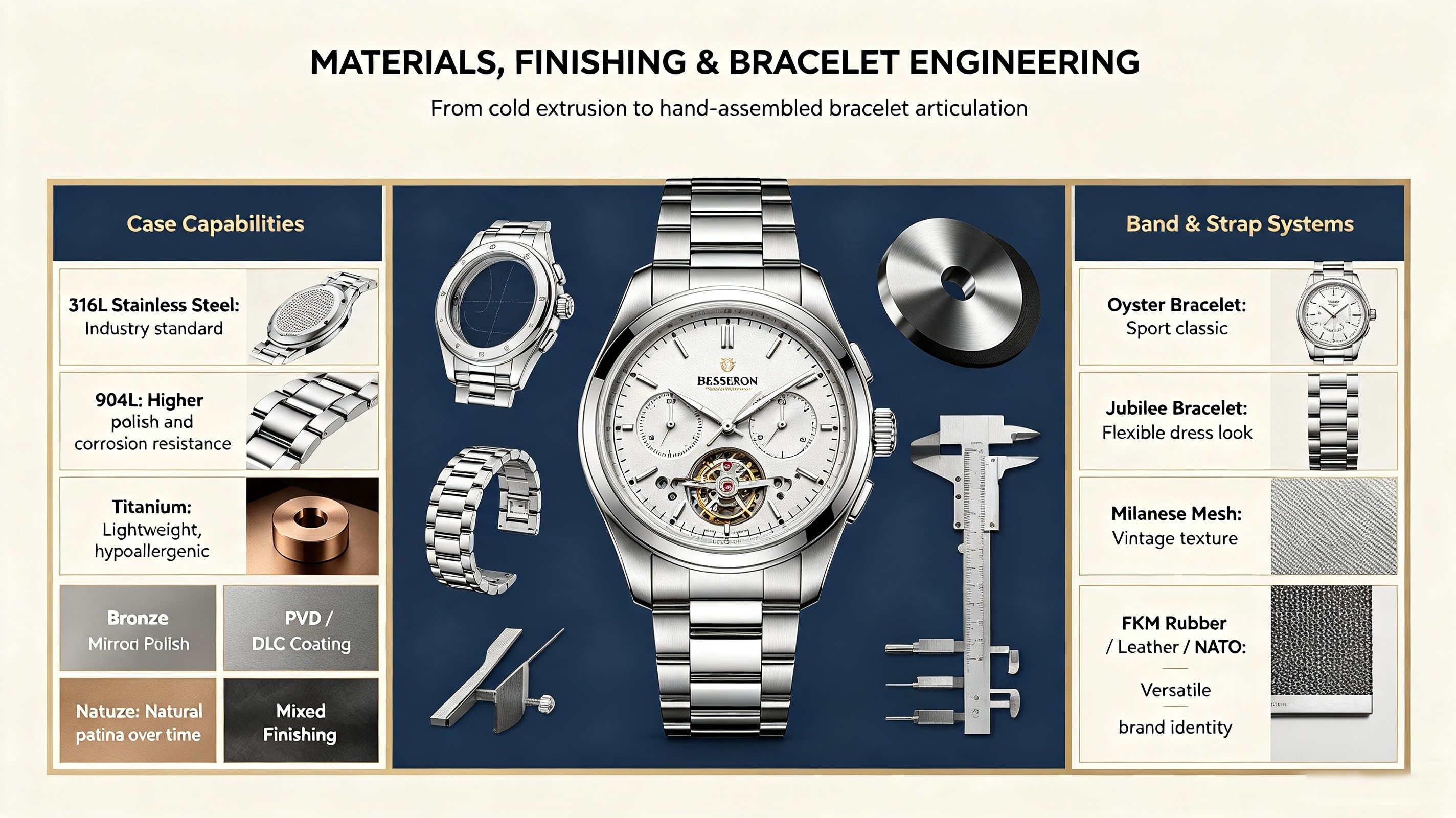
The material choice for a watch case determines not only its appearance but its weight, its thermal behavior, its corrosion resistance, and — critically — the first tactile impression it makes on a customer.
For the vast majority of watch brands operating in the 1,200 retail segment, 316L surgical-grade stainless steel is the correct material. It offers an excellent combination of corrosion resistance, polishability, hypoallergenic properties, and cost-effectiveness. A well-manufactured 316L case can achieve a mirror polish that rivals significantly more expensive materials.
Our master polisher at BESSERON, who has eighteen years of experience in watch case finishing, explains it this way: "The difference between a two-hundred-dollar watch and a two-thousand-dollar watch often lives in the case finishing and bracelet articulation. He can feel a 0.01-millimeter deviation with his fingertips. When the polishing compound is applied at the wrong angle or the buffing wheel speed is too high, the case gets shiny but loses its sharp edges. That is the difference between a case that looks expensive and a case that actually is expensive."
904L offers superior corrosion resistance compared to 316L and takes a noticeably higher polish. The material was popularized by Rolex, which uses 904L across its entire line. For brands positioning products above $800 retail, 904L can provide a meaningful differentiation point — particularly when the brand story educates customers on why the material matters.
The trade-off is cost and machinability. 904L is approximately 30% more expensive than 316L as a raw material and is significantly harder to machine, which increases tooling wear and production time. Not every manufacturer has the capability to work with it effectively.
Titanium offers a fundamentally different tactile experience from steel. It is approximately 40% lighter, completely hypoallergenic, and feels warm to the touch — steel feels cold because it conducts heat away from the skin rapidly. Titanium cases appeal to customers who prioritize comfort, to those with metal sensitivities, and to brands whose identity is associated with technical materials and modern engineering.
The manufacturing challenges of titanium include its tendency to gall (cold-weld to cutting tools) during machining, its difficulty in achieving a high polish (titanium is typically finished with a brushed or blasted surface), and its higher raw material cost. Titanium cases are appropriate for brands in the $800-plus retail segment where weight reduction and technical positioning justify the cost premium.
CuSn8 bronze develops a unique patina over time as the metal reacts with air, moisture, and skin contact. Every bronze watch becomes one-of-a-kind through wear. This characteristic appeals to brands whose identity is tied to heritage, adventure, or individuality — dive watches that look better after a hundred dives, field watches that earn their character through use.
Bronze cases must be manufactured with attention to the alloy composition, as variations in tin content affect both the patina color and the metal's workability. Bronze is also softer than steel and requires more careful handling during manufacturing and assembly.
Case shape is the most recognizable element of a watch's design language. Before a customer reads the dial text or identifies the movement, they recognize the case silhouette on a wrist across a room.
Round cases remain the dominant form factor, accounting for an estimated 75% to 80% of watch sales in the US market. Within the round case category, subtle differences — the proportion of lug width to case diameter, the curvature of the case band, the transition from case side to lug — create distinct visual identities.
Cushion cases, with their rounded-square profile, have experienced a resurgence among design-focused brands, particularly those drawing inspiration from 1970s watch design. The cushion shape photographs distinctively and reads clearly on a wrist from distance, making it effective for Instagram-oriented brands.
Tank and rectangular cases occupy a specific niche in the dress watch category. They are strongly associated with elegance and formality. From a manufacturing perspective, rectangular cases are more challenging to produce than round cases because the corners must maintain sharpness through the polishing process. As our lead engineer at BESSERON explains: "316L cold extrusion is essential for the tank watch's profile to maintain crisp lug geometry through thousands of polishing cycles. Pure CNC from bar stock introduces micro-vibrations that inevitably round off the sharp edges that define a tank case. For a dress watch intended for Manhattan boutique shelves, those edges are the difference between premium and ordinary."
Tonneau and asymmetrical cases appeal to brands that prioritize design distinctiveness over broad market appeal. These shapes require custom molds and more complex machining, which increases development cost and MOQ. They are typically reserved for established brands with proven demand.
Case sizing is a strategic decision that affects market reach. The US market currently favors case diameters between 38mm and 42mm, with 40mm representing a widely accepted sweet spot for unisex designs. The trend toward smaller cases — driven by vintage design influence and changing consumer preferences — has reduced the dominance of 44mm and larger sport watches that characterized the 2010s.
Brands targeting the women's market should consider 34mm to 38mm cases. Brands targeting the unisex market should center on 38mm to 40mm. Brands targeting traditionally male buyers should consider 40mm to 42mm, with 44mm reserved for dive watches and tool watches where larger dimensions are functionally justified.
Case finishing determines how a watch interacts with light — arguably the most important visual characteristic of a luxury timepiece. The interplay of polished and brushed surfaces creates the visual complexity that communicates quality and justifies premium pricing.
Full mirror polishing produces a reflective surface that acts like a mirror. It is most common on dress watches, where formal elegance is the primary aesthetic goal, but it also appears on the case sides and bezels of sports watches to create visual contrast.
Brushed finishing — also called satin finishing — produces a directional grain that scatters light rather than reflecting it directly. Brushed surfaces are more practical than polished surfaces because they do not show scratches as readily. Most sports watches combine brushed case tops with polished case sides.
PVD and DLC coating applies a thin film to the case surface through physical vapor deposition. Black PVD and diamond-like carbon (DLC) coatings produce deep black cases that are both visually distinctive and highly scratch-resistant. Rose gold and gold PVD coatings provide the appearance of precious metal at a fraction of the cost. PVD coating quality varies significantly between manufacturers, poor application results in uneven color, peeling at edges, and premature wear.
Two-tone and mixed finishing — combining brushed and polished surfaces on the same case — is the finishing strategy that most effectively communicates luxury. The contrast between surfaces draws the eye and demonstrates the manufacturer's capability, because achieving a clean transition line between brushed and polished areas requires exceptional skill.
A watch bracelet is a precision mechanism, not a simple accessory. A well-engineered bracelet links should articulate smoothly, drape naturally around the wrist, and produce no audible rattle. The end links should fit the case with no visible gap. The clasp should close with a reassuring click and open with deliberate pressure.
Oyster-style bracelets, with their three-link design and flat outer links, are the most common bracelet type for sports watches. The quality of an Oyster bracelet is primarily judged by the articulation of its links and the security of its clasp.
Jubilee-style bracelets, with their five-link design and smaller individual links, offer greater flexibility and a dressier appearance. They are more complex to manufacture due to the number of individual components.
Milanese mesh bracelets provide a distinctive vintage or fashion-forward appearance. The mesh is woven from stainless steel wire and attaches to the case with a clasp mechanism. Quality varies enormously — cheap mesh bracelets pull arm hair and deform with wear, and quality mesh bracelets are supple and durable.
Integrated bracelets flow seamlessly from the case with no traditional lug structure. This design approach, popularized by watches like the Audemars Piguet Royal Oak and Patek Philippe Nautilus, has become a significant trend in independent watchmaking. Integrated bracelets require case and bracelet to be designed as a single system, which increases tooling cost but produces a distinctive silhouette.
While bracelets define a watch's visual identity, straps define its versatility. A watch that ships with both a bracelet and a leather strap offers the customer two wearing experiences — and two reasons to choose your product over a competitor's.
Leather straps remain the standard for dress watches and are increasingly common on casual designs as well. The quality hierarchy progresses from genuine leather (the lowest tier, made from split leather bonded and embossed) through top-grain leather to full-grain leather (the highest tier, made from the full thickness of the hide with natural grain intact). Italian calfskin and Horween leather from Chicago represent premium sourcing options that carry their own brand recognition among watch enthusiasts.
FKM rubber straps have largely replaced traditional silicone in quality watch applications. FKM (fluoroelastomer) is more durable than silicone, resists deformation and discoloration, and does not attract dust. It is the standard material for dive watch straps and has become increasingly common on casual sports watches.
NATO and fabric straps offer affordability, interchangeability, and a military heritage aesthetic. The quality of NATO straps varies enormously, from loose-weave nylon that frays within weeks to dense-woven ballistic nylon that lasts years.
At BESSERON, case and band manufacturing is the core of what we do. Our case production capabilities span the full range of materials (316L, 904L, titanium, bronze), forming technologies (cold extrusion and CNC machining), and finishing techniques (mirror polish, brushing, PVD, DLC, two-tone, and mixed finishing).
Every case passes through dimensional verification using a coordinate measuring machine to confirm that all critical dimensions match the CAD specification to within ±0.01mm. Every bracelet is hand-assembled and checked for link articulation, end-link fit, and clasp function. Every strap is sourced from qualified suppliers with material certifications and origin traceability.
For OEM clients developing new case designs, we provide engineering review of CAD files to identify manufacturability issues before tooling investment. For ODM clients, we offer a growing library of case platforms that can be customized with finishing, dial, and hand options.
Q: How much does it cost to develop a custom watch case mold?
A: A custom stainless steel case mold for cold extrusion typically costs 3,500 depending on case complexity, the number of mold cavities, and whether the design includes an integrated bracelet. A CNC-only case (without a custom mold) is less expensive to develop but more expensive per unit to produce, making it appropriate only for very small production volumes.
Q: What is the difference between PVD and DLC coating for black watch cases?
A: PVD (Physical Vapor Deposition) deposits a thin film of a material — typically titanium nitride or chromium nitride — onto the case surface. DLC (Diamond-Like Carbon) is a specific type of PVD coating that incorporates carbon to produce a harder, more scratch-resistant surface. DLC is superior to standard PVD for scratch resistance but is more expensive to apply. Both should be applied evenly on all visible surfaces, including lug interiors and case-back edges.
Q: How do I choose the right strap material for my watch brand?
A: Align the strap material with your brand positioning and target customer. Dress watches generally pair with leather (full-grain calfskin or alligator). Dive watches require rubber (FKM) or metal bracelets. Field watches work well with NATO or canvas. Casual everyday watches benefit from offering multiple strap options — leather for formal settings and rubber or NATO for casual wear. Consider including two strap options with each watch to increase perceived value and give customers versatility.
Q: What case finishing should I choose for my first collection?
A: For a first collection, a brushed case with polished case sides is the safest and most broadly appealing approach. It offers the durability of a brushed surface on the most visible areas with the visual interest of polished accents. Full polish is appropriate for pure dress watches but shows scratches easily. Full brushing is appropriate for tool watches but can look flat under certain lighting. The combination of brushed and polished surfaces demonstrates manufacturing capability while remaining practical for daily wear.
Q: Can I use a standard case design but customize the finishing to differentiate my brand?
A: Yes, and this is a common strategy for ODM and Private Label brands that do not yet have the volume to justify custom case mold investment. A standard case platform can be differentiated through finishing choices (all-brushed, two-tone, PVD coated), dial customization, hand selection, and crown design. These elements, combined with distinctive branding and packaging, can create a product that feels unique even when built on a shared case platform.
Ready to develop custom cases and bands for your watch brand? Contact BESSERON to discuss case manufacturing, bracelet engineering, and strap sourcing for your next OEM, ODM, or Private Label watch production project.

