For B2B watch buyers, microbrand founders, and global distributors, the watch design process is the foundation of product success. A strong design is not only about aesthetics—it is a balance of engineering feasibility, manufacturing capability, and market demand.
In today’s competitive watch industry across the US, Europe, and Australia, successful brands rely on structured OEM and ODM workflows to transform ideas into commercially viable products.
This guide explains the complete watch design process from concept to OEM production, including market research, CAD development, prototyping, and manufacturing integration.
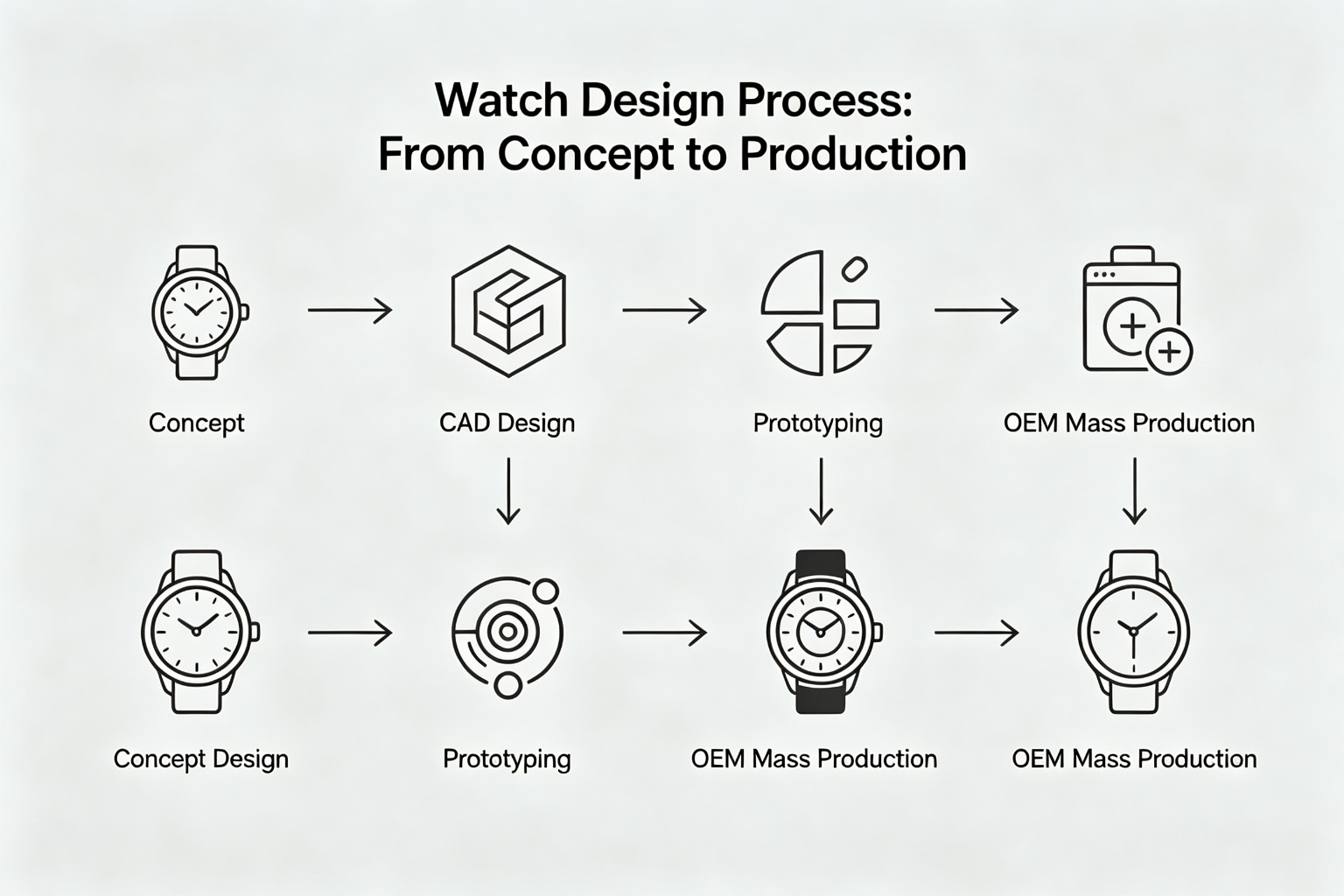
A successful watch design is built on three essential pillars:
1. Aesthetics
This defines the visual identity of the brand:
- Case shape and proportion
- Dial layout and textures
- Hand and index design
- Material and color selection
Aesthetics create emotional connection and brand recognition.
2. Functionality
A watch must perform reliably under real-world conditions:
- Time readability
- Water resistance
- Movement accuracy
- Luminous performance
- Wearing comfort
Functional design ensures long-term usability and customer satisfaction.
3. Manufacturability
This is the most critical factor for OEM watch production.
Even a visually perfect design may fail if it cannot be manufactured efficiently.
Manufacturability includes:
- CNC machining feasibility
- Tolerance control (micron-level precision)
- Assembly complexity
- Material compatibility
- Production scalability
Ignoring this stage often leads to delays, redesigns, or cost overruns.
2. Market Research: Defining the Right Product Direction
Before design begins, successful brands conduct structured market research to align product direction with demand.
Target Customer Definition
Typical B2B segments include:
- Luxury watch brands
- Microbrand startups
- E-commerce sellers
- Distributors and wholesalers
Understanding user identity defines product positioning.
Regional Market Preferences
United States
- Sports watches and diver watches
- Minimalist fashion watches
- 40–42mm mid-size cases
Europe
- Classic mechanical watches
- Heritage-inspired designs
- Premium material focus
Australia
- Durable lifestyle watches
- Water-resistant outdoor models
- Lightweight ergonomic designs
Competitive Analysis
Brands should analyze:
- Price positioning
- Material selection
- Movement type
- Design language
- Customer feedback patterns
This helps identify market gaps and opportunities.
3. CAD Design & Industrial Development Process
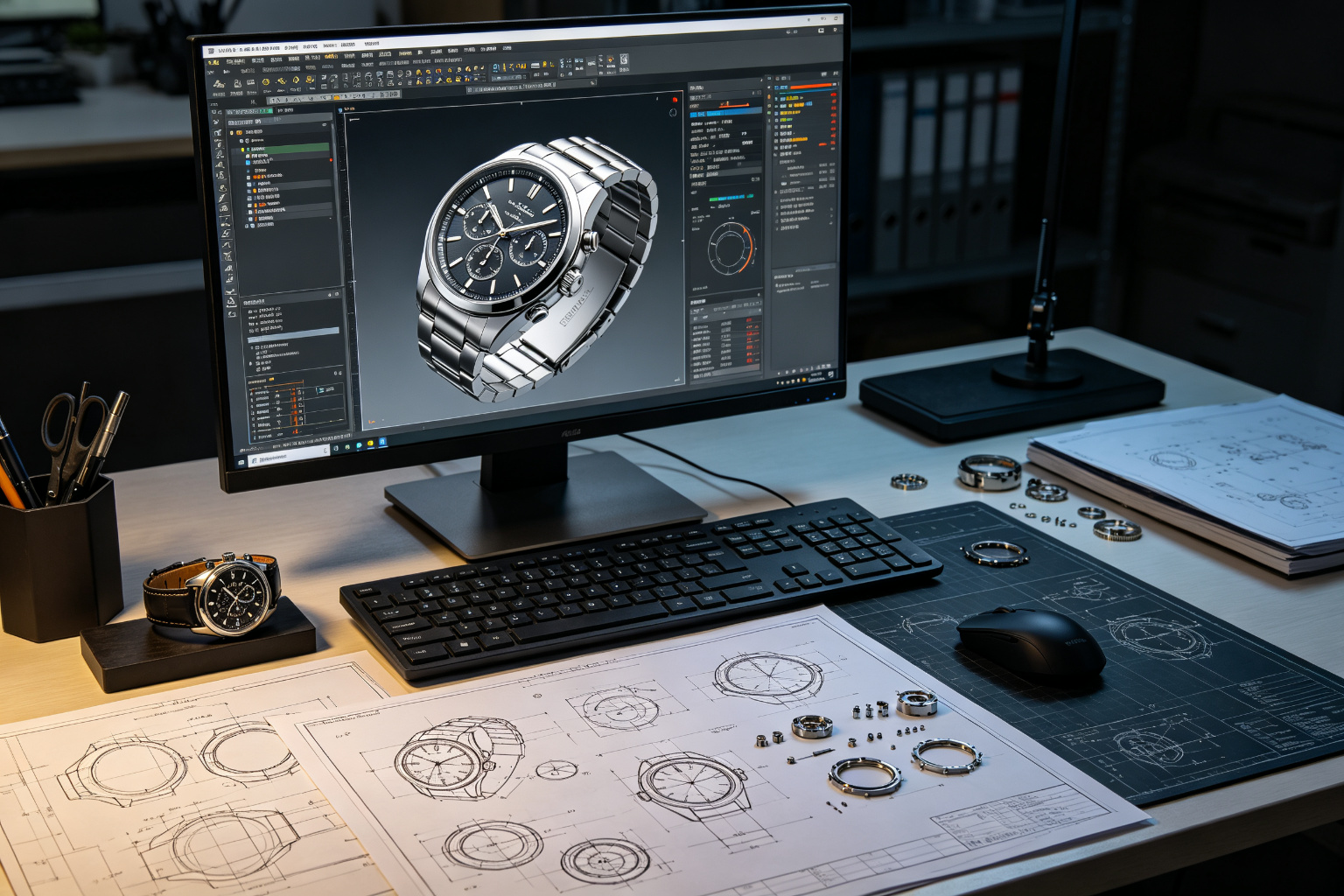
Once direction is defined, the concept enters CAD development.
From Sketch to 3D Model
Designers convert ideas into digital 3D models using:
- SolidWorks
- Rhino 3D
- AutoCAD
This stage defines:
- Exact dimensions
- Structural layout
- Material assignments
- Assembly architecture
Design for Watch Manufacturability (DFM)
OEM engineers evaluate:
- Wall thickness feasibility
- Structural stress points
- Assembly compatibility
- Tooling limitations
DFM ensures the design can be mass-produced without quality risk.
3D Rendering for Validation
High-quality renders are used for:
- Design approval
- Marketing preview
- Crowdfunding campaigns
This allows brands to validate products before physical production.
4. Watch Dial Design: Brand Identity in Detail
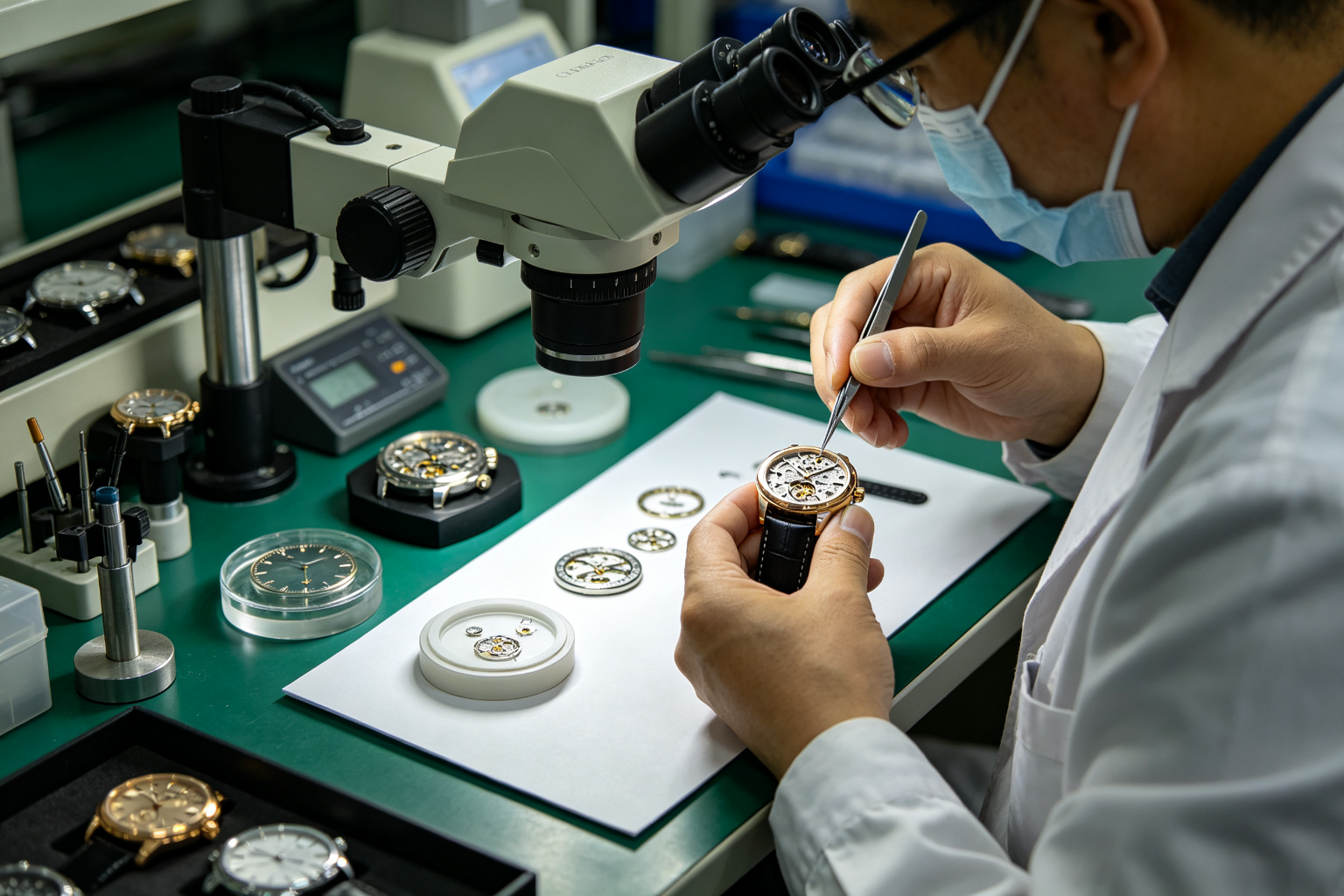
The dial is the most visually important part of a watch.
Common materials include:
- Brass (most widely used)
- Aluminum alloy
- Stainless steel
Surface Finishing Techniques
Different textures define brand personality:
- Sunray brushing
- Matte finishing
- Guilloché engraving
- Laser textures
- Sandblasted effects
Each finish requires specific tooling precision.
Brand identity is applied through:
- Pad printing
- Embossing
- Applied metal logo
Accuracy is critical—misalignment can affect entire batch quality.
Legibility Optimization
Key design factors:
- Contrast between dial and hands
- Index size balance
- Luminous coating visibility
- Font clarity
A good dial must be readable in all lighting conditions.
5. Case & Strap Engineering: Ergonomics & Wearability
The case defines structure, while the strap defines comfort.
Key Case Parameters
- Case diameter (36–44mm typical range)
- Thickness (affects wearing comfort)
- Lug-to-lug distance (critical for wrist fit)
Material Selection
- 316L stainless steel (durability & cost balance)
- Titanium (lightweight premium segment)
- Ceramic (scratch-resistant luxury)
Strap Integration
Common options:
- Leather straps
- Silicone sports straps
- Stainless steel bracelets
Quick-release systems are increasingly popular in microbrands.
Ergonomic Design Importance
Poor ergonomic design leads to:
- Wrist discomfort
- Reduced product retention
- Negative customer feedback
OEM factories optimize case geometry for global wrist sizes.
6. Prototyping & Engineering Validation
Prototype development transforms digital design into physical samples.
Tooling Development
Includes:
- CNC molds
- Die casting tools
- Precision cutting fixtures
First Sample Testing
Key evaluations:
- Dimensional accuracy
- Assembly compatibility
- Visual inspection
- Function testing
Iteration Cycles
Most watch projects require:
- 2–5 prototype revisions
- Design adjustments based on feedback
- Engineering refinements
B2B Insight
Prototype stage is the most critical investment phase:
- Determines final product quality
- Impacts production timeline
- Affects total project cost
7. Common Mistakes in Watch Design Projects
1. Overly Complex Design
Complex shapes increase:
- Tooling cost
- Production difficulty
- Defect rates
2. Ignoring Manufacturing Limits
Designs without DFM review often fail in mass production.
3. Unrealistic MOQ Expectations
Low-volume production requires specialized factory selection.
4. Missing Technical Documentation
Relying only on sketches leads to:
- Miscommunication
- Sampling errors
- Production delays
OEM (Original Equipment Manufacturing)
- Brand provides full design
- Factory produces accordingly
- Best for established brands
ODM (Original Design Manufacturing)
- Factory provides design solutions
- Brand customizes existing models
- Best for startups and microbrands
Hybrid Strategy
Many successful brands use:
- ODM for speed-to-market
- OEM for brand differentiation
Conclusion: Turning Design Into Market Success
The watch design process is not only creative—it is deeply technical and manufacturing-driven.
Successful brands understand:
- Market demand before design
- Engineering feasibility before production
- OEM/ODM workflow before scaling
With 16+ years of OEM/ODM manufacturing experience, professional watch factories provide end-to-end support from concept to mass production.
This ensures:
- Lower development risk
- Faster market entry
- Stable production quality
- Stronger brand competitiveness
Q1: How long does the watch design process take?
Typically 2–6 months depending on complexity and revision cycles.
Q2: Can I fully customize my watch design?
Yes, including dial, case, strap, movement, and packaging.
Q3: What is the difference between OEM and ODM?
OEM uses your design, ODM uses factory-provided designs with customization.
Q4: How many prototypes are usually needed?
Most projects require 2–5 iterations before final approval.
Q5: What is the biggest risk in watch design?
Poor manufacturability planning and lack of technical documentation.


