
The dial is the face of a watch, and in more ways than one, it is also the face of a watch brand. When a consumer encounters your timepiece for the first time — in a display case on Abbot Kinney Boulevard, in an Instagram post viewed during a morning commute, or on the wrist of a colleague in a Silicon Valley boardroom — the dial is what they see first. Before they register the case shape, before they notice the bracelet, before they check the brand name, their eye has already processed the dial and formed an impression that either draws them closer or allows their attention to wander.
For watch brand founders, dial manufacturing represents both the greatest creative opportunity and the greatest technical challenge in the production process. A dial that measures 0.4 millimeters thick contains, in a professional OEM and ODM watch, as many as seven distinct manufacturing layers: base plate preparation, surface texturing, color application, printing, index application, luminous treatment, and protective lacquering. Each layer introduces its own tolerance requirements, its own potential failure modes, and its own contribution to the final visual impact.
This guide provides a comprehensive framework for brand founders who need to make informed decisions about dial customization. It covers materials, finishing techniques, printing technologies, index and lume selection, and — perhaps most importantly — the quality control methodologies that ensure your production dials match the sample you approved.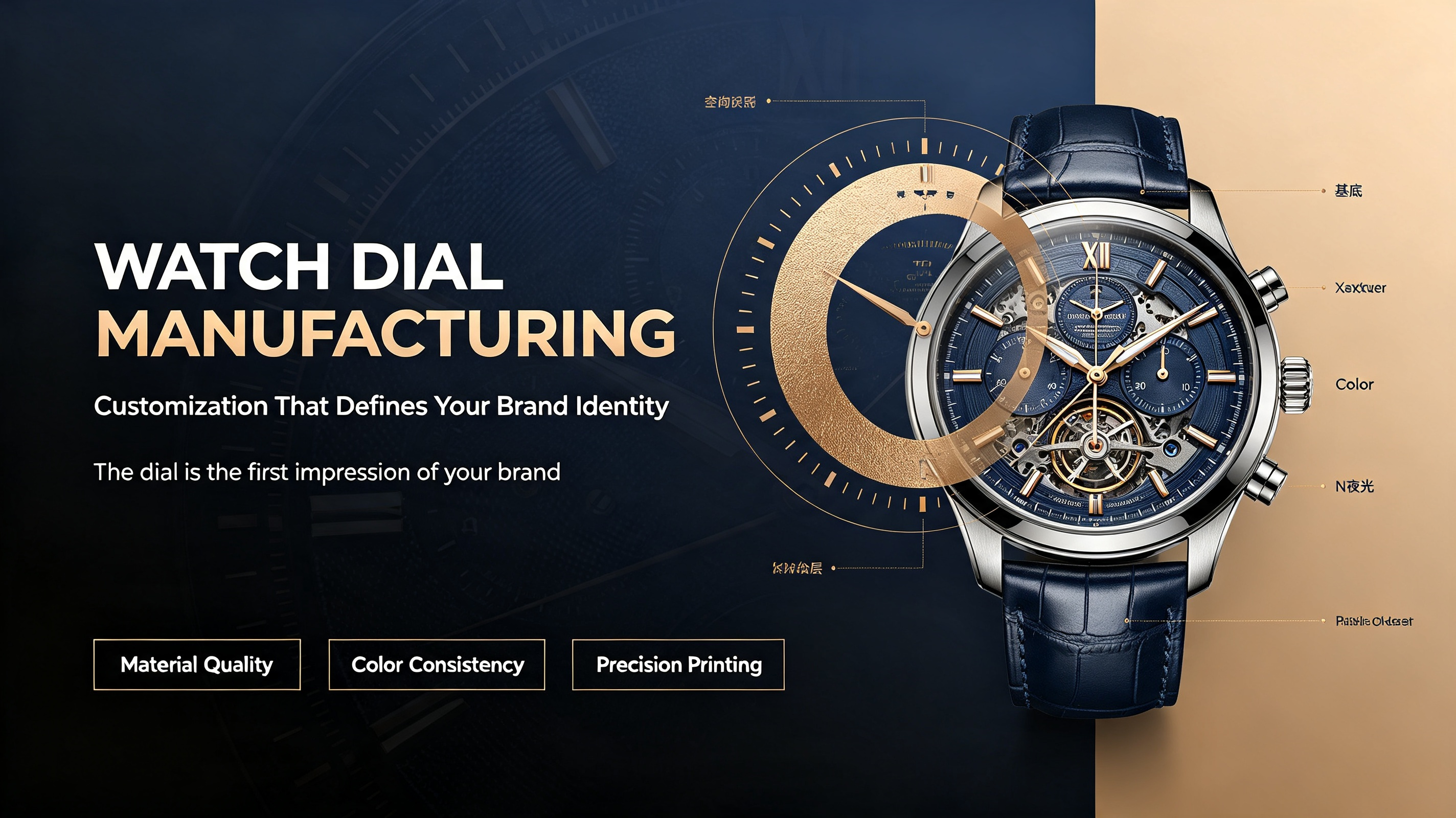
Consumer research consistently shows that dial design is the single most influential factor in a watch purchase decision, ranking ahead of brand name, movement type, and even price among certain buyer segments. A proprietary study of independent watch brand customers found that 64% cited "dial appearance" as their primary reason for initial interest, compared to 18% for "brand story" and 12% for "movement specification."
This finding has strategic implications for brand founders. If dial design drives initial interest, then dial manufacturing quality drives purchase conversion and return behavior. A dial that photographs beautifully but shows visible printing defects at arm's length will generate returns at a rate that destroys your unit economics. Conversely, a dial that reveals new details on closer inspection — a subtle sunburst pattern that shifts with the light, applied indices that catch and reflect illumination, lume that glows evenly in darkness — creates the kind of customer delight that generates word-of-mouth referrals and repeat purchases.
For design-focused brands based in cities like San Francisco, where the aesthetic standard is set by a community of industrial designers, architects, and tech creatives, dial quality is not negotiable. These customers notice the alignment of printed text relative to hour markers. They notice whether the date window frame is applied or printed. They notice whether the brand name is pad-printed or applied as a three-dimensional metal logo. The difference between "good" and "exceptional" in dial execution is measured in fractions of a millimeter, but its impact on brand perception is measured in hundreds of dollars of retail price.
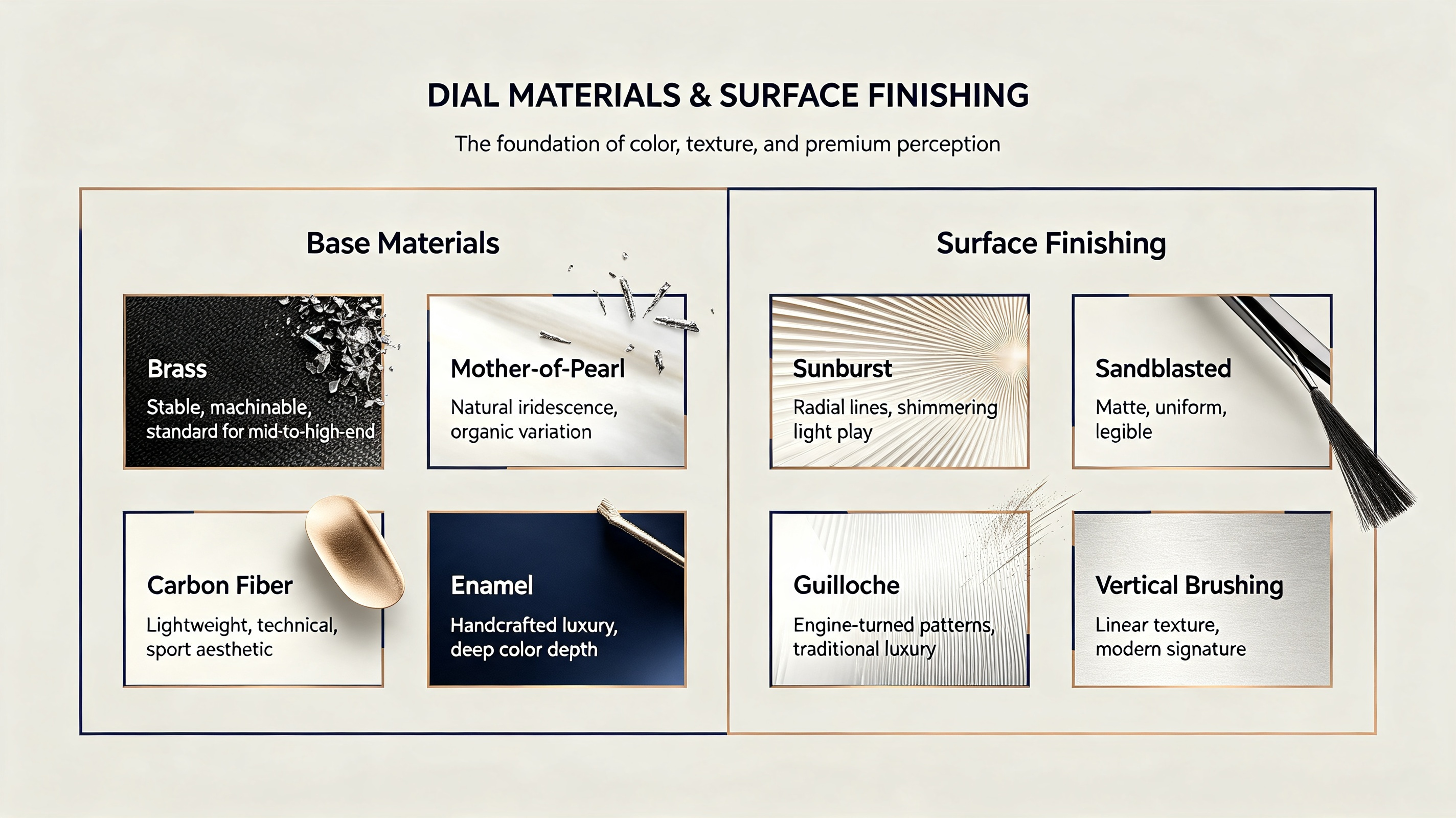
The base material of a watch dial establishes the canvas on which all subsequent manufacturing steps are performed. Each material brings distinct characteristics in terms of appearance, workability, durability, and cost.
Brass remains the industry standard for mid-to-high-end watch dials. It offers an ideal combination of machinability, surface finish quality, and cost-effectiveness. Brass dials accept a wide range of surface treatments — from mirror polishing to deep sandblasting — and provide excellent adhesion for printing inks and luminous compounds. For brands building their collections in the 800 retail range, brass is almost always the correct choice. BESSERON's standard dial manufacturing uses high-grade brass substrates with thickness controlled to ±0.02mm.
Mother-of-pearl introduces natural variation into dial production. No two mother-of-pearl dials are identical; the organic iridescence shifts with viewing angle and lighting conditions. This material is popular for dress watches targeting the women's market, though it has also found a place in unisex designs that emphasize natural materials and organic aesthetics. Mother-of-pearl is significantly more difficult to work with than brass — it is brittle, sensitive to heat during processing, and requires specialized cutting and polishing techniques.
Meteorite dials represent the upper tier of dial material exclusivity. Genuine meteorite — typically Muonionalusta meteorite, which features a distinctive Widmanstatten crystalline pattern — must be sliced, etched, and stabilized. Each dial is unique, and the raw material supply is inherently limited. Meteorite dials typically add 400 to the FOB cost of a watch and are appropriate for limited-edition models or flagship products in the $1,500-plus retail segment.
Enamel dials sit at the intersection of traditional craftsmanship and modern luxury. Grand Feu enamel — literally "great fire" — involves fusing powdered glass to a copper or silver dial blank at temperatures exceeding 800 degrees Celsius, repeated in multiple layers to build depth and luminosity. Enamel dials are handmade by specialized artisans and cannot be mass-produced. They are appropriate only for small-batch luxury products where the dial alone represents a meaningful portion of the manufacturing story.
Carbon fiber has emerged as a contemporary dial material for sports and technical watch designs. It offers a distinctive woven visual texture, extremely low weight, and high durability. Carbon fiber dials appeal to brands targeting the motorsport, aviation, and outdoor adventure segments.
Once the base material is selected and cut to size, the surface finishing process begins. This is where the dial acquires the visual texture that will capture and reflect light in the distinctive way that signals quality to the observer.
Sunburst finishing is produced by rotating the dial against an abrasive brush, creating radial lines that emanate from the dial center. The result is a shimmering effect as the dial moves relative to a light source — the defining characteristic of dress watches and elegant sports watches alike. Achieving a uniform sunburst pattern across a production run of 500 dials requires consistent brush pressure, rotation speed, and abrasive condition. Dial manufacturers that cut corners on sunburst quality produce dials with visible inconsistency between samples and production units.
Sandblasted or matte finishing uses pressurized abrasive media to create a uniform, non-reflective surface. Matte dials are favored by military and field watch designs, where legibility under harsh lighting conditions is prioritized over visual glamour. The quality of a sandblasted finish depends on media consistency and application uniformity. A properly sandblasted dial should show no directional pattern under magnification.
Guilloche represents the traditional art of engine-turned geometric patterns engraved into the dial surface by a rose engine lathe. Authentic guilloche is performed by a skilled artisan operating a manual machine, producing intricate patterns — Clous de Paris, barleycorn, sunburst, wave — that catch light in mesmerizing ways. Modern stamped guilloche patterns, produced by pressing the dial blank against an engraved die, approximate the visual effect at a fraction of the cost. True rose-engine guilloche is appropriate only for the highest tier of custom OEM watchmaking.
Vertical brushing and circular graining are directional finishing techniques that produce linear or concentric patterns on the dial surface. These are less common than sunburst or matte finishes but can create distinctive brand signatures when applied intentionally.
Color is where brand identity takes physical form. Whether your brand's signature is a specific shade of navy blue, a distinctive forest green, or an unconventional terracotta, the precision with which your manufacturer reproduces that color in production determines whether your watches look like your brand or like an approximation of it.
Galvanic plating is the dominant color application method for high-quality brass dials. The dial is immersed in an electroplating bath where metal ions — typically nickel, rhodium, or gold — are deposited onto the brass surface. By controlling bath chemistry, temperature, and current density, manufacturers can produce a wide spectrum of metallic colors: silver-white, champagne, rose gold, yellow gold, gunmetal gray, and blue-tinted rhodium.
The advantage of galvanic plating is durability. The color is bonded at the molecular level, not applied as a surface coating. A properly plated dial will not chip, peel, or fade over decades of wear.
Lacquered color involves applying pigmented lacquer to the dial surface. This technique produces deeper, richer non-metallic colors — jet black, pure white, racing green, royal blue — that cannot be achieved through plating alone. Lacquered dials require multiple thin coats, each baked to cure, to build the depth and uniformity that characterizes luxury watch dials.
For both plating and lacquering, color consistency across production batches is the critical quality metric. At BESSERON, our color-matching protocol uses spectrophotometer measurement to verify that production dial colors match the approved sample within a delta-E tolerance of 1.5 or less. Delta-E is a standardized measure of color difference; a value below 2.0 is generally imperceptible to the human eye.
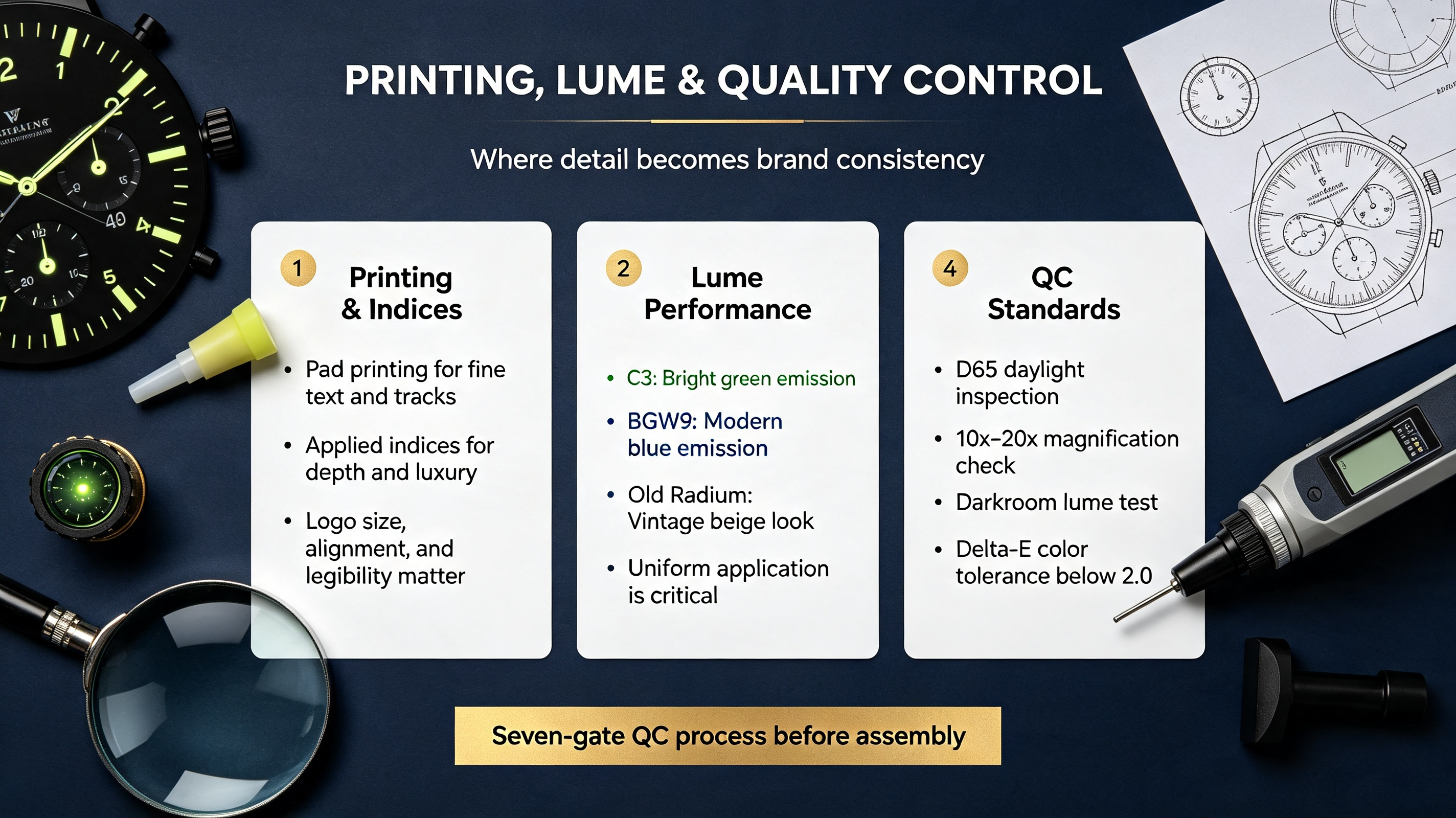
The final layer of dial manufacturing involves the elements that convey information — hour markers, brand text, minute tracks, date windows — and the luminous treatment that makes the watch functional in darkness.
Pad printing is the most common method for applying text, logos, and minute tracks to watch dials. A silicone pad transfers ink from an etched printing plate to the dial surface. Pad printing can reproduce extremely fine detail — text as small as 0.3mm in height — with reliable consistency across thousands of units.
Applied indices represent a step up in perceived quality. Rather than printing hour markers, the manufacturer affixes three-dimensional metal indices to the dial surface. Applied indices catch light differently than printed markings, creating depth and shadow effects that communicate luxury. The indices themselves are manufactured through stamping or CNC machining, then polished or brushed to match the case finishing.
Super-LumiNova is the industry-standard luminous compound for high-end watches. Manufactured by RC Tritec in Switzerland, Super-LumiNova is available in multiple grades and colors — C3 (green emission, highest brightness), BGW9 (blue emission, popular for dive watches), and Old Radium (vintage beige appearance). The compound is applied to the dial and hands, where it charges from ambient light and emits a glow in darkness.
Lume quality is evaluated on three dimensions: initial brightness, longevity through the night, and application uniformity. A dial with visibly uneven lume application — one index glowing brighter than another — is an immediate signal of quality shortcuts.
Dial QC is multilayered because dial defects exist at multiple scales. At the macro level, color matching and overall visual impact are evaluated against the approved gold sample. At the micro level, printing registration, index alignment, and lume uniformity are inspected under magnification.
Professional dial inspection includes: visual inspection under standardized lighting (D65 daylight simulation, 2000 lux), printing registration verification under 10x to 20x magnification, index alignment verification using alignment fixtures, lume uniformity inspection in a darkroom after standardized charging, adhesion testing for printed elements, and environmental testing (temperature cycling and humidity exposure) on production samples.
At BESSERON, every production dial passes through a seven-gate QC process before it reaches the assembly line. Dials that fail any gate are rejected and remanufactured. We provide QC documentation, including inspection photos and lume test results, with every production order.
The gap between a beautiful dial rendering and a production-ready dial is the gap that determines whether a watch brand succeeds or fails. Bridging that gap requires manufacturing expertise that understands both the creative intent and the technical constraints of dial production.
Our approach at BESSERON begins with design review. When you submit a dial design, our engineering team evaluates it for manufacturability: Are the index dimensions appropriate for the dial thickness? Will the hand stack clear the applied indices? Is the logo size appropriate for pad printing fidelity? We identify potential issues and propose solutions before prototyping begins, saving weeks of sample iteration.
During prototyping, we produce a complete dial sample with the exact materials, finishing, printing, and lume specified for production. This sample becomes the contractual reference standard. Every production dial is measured against this standard.
During production, our spectrophotometer-based color matching ensures batch-to-batch consistency. Our magnification-based QC process catches printing defects, index misalignment, and lume irregularities before dials reach your watches.
Q: What is the minimum order quantity for custom watch dials?
A: The MOQ for a fully custom dial — with your logo, specific color, custom indices, and unique finishing — is typically 100 to 300 units depending on complexity. For dials using standard templates with logo customization only, the MOQ can be as low as 50 units. BESSERON offers flexible MOQ options as part of our OEM and ODM programs, designed to support brands at every stage of growth.
Q: How do I ensure that production dials match the color I approved on the sample?
A: Color consistency is maintained through spectrophotometer measurement, referenced against your approved sample. Every production batch should be measured and verified for delta-E below 2.0. Request that your manufacturer provide spectrophotometer readings in the QC documentation for your order. At BESSERON, we provide spectral color data with every dial production batch.
Q: Can you reproduce a specific Pantone color on a watch dial?
A: Yes, within the physical constraints of the coloring method. Galvanic plating produces metallic colors that follow the spectrum achievable through electroplating chemistry. Lacquered dials can reproduce a wider gamut of Pantone colors but may require development time to achieve an exact match. We recommend providing your Pantone reference and allowing one to two sample iterations for color confirmation.
Q: What lume options are available, and which is best for my brand?
A: Super-LumiNova C3 (green emission) offers the highest brightness and is the standard choice for dive watches and sports models. BGW9 (blue emission) provides a more modern, technical appearance and is popular with design-focused brands. Old Radium and Vintage color grades offer classic aesthetics at the cost of reduced brightness. Your choice should align with your brand positioning, sports watches benefit from maximum brightness, and dress watches benefit from subtle, vintage-appropriate lume.
Q: How durable are custom watch dials? Will they fade or discolor over time?
A: A professionally manufactured dial using galvanic plating and high-quality lacquer should maintain its appearance for decades under normal wear conditions. The primary threat to dial longevity is moisture ingress through a failed case seal. If the watch case maintains its water resistance, the dial inside should remain stable. UV-resistant lacquers and stable plating chemistries ensure that colors do not shift with sun exposure.

