
For the technical procurement officer of a Manhattan luxury label or the lead designer of a Silicon Valley microbrand, the aesthetic of a timepiece is only half the story. The true test of a brand's longevity lies in its "Mechanical Heart"—the movement. In a market where a 1% increase in the defect rate can erase the profit margins of a TikTok Seller or a boutique store, understanding the technical nuances of movement stability is paramount.
As a leading luxury watches manufacturer, BESSERON WATCH MANUFACTURER recognizes that technical buyers don't just buy parts; they buy reliability. This guide provides a deep-dive into the Japanese and Swiss calibers that power the world’s most successful private labels, focusing on the engineering standards required to ensure every watch that arrives at the Port of Los Angeles is a masterpiece of precision.
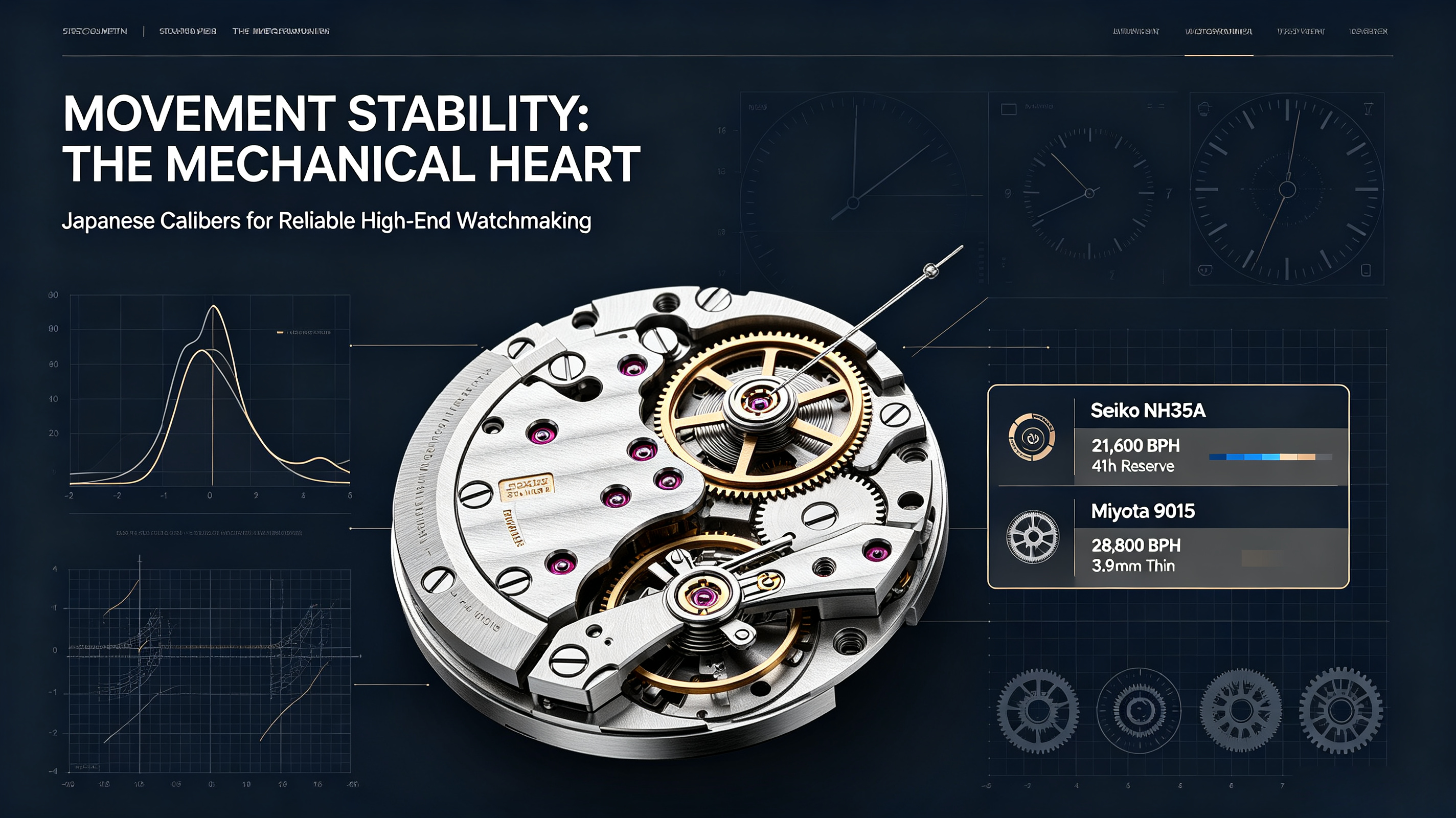
In the watch industry, the "Movement" is the single greatest factor in after-sales costs. A brand launching on Kickstarter or through a Beverly Hills retail chain cannot afford "Dead on Arrival" (DOA) units or chronic time-loss issues. Technical buyers prioritize three metrics: Stability, Serviceability, and Availability.
Choosing between Japanese watch manufacturers and Swiss houses is the first strategic gate. While Swiss movements carry a prestige premium, Japanese calibers from Seiko and Miyota have become the "Workhorses of the Industry" due to their exceptional shock resistance and cost-to-performance ratio. For a brand building its reputation, the choice must be backed by data, not just marketing.
For mid-to-high-end stainless steel watches, two movements dominate the conversation among wrist watch manufacturers. Both offer distinct advantages for different brand positionings.
At BESSERON, we don't just source these movements; we optimize them. Every Seiko or Miyota unit is subjected to a secondary "Timegrapher Calibration" in our factory, ensuring that the final output exceeds the standard factory specs.
For TikTok Sellers and fashion-forward brands in Los Angeles, the choice between Quartz and Mechanical often comes down to the "Use Case."
As a specialized watch manufacturer, we help you decide based on your target audience's technical expectations and your brand's price-tier strategy.
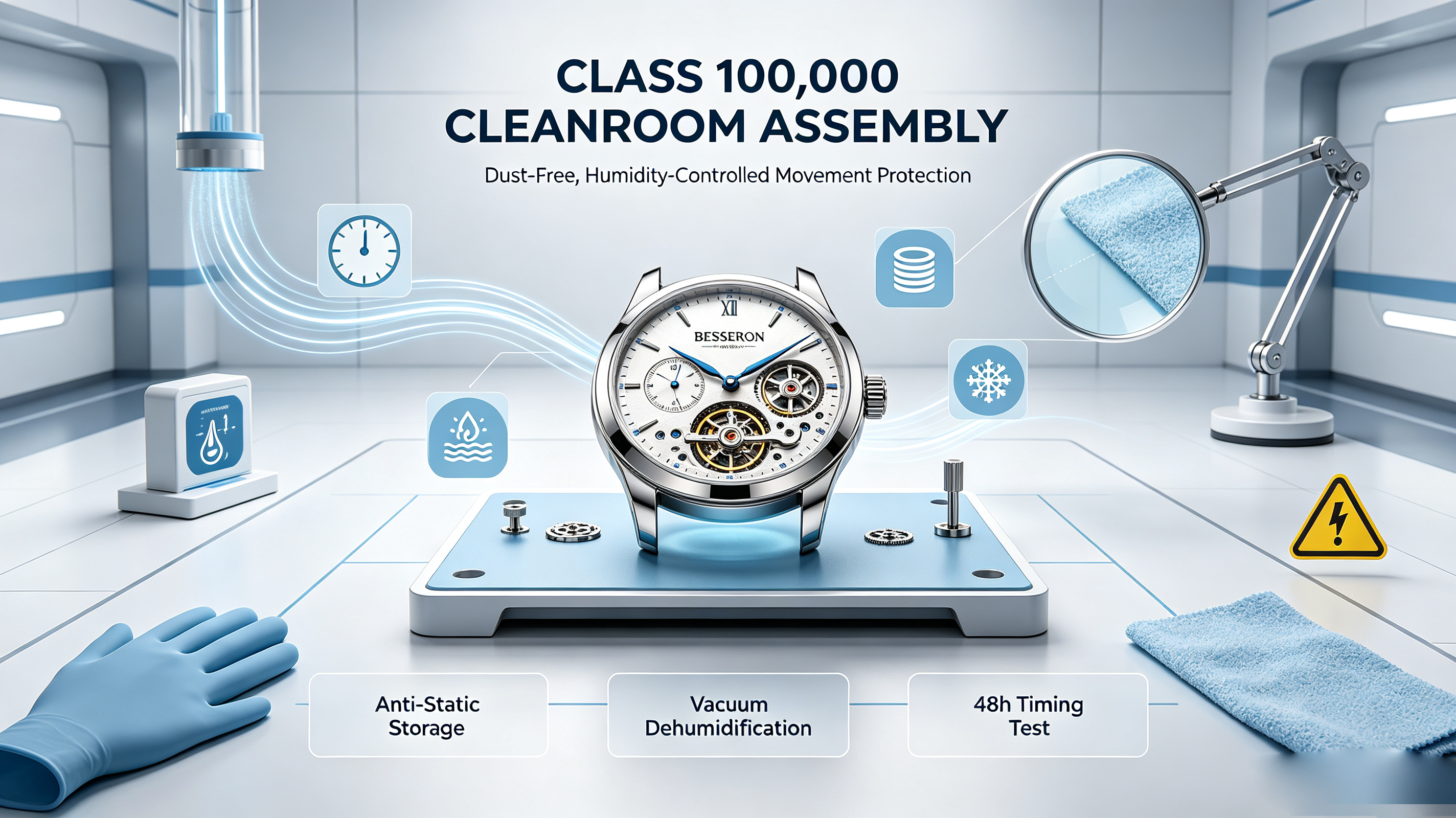
At BESSERON WATCH MANUFACTURER, we know that even the best movement can fail if the assembly environment is compromised. Our Head of Production, a veteran of luxury watch manufacturing, defines our technical edge:
"Our lead engineer suggests that for technical stability, the 'Dust-Free Cleanroom' is as important as the movement itself. Even a single microscopic fiber can stop a high-beat movement like the Miyota 9015. At BESSERON, our assembly lines operate under Class 100,000 Cleanroom standards. Furthermore, we implement a 'Movement Protection Protocol'—every movement is stored in anti-static, humidity-controlled environments from the moment it leaves the Japanese manufacturer until it is encased in our 316L stainless steel."
This commitment to technical hygiene is why BESSERON is the trusted partner for brands that cannot afford a high return rate. We help you build watch brands that sell by ensuring they never stop ticking.
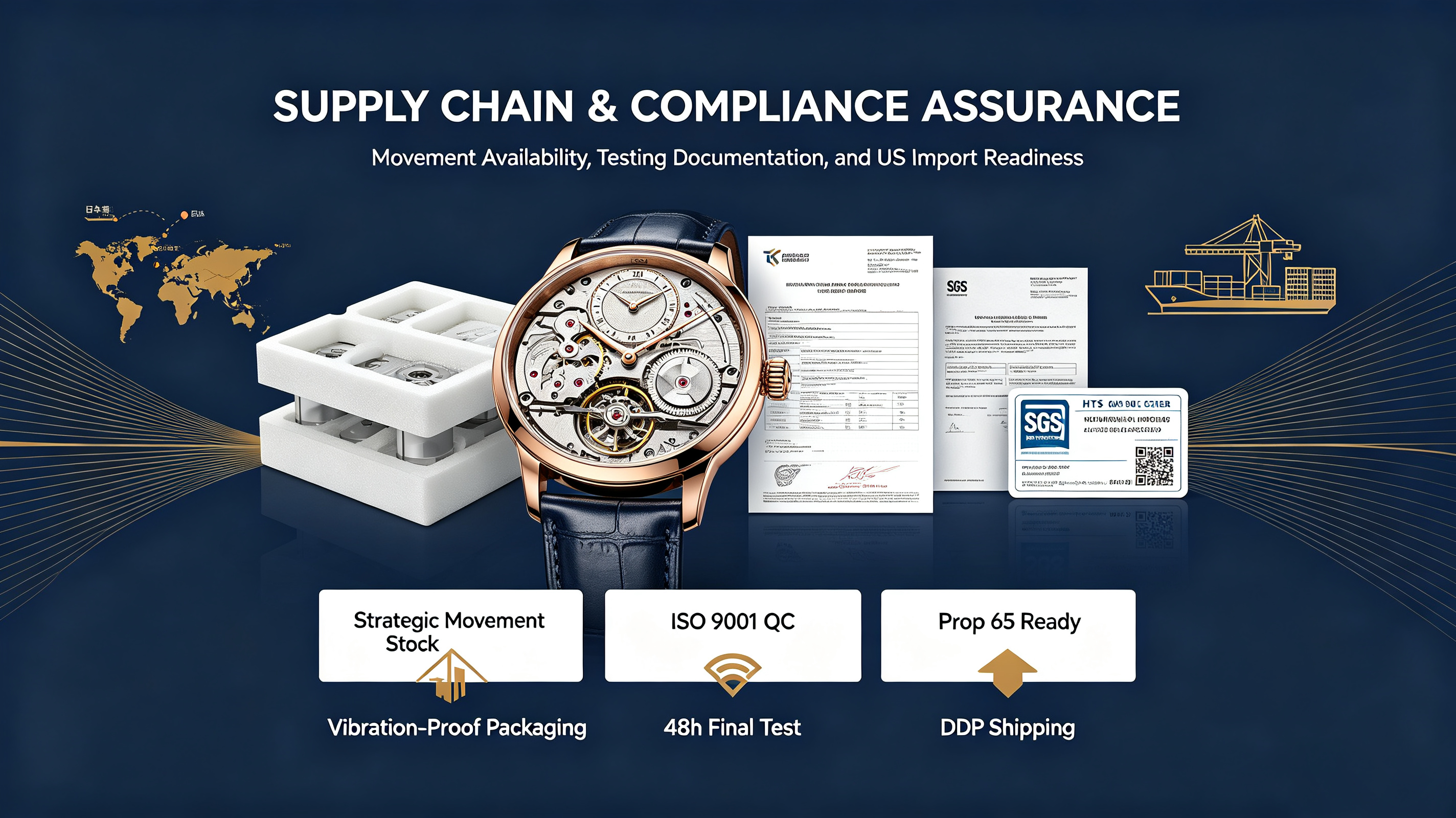
The biggest fear for a B2B buyer is the "Vibration Risk"—the danger that movements will be knocked out of alignment during the trans-Pacific journey to JFK or LAX.
For a watch brand builder, the "Supply Gap" is a nightmare. In recent years, the industry has seen massive shortages of popular calibers. Partnering with a watch manufacturer in China that has direct, long-term relationships with Japanese watch manufacturers is a critical business continuity strategy.
BESSERON maintains a strategic reserve of the most popular calibers (NH35, 9015, GL20). This means that even when the global market is tight, our B2B partners in the US receive their shipments on time, allowing them to hit their seasonal launch windows without delay.
Technical stability isn't just about the mechanics; it's about the "Legal Stability" of your import.
High-end private labels are increasingly asking for "Visual Technicality." As custom watch manufacturers, BESSERON offers:
In the watch business, quality is the only sustainable competitive advantage. To build a brand that enthusiasts respect and customers trust, you need a manufacturing partner that prioritizes technical stability above all else.
BESSERON WATCH MANUFACTURER provides the 316L stainless steel, Sapphire Crystal, and Japanese movement precision that the US market demands. Whether you are a technical buyer in Manhattan or a startup in Silicon Valley, we are here to provide the engineering excellence your brand deserves.
Q1: What is the difference between "Japanese Movement" and "Swiss Parts" movements? A1: "Japanese Movement" refers to calibers fully manufactured in Japan (e.g., Miyota, Seiko). "Swiss Parts" often refers to movements designed in Switzerland but assembled elsewhere. As a luxury watch manufacturer, we recommend fully Japanese movements for the best stability/cost ratio.
Q2: How do you prevent moisture from entering the case during assembly? A2: We use specialized Vacuum Dehumidification chambers during the final assembly process. This ensures that the air trapped inside the case has 0% humidity, preventing fogging when the watch is exposed to the cold climates of the Northern US.
Q3: Is the Miyota 9015 loud? We’ve heard about "Rotor Noise." A3: The 9015 is a unidirectional winding movement, which can result in a slight "whirring" sound. As high end watch manufacturers, we use sound-dampening case-back gaskets and thicker sapphire glass to minimize this, turning a technical trait into a "Mechanical Feature."
Q4: Can you provide "Waterproof Testing" certificates for our bulk order? A4: Yes. We can provide a batch report showing the results of our 10ATM Pressure Testing. We use high-precision testing equipment that provides a digital readout of the deflection and seal integrity for each unit.
Q5: What is the lifespan of a Japanese Quartz movement battery? A5: Typically, the batteries in our Miyota or Seiko quartz models last 2.5 to 4 years. We offer high-capacity Sony or Maxell batteries as standard, ensuring your brand has a low return rate for "dead batteries."

