Watch Quality Control and US Compliance: Essential Guide for Brands
By Besseronwatch
August 4th, 2026
40 views
Watch Quality Control and US Import Compliance: The Essential Guide for Watch BrandsThe moment a watch brand founder realizes they have a quality control problem is almost never the moment the problem began. It is usually six weeks after a production batch arrived, when returns start trickling in and a pattern emerges: five customers reporting fogged crystals, three complaints about misaligned bezels, and an Amazon review with a macro photograph showing a dial speck that should have been caught before the watch left the factory. By the time the pattern is visible, the batch has shipped to customers, the reviews are live, and the founder is facing the cost of replacements, refunds, and reputational repair — none of which the manufacturer's warranty fully covers.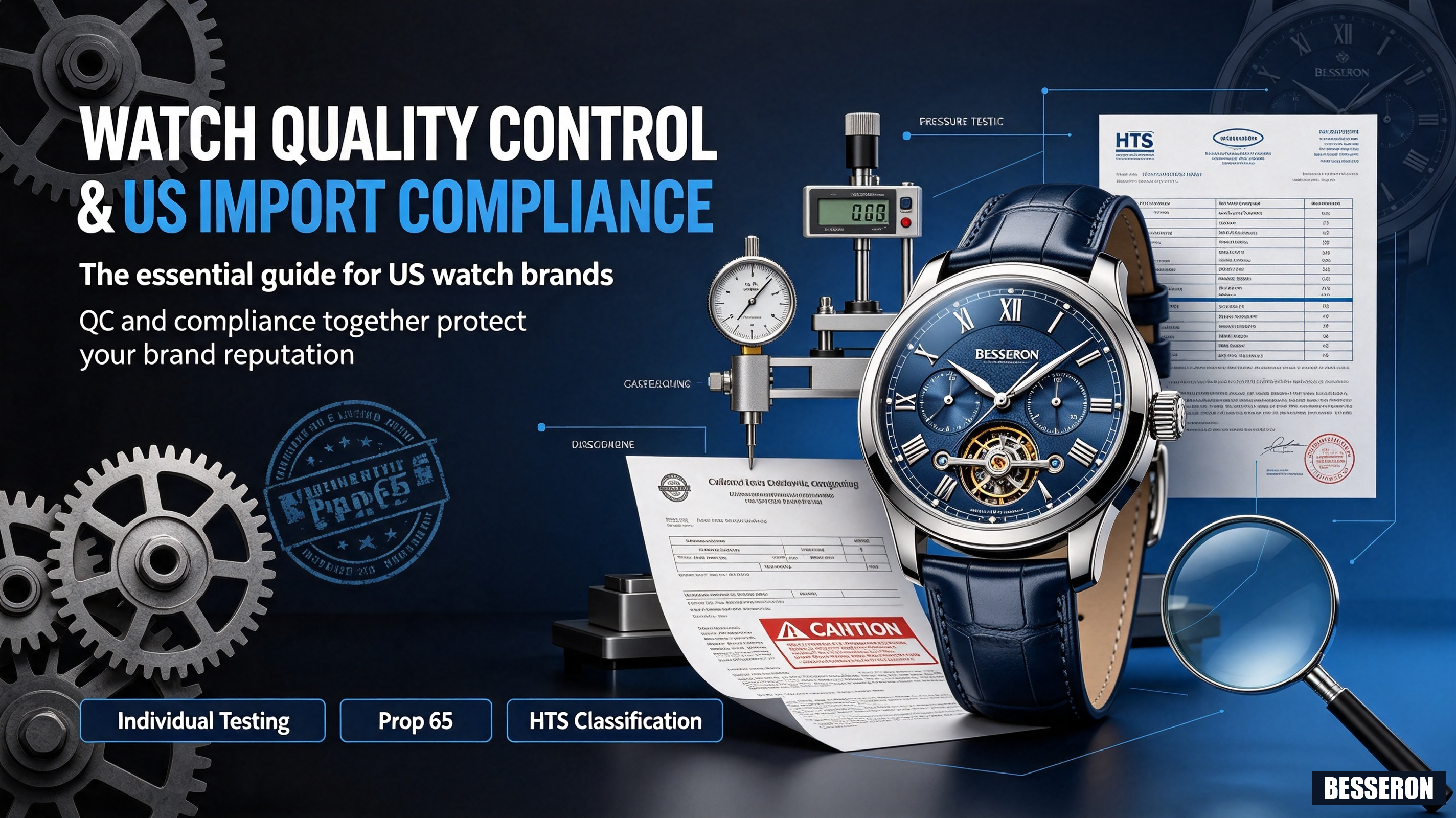
Quality control in watch manufacturing is not a checkpoint at the end of the production line. It is a system that spans the entire manufacturing process, from incoming material inspection through final pressure testing. And for US-based watch brands, QC must integrate with another equally important system: import compliance. A watch that passes every quality gate but lacks the documentation required by US Customs or California's Proposition 65 is a watch that never reaches your customers.This guide provides watch brand founders with a complete framework for quality control and US import compliance, built from direct experience manufacturing watches in China and importing them into the United States market.The Anatomy of a Watch QC FailureBefore discussing solutions, it is worth understanding exactly how QC failures occur and why they are so costly for watch brands. The most common failure modes follow predictable patterns.Water resistance failure is the single most expensive QC problem in the watch industry. A watch rated at 5ATM that leaks during handwashing generates a return that costs the brand approximately three times the wholesale cost of the watch when you account for shipping, processing, replacement, and the lost opportunity of a dissatisfied customer who will not buy from you again. The root cause is almost always inadequate pressure testing at the factory: batch testing one unit per hundred rather than testing every unit individually.Dial contamination — visible dust, fibers, or particles on the dial surface — is surprisingly prevalent in watches below the $500 retail mark. These contaminants enter during assembly and are missed during final inspection because the factory's lighting, magnification, or inspection protocols are inadequate. A dial that looks clean under standard factory lighting may reveal multiple particles when photographed under the bright, directional lighting that watch photographers use for product images — which are then shared thousands of times on Instagram and product pages.Timing inconsistency occurs when movements are not individually regulated. A Miyota 9015 or Seiko NH35 movement straight from the manufacturer typically runs within -20 to +40 seconds per day. A properly regulated movement should run within ±10 seconds per day, and a carefully regulated movement can achieve ±5 seconds per day. When a brand ships watches without individual regulation, some customers receive units running at +35 seconds per day. Those customers leave one-star reviews.Finishing inconsistency — uneven polishing between case sides, visible tool marks on lugs, inconsistent brushing direction — communicates low quality regardless of the materials used. A case made from genuine 316L stainless steel that is poorly finished will be perceived as lower quality than a case made from 304 stainless steel that is expertly finished. Finishing quality is almost entirely a function of the manufacturer's polishing department capability and their willingness to invest time in each unit.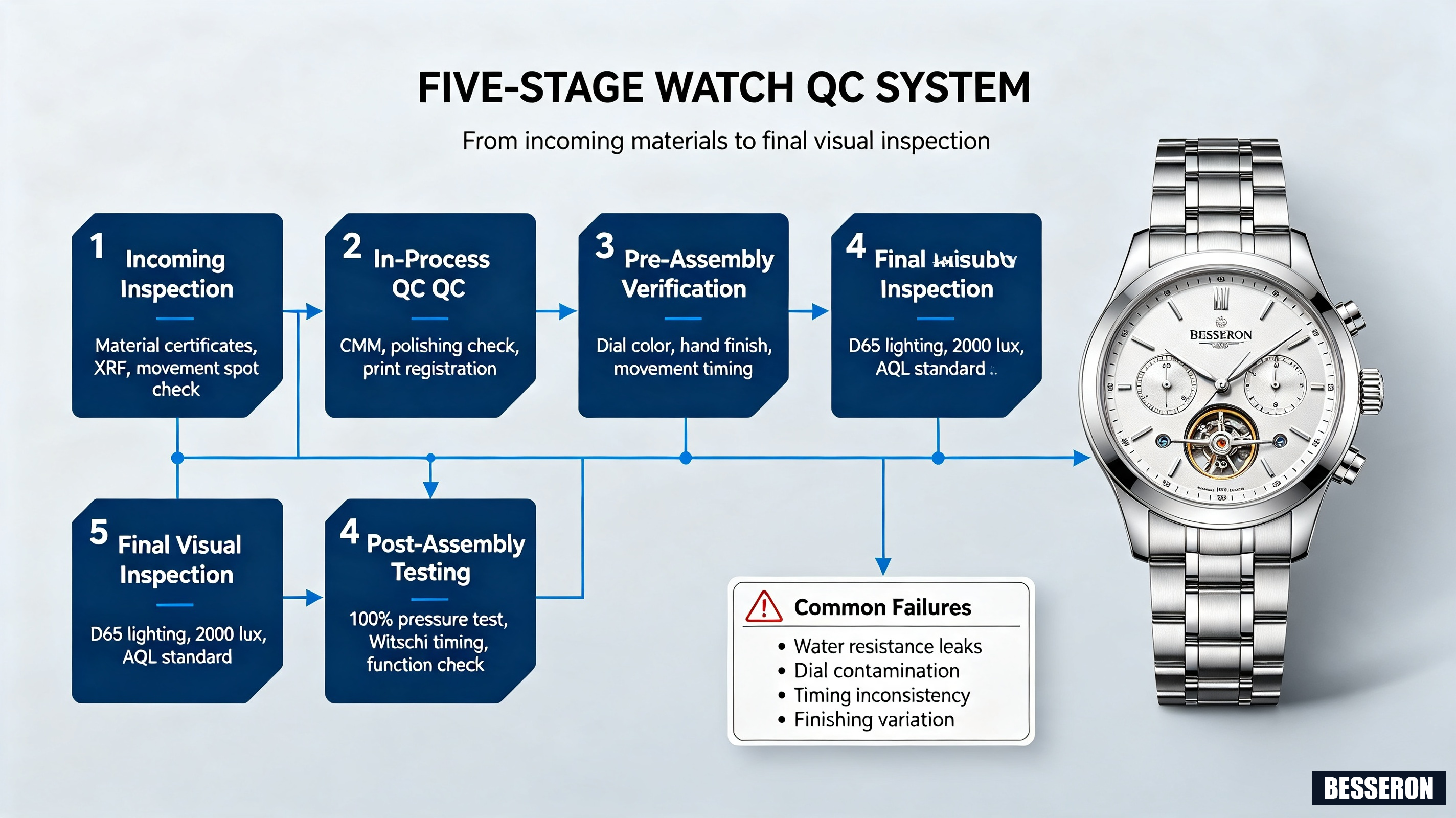 Building a Watch QC System That WorksA functional watch QC system operates at multiple stages of production. The manufacturer should be able to describe each stage in detail when asked.Stage 1: Incoming Material InspectionBefore manufacturing begins, every batch of incoming material — steel bar stock, movement shipments, crystal deliveries, dial blanks, hand sets, strap orders — should be inspected against specification. Material certificates should be collected, movement timing should be spot-checked, and crystal clarity should be verified.At this stage, critical material properties are verified. For 316L stainless steel, X-ray fluorescence (XRF) analysis can confirm alloy composition, verifying that the chromium, nickel, and molybdenum content matches the 316L specification. For movements, a sample is mounted on a timing machine to verify amplitude, beat rate, and positional variation.Stage 2: In-Process InspectionDuring production, QC gates at each major manufacturing stage catch defects before additional value is added to a defective component. After case machining, dimensional verification using a coordinate measuring machine (CMM) confirms that critical dimensions match the CAD specification. After case polishing, surface finish is evaluated against reference standards under standardized lighting. After dial printing, printing registration is checked under magnification.In-process inspection is where the difference between a manufacturer with robust QC and a manufacturer with cosmetic QC becomes apparent. A cosmetic QC system inspects the finished product and hopes to catch problems. A robust QC system catches problems at each stage, preventing defective components from progressing further and wasting additional labor and materials.Stage 3: Pre-Assembly VerificationBefore components move to final assembly, the dial, hands, movement, case, and crystal should each pass a final component-level inspection. Dial color is verified against the approved sample. Hand finish and lume application are checked. Movement timing is verified on a Witschi timing machine. Case finishing is inspected under standardized lighting.Stage 4: Post-Assembly TestingAfter the watch is fully assembled, it enters a battery of functional tests. Water resistance testing should be performed on every unit, not batch-sampled. The testing method matters: dry pressure testing (which detects pressure change in a sealed chamber) is rapid and non-destructive, making it suitable for 100% testing. Wet testing (submersion in water under pressure) is more definitive but slower and carries a small risk to the watch; it is typically reserved for dive watches with depth ratings of 100 meters or more.Timing verification on a Witschi timing machine should be performed on every automatic watch after casing. The timing machine measures rate (seconds per day), amplitude (degrees of balance wheel rotation), beat error (milliseconds of asymmetry in the escapement), and positional variation. A watch that leaves the factory without passing through a timing machine is a watch whose accuracy is unknown.Functional checks verify that the crown operates smoothly through all positions (winding, date setting if applicable, time setting), that the date changes cleanly at midnight, that the chronograph resets to zero (if applicable), and that the bezel rotates with appropriate resistance (if applicable).Stage 5: Final Visual InspectionThe final visual inspection is performed under standardized lighting conditions — typically D65 daylight simulation at 2,000 lux — with the inspector working to a detailed checklist. Every visible surface is examined: case top, sides, and back; crystal surface and edges; dial surface under magnification; hand alignment and finish; crown detail; bracelet or strap finish and attachment. The AQL standard (ANSI/ASQ Z1.4) defines the sampling plan and acceptance criteria. For luxury watches, the AQL for major defects should be no looser than 2.5, and the AQL for critical defects should be zero.Independent Pre-Shipment InspectionEven with a manufacturer's internal QC system, independent verification provides an additional layer of confidence. For production orders above 200 units, commissioning a pre-shipment inspection through SGS, Bureau Veritas, or Intertek is a prudent investment. The inspection typically costs 400 to 400 to 800 and provides an independent assessment of product quality before the shipment leaves the factory.A pre-shipment inspection report covers: quantity verification, packaging and labeling verification, visual and workmanship inspection against the AQL standard, functional testing on a sample of units, and review of certification documentation. The inspector works for you, not for the manufacturer, and their report is your final quality gate before authorizing shipment.US Import Compliance: What Every Watch Brand Must KnowQuality control ensures your watches meet your standards. Import compliance ensures they legally enter the United States. Both systems must work together.
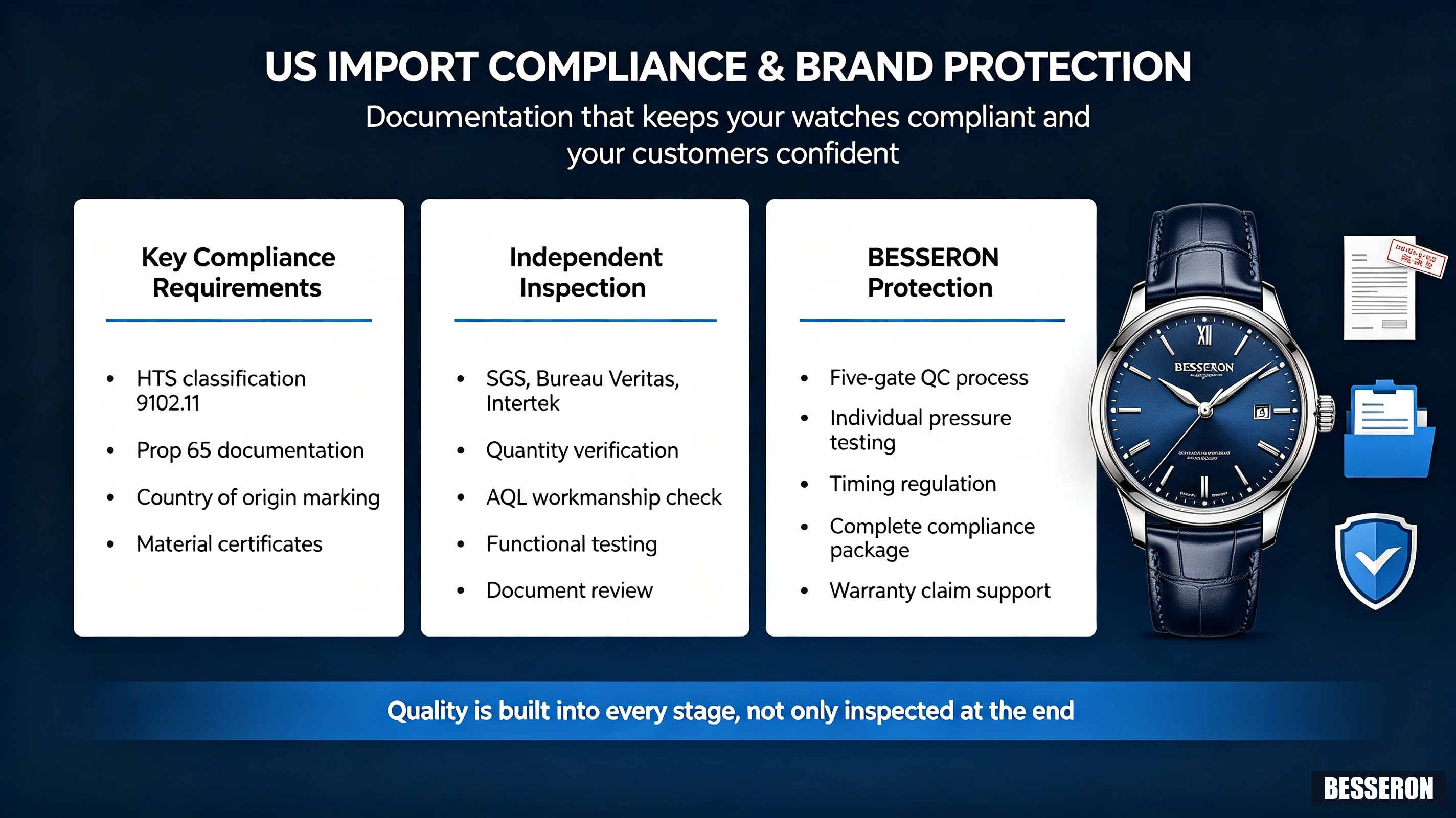 HTS ClassificationMechanical wristwatches are generally classified under HTS code 9102.11. The full classification depends on case material, movement type, number of jewels, and whether the watch includes additional functions. Correct classification is essential because it determines the duty rate and because incorrect classification can trigger customs audits, penalties, and shipment delays. Your manufacturer should provide HTS classification guidance as part of the order documentation. At BESSERON, we include HTS classification support with every OEM and ODM production order.Proposition 65 ComplianceCalifornia's Proposition 65 requires warning labels for products that contain chemicals known to the state to cause cancer, birth defects, or reproductive harm. For wristwatches, the relevant substances potentially include lead (in brass components), cadmium (in some plating processes), and phthalates (in some plastic or synthetic strap materials).Prop 65 compliance is mandatory for any watch sold in California — which means, practically, any watch sold online to US consumers, since you cannot control where your customer is located. Your manufacturer should provide Prop 65 compliance documentation, including material composition declarations and, where applicable, third-party laboratory test results demonstrating that regulated substances are below the threshold requiring a warning label.At BESSERON, we treat Prop 65 compliance as a non-negotiable part of every production order. Our material supply chain is audited for regulated substances, and we provide the compliance documentation that your brand needs to sell confidently in the California market — from Beverly Hills boutiques to Silicon Valley e-commerce customers.Country of Origin MarkingUS Customs regulations require that imported watches be marked with their country of origin in a conspicuous location. For watches, this typically means marking on the dial, case back, or movement. The marking must be permanent and legible.Note that the "country of origin" for a watch is determined by where the movement was manufactured, not where the watch was assembled. A watch with a Japanese Miyota movement assembled in China is typically considered of Japanese origin for customs purposes. This determination affects both marking requirements and duty rates.Additional Compliance ConsiderationsIf your watch includes leather straps, the Lacey Act requires documentation that the leather was legally sourced and that the species is not protected under CITES. If your watch includes exotic leather — alligator, crocodile, lizard, or ostrich — additional CITES documentation is required, and certain species may be restricted from import entirely.If your watch has wireless connectivity — Bluetooth for a smartwatch or hybrid watch — FCC certification is required. This is typically handled by the electronics module manufacturer but should be verified before import.Building Your Brand's Quality ManualEvery watch brand should maintain a quality manual that defines the standards against which their products are evaluated. This manual serves as the contractual reference for your manufacturer and as the training document for your own team.A quality manual for a watch brand should include: the approved gold sample reference (photographed under standardized lighting from multiple angles), the acceptable tolerance ranges for each quality dimension (case dimensions, dial printing registration, timing accuracy, water resistance, finishing quality), the AQL sampling plan for incoming inspection at your warehouse, the return and warranty policy including defect classification criteria, and the escalation process for quality issues including communication protocols and remedy timeframes.How BESSERON Protects Your Brand's Quality and ComplianceOur QC system reflects the philosophy that quality is not inspected into a product at the end of the line; it is built into the process at every stage. Every BESSERON production order passes through five QC gates: incoming material inspection with material certification collection, in-process inspection at each manufacturing stage, pre-assembly component verification, 100% post-assembly functional testing including individual pressure testing and timing regulation, and final visual inspection under D65 lighting to AQL 2.5 or tighter as specified by the client.For compliance, every BESSERON order includes a complete documentation package: Prop 65 compliance certificates, material composition declarations, HTS classification guidance, and country-of-origin documentation. We do not consider a production order complete until the compliance documentation is as thorough as the quality documentation.Frequently Asked QuestionsQ: What is the difference between batch testing and individual testing for water resistance, and why does it matter?A: Batch testing samples one unit per hundred or per batch and assumes that if the sample passes, the batch is acceptable. Individual testing verifies every single unit. The difference matters because water resistance failures are often caused by assembly errors — a gasket that was pinched during case-back installation, a crown stem that was cut slightly too short — that affect individual units randomly, not entire batches. A batch-tested production run can contain individually defective units. Only individual testing guarantees that every watch meets its rated water resistance. At BESSERON, we individually pressure-test every watch that carries a water resistance rating.Q: How do I handle a situation where a production batch arrives with quality issues?A: Document the issues immediately with photographs and detailed descriptions referencing the approved gold sample. Notify the manufacturer in writing within the timeframe specified in your contract. Request a corrective action plan that addresses both the immediate batch (replacement, credit, or repair) and the root cause (process change, additional inspection, or supplier change). A professional manufacturer will have a defined warranty and quality claim process. At BESSERON, warranty claims are processed within five business days of receiving the defective unit, with replacement or credit as appropriate, accompanied by root cause analysis and corrective action documentation.Q: Is Prop 65 compliance really necessary if I do not have a physical store in California?A: Yes. Prop 65 applies to any product sold to California consumers, which includes e-commerce sales where the customer's shipping address is in California. Since you cannot restrict online sales to exclude California, and since California represents approximately 12% of the US consumer market, Prop 65 compliance is effectively mandatory for any watch brand selling online to US consumers. Non-compliance penalties can reach $2,500 per violation per day.Q: What is AQL and how do I choose the right level for my watch brand?A: AQL (Acceptable Quality Limit) is the maximum percentage of defective units that can be considered acceptable during random sampling inspection, as defined by the ANSI/ASQ Z1.4 standard. For a luxury watch brand, we recommend AQL 2.5 for major defects (visible defects that would cause customer dissatisfaction) and AQL 0 for critical defects (defects that affect safety, functionality, or legal compliance). Some brands targeting the highest market tier specify AQL 1.5 for major defects. The tighter the AQL, the larger the sample size that must be inspected — which affects inspection cost and time.Q: How does the country-of-origin marking work for watches with Japanese movements assembled in China?A: Under US Customs regulations, the country of origin for a watch is determined by the movement's origin, not the assembly location. A watch with a Japanese Miyota movement that is assembled, cased, and finished in China is marked as having Japanese movement origin. The specific marking requirements and their implications for duty rates should be confirmed with a customs broker. Your manufacturer should provide the documentation that supports correct country-of-origin determination.


