
The global wholesale watch market is undergoing the most significant structural transformation in its history. For most of the postwar era, the path from factory to American consumer ran through a predictable sequence of intermediaries: manufacturer to distributor, distributor to retailer, retailer to customer. Each layer added margin. Each layer added time. Each layer inserted itself between the brand and the person who would ultimately wear the watch.
That structure is collapsing. Not gradually, but rapidly — accelerated by the direct-to-consumer revolution, the rise of factory-direct sourcing platforms, and a generation of brand founders who see no reason why a watch should pass through three intermediaries before reaching the wrist it was made for.
This guide is written for the professionals navigating this transformation: the watch brand founder sourcing their first production order, the boutique owner building a house brand, the online retailer transitioning from resale to original product, and the established brand evaluating whether their current supply chain is still the right one. It provides a complete framework for wholesale custom wristwatch procurement, from supplier evaluation through logistics and long-term partnership management.
Three structural shifts have converged to reshape wholesale watch sourcing. First, the capabilities of Chinese OEM and ODM watch manufacturers have advanced to the point where a Guangzhou-based factory can produce watches that meet the quality expectations of the 1,200 US retail segment — the segment where most independent brands compete. Second, factory-direct communication has been enabled by digital platforms, bilingual project management, and the maturation of cross-border logistics infrastructure. Third, consumer preferences have shifted toward independent brands, direct-to-consumer models, and the authenticity that comes from a brand with a transparent supply chain story.
The result is that a brand founder in Manhattan, Los Angeles, or San Francisco can now source custom watches directly from a manufacturer like BESSERON — specifying the case, dial, hands, movement, strap, and packaging — at FOB prices that were previously only available to importers ordering tens of thousands of units. The wholesale watch market has been democratized.
Sourcing custom watches is a strategic decision, not a transactional purchase. The framework below organizes the key decisions that every watch brand must navigate.
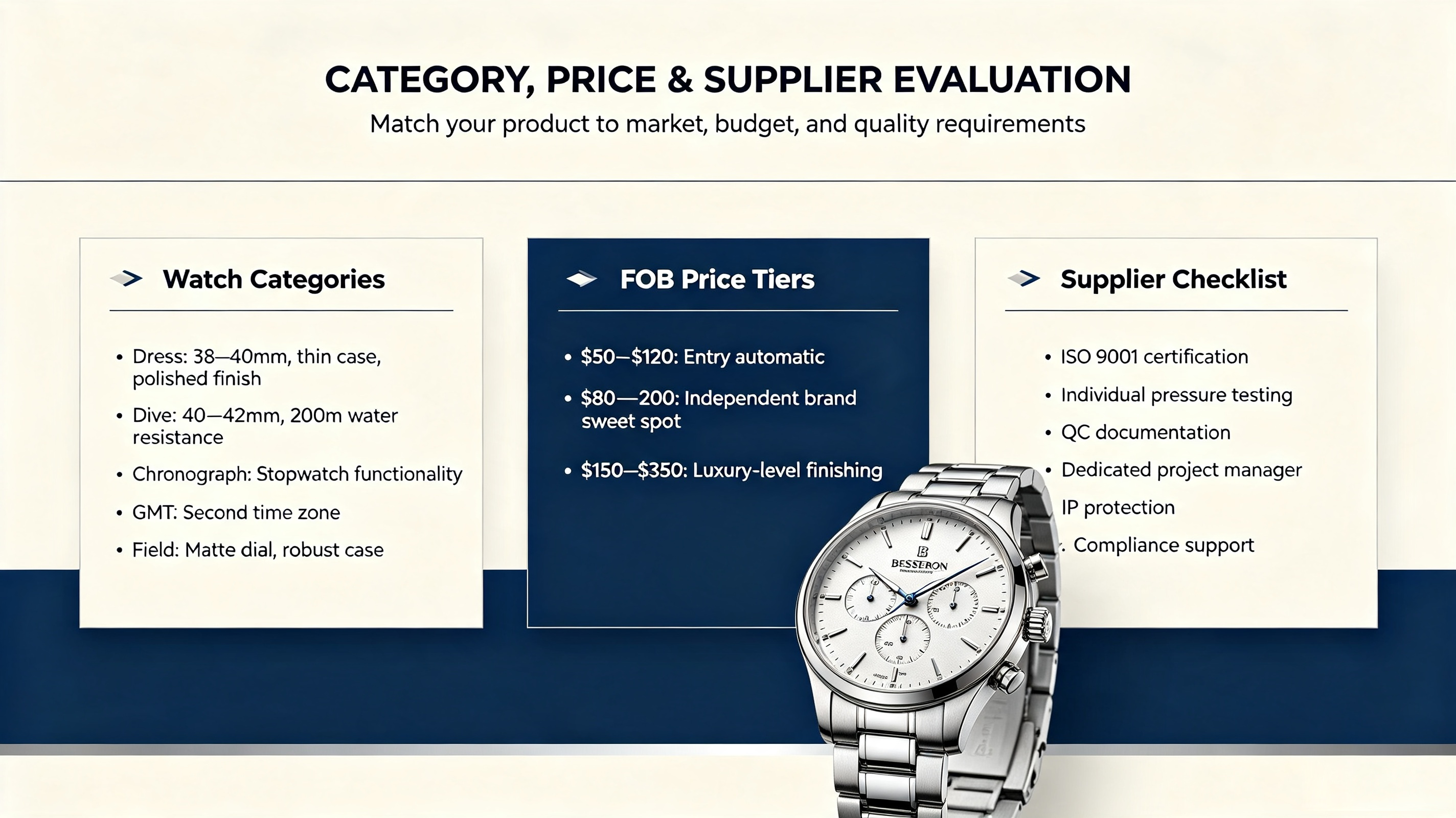
Before evaluating suppliers, define what you are buying. Watch categories are defined by function and aesthetic, and each category has distinct manufacturing requirements.
Dress watches prioritize thinness, elegance, and refinement. The case should be 38mm to 40mm in diameter and under 10mm in thickness. The movement should be thin enough to enable the case profile — Miyota 9015 at 3.9mm is ideal — and the finishing should be predominantly polished. Dress watches typically retail for 900 for independent brands using Japanese automatic movements.
Dive watches prioritize legibility, durability, and water resistance. The case should be 40mm to 42mm, with a unidirectional rotating bezel, a screw-down crown, and a minimum water resistance rating of 200 meters. Seiko NH35 movements are standard at the entry-to-mid level. Dive watches typically retail for 800 for independent brands.
Chronograph watches add stopwatch functionality through either mechanical (Valjoux 7750, Seiko NE88) or meca-quartz (Seiko VK64, Miyota 6S21) movements. Chronographs are visually complex, which makes them photogenic for social media, but they are also more expensive to manufacture and more prone to QC issues due to the additional mechanical complexity.
GMT watches display a second time zone through an additional hand and a 24-hour bezel or chapter ring. The Seiko NH34 GMT movement has made GMT complications accessible to independent brands at a reasonable cost. GMT watches appeal to travelers, pilots, and the business audience, and they typically retail for 900.
Field watches prioritize legibility, durability, and a military heritage aesthetic. They feature matte dials, Arabic numerals, and robust cases. They typically retail for 500 and appeal to the outdoor, military, and heritage-oriented customer segments.
Understanding the relationship between manufacturing cost and retail price is essential to sourcing profitably.
The 120 FOB tier supports retail prices of 350. At this tier, expect standard 316L cases with brushing or basic polishing, Seiko NH35 or Miyota 8215 movements, printed dials with standard lume, mineral crystals, and basic packaging. This tier is appropriate for brands competing on value in the entry-level automatic market.
The 200 FOB tier supports retail prices of 600. At this tier, expect well-finished 316L cases with consistent brushing and polishing, regulated Seiko NH35 or Miyota 9015 movements, applied indices, Super-LumiNova lume, sapphire crystals with anti-reflective coating, and premium packaging. This is the sweet spot for most independent watch brands.
The 350 FOB tier supports retail prices of 1,200. At this tier, expect exceptional case finishing with mixed brushed and polished surfaces, regulated premium movements (Miyota 9015 or ETA 2824), fully custom dials with applied indices and premium lume, sapphire crystals with multiple AR coatings, custom packaging with premium materials, and individual QC documentation for each watch. This tier requires a manufacturing partner whose QC infrastructure supports luxury-level standards at scale.
Selecting a wholesale watch manufacturer should be approached with the same rigor as any strategic vendor relationship. The checklist below organizes the key evaluation criteria.
Manufacturing capability: Case materials and forming technologies available, movement integration experience with your target calibers, dial customization depth, finishing quality capability, assembly line configuration and capacity.
Quality infrastructure: ISO 9001 certification (minimum), ISO 14001 (environmental), individual versus batch testing policy, QC documentation provided with orders, third-party inspection policy, warranty terms and claims process.
Communication and project management: English language capability, dedicated project manager assignment, response time commitment, production update frequency and format, design feedback and engineering review, sample development process.
Commercial terms: MOQ flexibility, payment terms, mold ownership policy, IP protection provisions, price stability commitment, trade terms offered (FOB, EXW, CIF).
Compliance support: Prop 65 documentation, HTS classification guidance, country of origin documentation, material certification, leather and exotic material documentation.
Logistics planning should begin before your production order is placed, not after it is completed. The key decisions involve shipping mode, customs clearance, and warehousing.
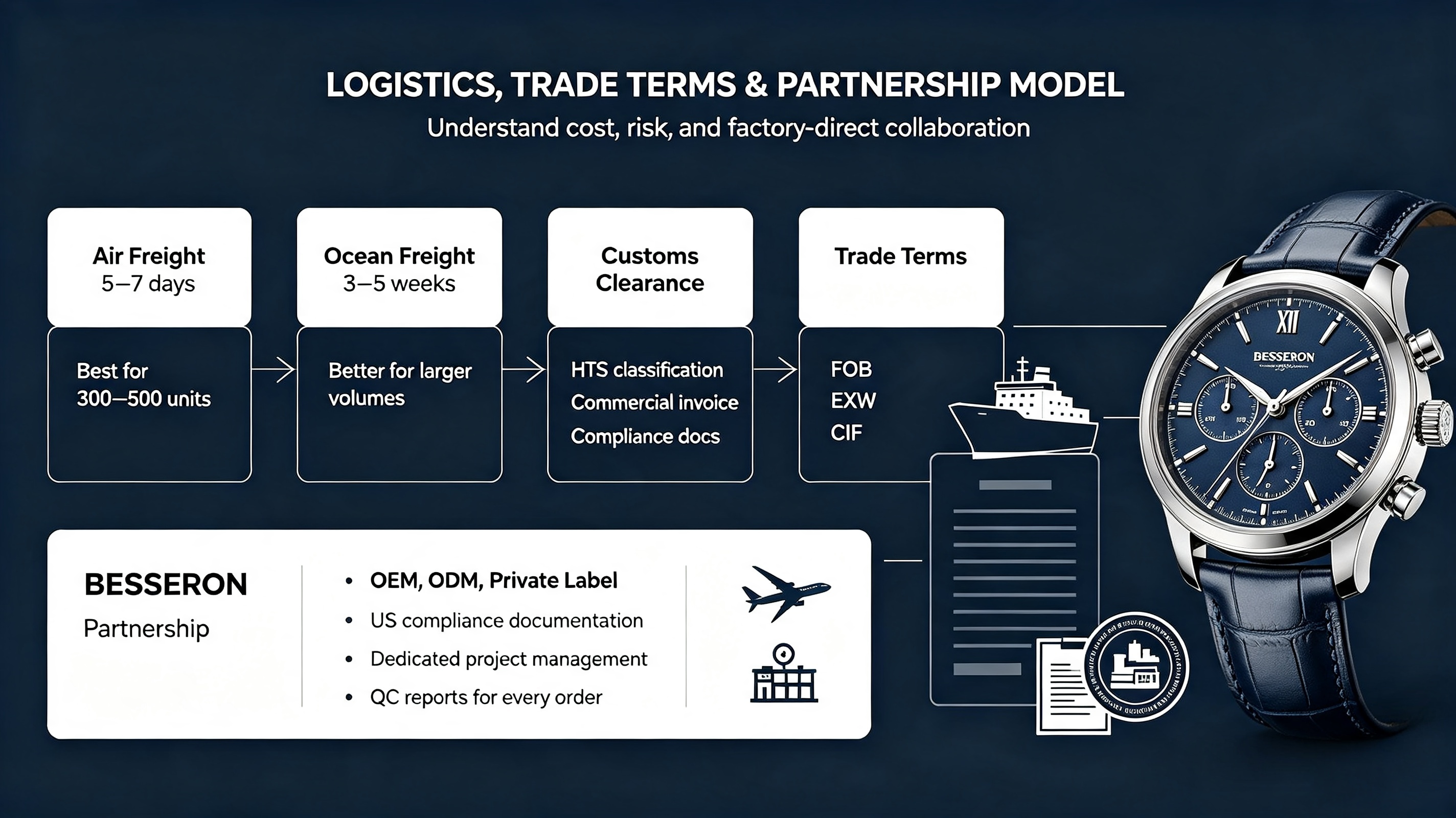
Air freight delivers watches from Guangzhou or Shenzhen to major US airports in five to seven days. It is cost-effective for shipments up to approximately 300 to 500 units. Above that volume, the per-unit shipping cost begins to favor ocean freight.
Ocean freight delivers watches to US ports in three to five weeks. The Port of Los Angeles and the Port of New York and New Jersey are the primary entry points for watch imports. Ocean freight is more economical for larger volumes but introduces timing uncertainty that must be factored into launch planning.
Customs clearance requires correct HTS classification, a commercial invoice, a packing list, and any required compliance documentation. Most watch brands use a customs broker to manage this process. The broker should be engaged before the shipment departs to ensure all documentation is in order.
Understanding trade terms is essential to managing cost, risk, and cash flow.
FOB (Free On Board) means the manufacturer is responsible for delivering the goods to the port of export and loading them onto the vessel. The buyer assumes responsibility for freight, insurance, and import clearance from that point onward. FOB is the most common trade term for watch manufacturing orders from Chinese suppliers.
EXW (Ex Works) means the buyer assumes responsibility for goods from the factory gate, including all transportation and export formalities. This term gives the buyer maximum control but also maximum responsibility.
CIF (Cost, Insurance, and Freight) means the manufacturer arranges and pays for transportation to the destination port, including insurance. This term simplifies logistics but may result in higher costs than the buyer could achieve by arranging freight directly.
Payment structures typically follow industry norms: 30% deposit with order confirmation, 70% balance before shipment for first-time partnerships; 30% deposit, 70% against copy documents for established relationships. Trade Assurance through Alibaba provides additional buyer protection for qualifying orders.
US watch brands operate in distinct regional markets, each with its own consumer expectations, aesthetic preferences, and competitive dynamics. A one-size-fits-all sourcing strategy does not serve brands that compete in fundamentally different market segments.
Manhattan and the New York metropolitan area is the center of gravity for premium and luxury-positioned independent watch brands. Customers in this market are sophisticated, comparison-oriented, and attuned to the subtle signals of quality — the way polished surfaces transition to brushed surfaces, the crispness of dial printing under magnification, the weight and articulation of a bracelet. Brands targeting this market should prioritize manufacturers with demonstrable capability in luxury-grade case finishing, premium dial execution, and detailed QC documentation. The customer who shops on Madison Avenue or in SoHo boutiques notices details that a mass-market customer overlooks.
Los Angeles and Southern California is the hub for social commerce watch brands. The brands that succeed here are built on Instagram, TikTok, and direct-to-consumer Shopify stores. Their customers discover watches through content, not through retail display. Their purchasing decisions are influenced by visual impact, brand story, and community engagement. Brands in this market should prioritize manufacturers that offer low MOQ flexibility, rapid prototyping, and the customization depth required to create visually distinctive products on ODM platforms. Speed to market and content-friendly design are the competitive advantages in this segment.
Silicon Valley and the San Francisco Bay Area is characterized by design-conscious consumers who work in technology, design, and creative industries. The watches that resonate here are characterized by clean aesthetics, intentional minimalism, and authentic material stories. A brand targeting this market might pair a recycled 316L stainless steel case with a plant-based leather strap, or a titanium case with a matte dial that features no text beyond the brand name. The manufacturing partner must be capable of executing subtle, refined designs where every visible element carries intent — and comfortable working with alternative and sustainable materials.
After fifteen years in watch manufacturing, serving brands that sell everywhere from Manhattan boutiques to Silicon Valley direct-to-consumer channels, we have developed a clear perspective on what makes manufacturing partnerships succeed.
As our founder reflects: "I have seen brands come and go. The ones that last are the ones who find a manufacturing partner, not just a supplier. At BESSERON, we do not take orders — we take partnerships. Every OEM, ODM, and Private Label client gets our engineering team's full attention, from the first sketch to the final QC report. Because we know that the watch we ship today is the watch that builds or breaks our client's reputation tomorrow. That responsibility is not something we take lightly."
BESSERON offers the complete spectrum of custom watch manufacturing: OEM for brands with established designs and the volume to support custom tooling, ODM for brands seeking customization on proven case platforms with faster turnaround and lower investment, and Private Label for brands entering the market or testing new categories with minimal upfront investment. All supported by US market compliance documentation, dedicated bilingual project management, and a QC system designed to meet the standards of the most demanding American watch consumers.
Q: What is a realistic budget for a first wholesale custom watch order?
A: A first production order of 150 to 300 units across three to five SKUs, at the 150 FOB price point, requires a budget of 45,000 for product cost. Add 8,000 for packaging, photography, and logistics. This positions the brand in the 500 retail segment with professional-quality product and sustainable unit economics. Brands can start smaller — 50 to 100 units per order — but should understand that smaller orders have higher per-unit costs, which compresses margins or forces higher retail prices.
Q: How do I protect my watch designs and intellectual property when dealing with overseas manufacturers?
A: IP protection requires a multi-layered approach. Execute a comprehensive NNN agreement (Non-Disclosure, Non-Use, Non-Circumvention) before sharing any design files. Register your brand trademark in China through the Madrid Protocol system. Ensure your manufacturing contract explicitly states that all molds, tooling, and design files created for your project are your property. Maintain physical separation of your molds at the manufacturer's facility. At BESSERON, we operate under documented IP protection protocols and have never had an IP breach in our operating history.
Q: How do I handle logistics and customs clearance for my first order?
A: Engage a US-based customs broker before your first order ships. Provide them with the commercial invoice, packing list, and HTS classification for your watches. The broker will handle customs entry and coordinate with your freight forwarder. If you are new to importing, consider using a freight forwarder who offers door-to-door service including customs clearance. Expect to pay 4% to 8% of the invoice value in duties, fees, and brokerage costs, depending on the watch type and value.
Q: What should I expect during a factory visit or audit?
A: A factory visit or audit should evaluate the manufacturing floor (equipment condition, organization, cleanliness, worker conditions), the QC department (equipment, documentation, inspection protocols), the sample room (capability to produce review samples that match production quality), and the management team (communication quality, technical knowledge, responsiveness to questions). If you cannot visit in person, commission a third-party audit through SGS or Bureau Veritas, which typically costs 1,500 and provides an independent assessment of the facility.
Q: How do I know when it is time to switch from ODM to OEM manufacturing?
A: The signals that indicate readiness for OEM investment include: consistent sales of 300-plus units per month across multiple months, customer feedback requesting design elements that are not achievable on your ODM platform, competitive pressure from brands that have begun investing in proprietary designs, and the availability of capital for mold investment (8,000 for case development). The transition should be planned as a gradual shift — introduce one OEM model while continuing ODM production for your existing catalog, rather than attempting to convert your entire line simultaneously.
Ready to source custom wristwatches for your US watch brand? Contact BESSERON for a confidential consultation on wholesale OEM, ODM, and Private Label watch manufacturing tailored to your market, your budget, and your brand vision.

